
The Pope’s Prophetic Mission in the Age of Artificial Intelligence, Global Conflict, and Ethical Governance
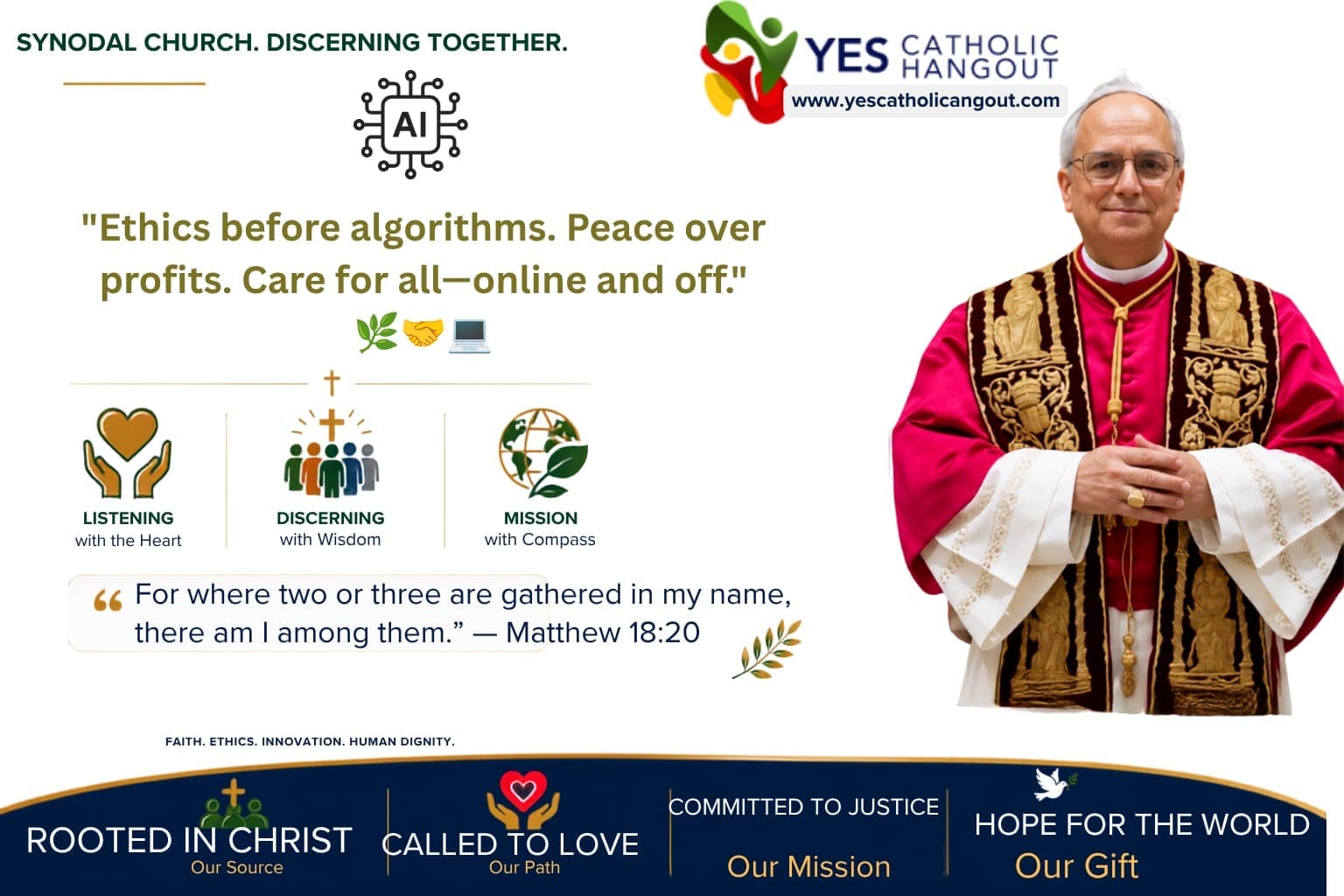
A Synodal Response through Magnifica Humanitas, Fratelli Tutti, Laudato Si’, and the Economy of Francesco
“Blessed are the peacemakers, for they shall be called children of God.” (Matthew 5:9)
The twenty-first century stands at an extraordinary crossroads. Humanity possesses unprecedented scientific ingenuity, digital connectivity, and technological capability, yet continues to wrestle with war, ecological degradation, widening inequality, forced migration, social fragmentation, and an accelerating revolution in Artificial Intelligence. These developments have transformed not only how people communicate, work, and govern, but also how they understand themselves.
In such a moment, the question confronting humanity is no longer simply, “What can technology do?” It is, more fundamentally, “Who is the human person technology is meant to serve?”
It is precisely here that the ministry of the Successor of Peter acquires renewed significance.
The Pope speaks not merely as the sovereign of the Holy See, a unique subject of international law with diplomatic relations across the world, but above all as the universal pastor entrusted with proclaiming the Gospel of Jesus Christ. These two dimensions are inseparable. The Holy See’s diplomatic engagement exists to safeguard the Church’s evangelical mission, defend human dignity, foster peace, and encourage dialogue among peoples and nations.
The Church’s influence has never depended principally upon military strength, economic dominance, or political coercion. Rather, her enduring contribution has been the persuasive power of moral truth rooted in the Gospel. Throughout history, the papacy has served as a conscience for humanity, reminding societies that authentic progress cannot be measured solely by technological sophistication or economic growth, but by the flourishing of every human person created in the image and likeness of God.
A Prophetic Voice Beyond Politics
In an era marked by geopolitical rivalry and ideological polarization, there is a persistent temptation to interpret every papal intervention through political categories. Such a reading, however, overlooks the distinctive nature of the Church’s mission.
The Pope does not seek political supremacy. Instead, he exercises a moral ministry that illuminates public life through the enduring principles of truth, justice, mercy, solidarity, and peace.
Political leaders carry the legitimate responsibility of making prudential judgments concerning governance, diplomacy, national security, and the protection of the common good. Catholic social teaching recognizes this responsibility while insisting that political decisions must remain accountable to objective moral principles. The Church therefore neither replaces the legitimate competence of civil authority nor withdraws from public life. Rather, she forms consciences so that political action may remain ordered toward justice and the dignity of every person.
This distinction preserves both the autonomy of political institutions and the indispensable role of moral guidance.
Magnifica Humanitas: The Human Person Before the Algorithm
Artificial Intelligence has become one of history’s most transformative innovations. It promises advances in medicine, education, agriculture, scientific discovery, and economic productivity. Yet its extraordinary capabilities also expose humanity to profound ethical risks: algorithmic discrimination, mass surveillance, manipulation, disinformation, erosion of privacy, labour displacement, and the reduction of persons to data points.
These challenges are fundamentally anthropological before they are technological. Magnifica Humanitas proposes that every ethical assessment of technology must begin with the inviolable dignity of the human person. Human beings are not products of algorithms. They are persons endowed with reason, conscience, freedom, creativity, and a vocation to love.
Artificial Intelligence therefore must remain an instrument serving humanity, not a system that subtly reshapes human identity according to technological efficiency or economic utility.
Ethical innovation demands transparency, accountability, fairness, human oversight, and the protection of vulnerable communities. Technological excellence and moral excellence must advance together. When innovation becomes detached from ethics, progress risks becoming domination.
Fratelli Tutti: Recovering the Culture of Encounter
The digital revolution has connected billions of people while simultaneously exposing the fragility of social relationships. Online hostility, ideological tribalism, misinformation, and social isolation increasingly threaten the bonds that sustain democratic societies and peaceful coexistence.
Fratelli Tutti offers an alternative vision grounded in fraternity and social friendship. The Church proposes dialogue not as weakness but as moral strength. Listening becomes an act of justice. Reconciliation becomes a path to peace. Encounter becomes the antidote to fear.
The Pope’s appeal for fraternity extends beyond national borders, political affiliations, economic interests, or religious identities. Every person possesses an irreducible dignity that demands respect.
In this vision, diplomacy becomes more than negotiation. It becomes the patient construction of trust. Peace becomes more than the absence of war. It becomes the presence of justice. Leadership becomes more than the exercise of authority. It becomes service to the common good.
Such fraternity is indispensable for governing emerging technologies whose effects transcend every national frontier.
Laudato Si’: Integral Ecology in the Digital Age
The ecological crisis cannot be separated from the moral crisis confronting humanity. Environmental degradation, unsustainable consumption, technological exploitation, and social exclusion reveal a deeper rupture in humanity’s relationship with God, neighbour, and creation.
Laudato Si’ proposes an integral ecology that recognizes these relationships as inseparable.
Artificial Intelligence and digital infrastructure themselves carry ecological consequences through energy consumption, electronic waste, critical mineral extraction, and expanding resource demands. Ethical innovation therefore requires environmental responsibility alongside technological advancement.
Protecting forests while exploiting workers is inconsistent. Developing intelligent machines while neglecting ecological sustainability is equally contradictory.
Integral development requires that environmental stewardship, technological innovation, economic growth, and social justice advance together. Care for creation is ultimately care for humanity itself.
The Economy of Francesco: Restoring the Human Face of Development
Economic systems increasingly shaped by automation and Artificial Intelligence present extraordinary opportunities alongside serious moral questions. Who benefits from technological progress? Who bears its costs? Who is excluded?
The Economy of Francesco challenges the global community to place the human person, not financial accumulation, at the centre of economic life.
Ethical entrepreneurship becomes an expression of solidarity. Innovation becomes a means of inclusion. Artificial Intelligence becomes a tool for expanding opportunity rather than concentrating power.
Young people, entrepreneurs, researchers, investors, governments, universities, and faith communities all possess indispensable roles in shaping an economy that rewards creativity while protecting dignity, meaningful work, and social participation.
The future economy must measure success not only by productivity but by the quality of human relationships, environmental sustainability, social cohesion, and hope.
Synodality: Listening Before Leading
Underlying these four pillars is the spirituality of synodality.
Synodality is not merely an ecclesial process. It offers humanity a culture of shared discernment in which listening precedes decision-making, dialogue overcomes polarization, and participation strengthens responsibility.
This culture is urgently needed within governments, technology companies, educational institutions, international organizations, and civil society. Artificial Intelligence governance requires interdisciplinary collaboration involving ethicists, engineers, theologians, economists, legal scholars, policymakers, educators, entrepreneurs, and ordinary citizens.
No single discipline possesses all the answers. The future must therefore be built together.
Toward a Global Ethical Ecosystem
The challenges confronting humanity cannot be solved by technology alone, nor by politics alone, nor by economics alone.
What is required is a global ethical ecosystem rooted in the conviction that every innovation must remain accountable to the dignity of the human person.
Such an ecosystem calls governments to legislate wisely, universities to educate ethically, technology companies to innovate responsibly, entrepreneurs to create sustainably, religious communities to form consciences, civil society to defend justice, and international institutions to strengthen cooperation across borders.
This is not an obstacle to innovation. It is the very condition that enables innovation to become genuinely human.
The Church’s contribution to this common endeavour is neither ideological nor partisan. It is evangelical. She offers a moral vision capable of illuminating technological progress with wisdom, economic development with justice, ecological stewardship with responsibility, and political leadership with service.
The Pope’s prophetic mission reminds the world that the future will not ultimately be determined by the sophistication of our machines but by the integrity of our humanity.
If the digital age is to become an age of hope rather than anxiety, humanity must ensure that every algorithm serves the person, every economy serves the common good, every political decision protects human dignity, and every technological advance strengthens peace.
Only then will innovation become an authentic expression of human flourishing, fraternity, and our shared vocation before God.
The future of civilization depends not simply on building smarter technologies, but on becoming wiser human beings.