
The Point of Interception: Where Divine Grace Meets Human Responsibility in Building a Magnificent Humanity
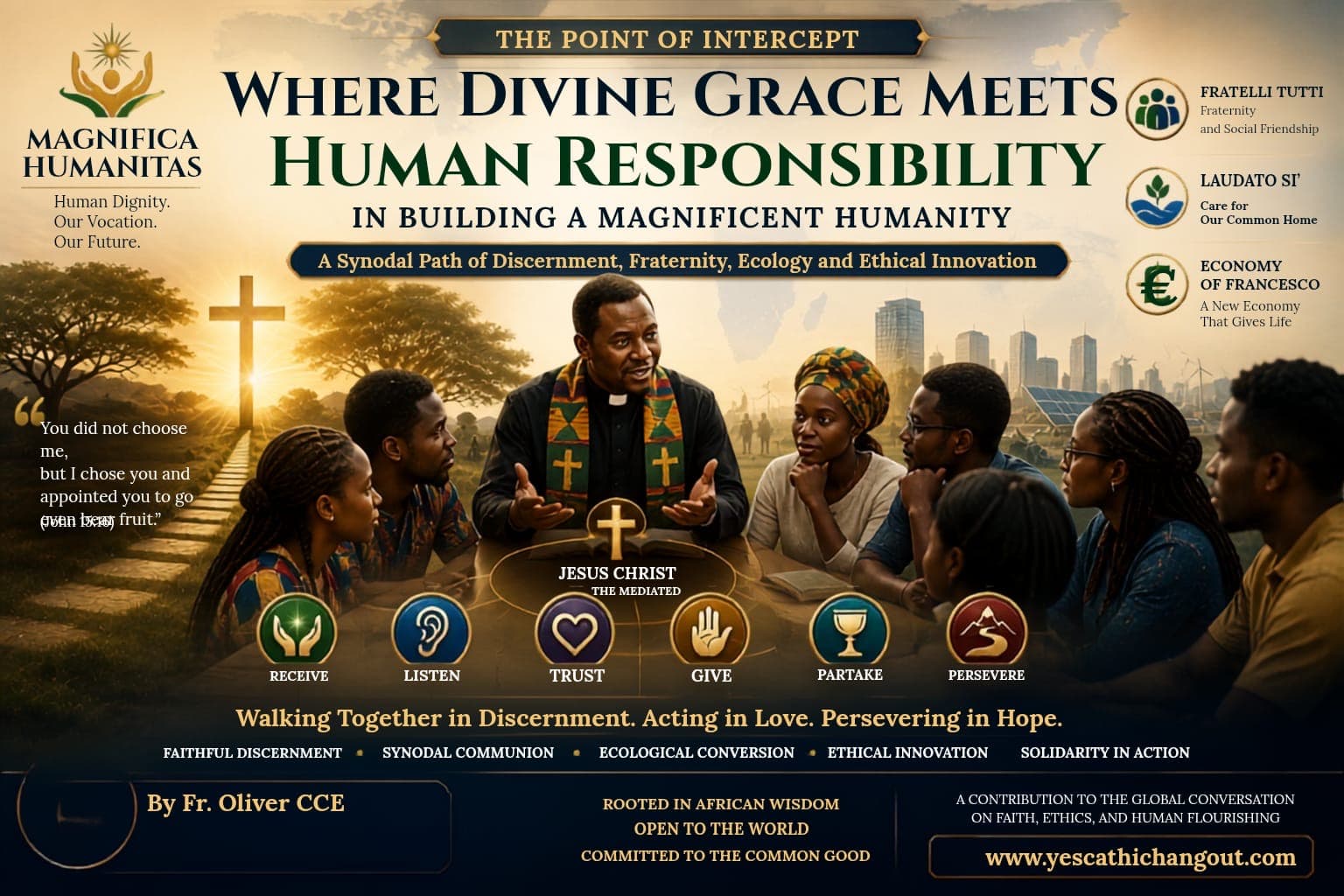
The Point of Interception Between the Sacred Calling and Divine Providence
The future of humanity is not secured when we become more powerful, but when our power becomes more attentive to the dignity of the person, the care of creation, and the communion for which we were made.
1. The Place Where Calling Becomes Response
Every authentic Christian vocation begins at a place that cannot be mapped by geography. It begins where God’s initiative encounters the freedom of a human being, and where that freedom is gradually taught to answer in faith. This is the point of interception: the living meeting between the sacred calling and divine providence.
The phrase is a pastoral and theological framework, not a claim that grace can be captured, measured, or controlled by a human technique. God remains God. Grace remains gift. Providence is not a mechanism that relieves us of responsibility, nor is discernment a strategy for making the future obey our preferences. The phrase names, with reverence and a certain simplicity, the moment in which a person recognises that divine love is addressing human freedom and asking for a response.
The first and clearest icon of this meeting is the Annunciation. Mary receives a word that exceeds every calculation. She asks a question, listens, and consents: “Let it be with me according to your word” (Luke 1:38). Her fiat is neither passive resignation nor self-appointed ambition. It is the free answer of a person whose humility makes room for God’s action. In her, vocation becomes embodied, and the Word takes flesh.
“The Word became flesh and lived among us” (John 1:14): the Christian understanding of responsibility is inseparable from this mystery of incarnation.
Jesus Christ is the eternal Mediator of this encounter. He does not stand between God and humanity as a distant intermediary, but unites them in his own person. In him, grace does not erase freedom; it heals, enlarges, and directs it. In him, responsibility is not a burden imposed from outside but a participation in the self-giving love of God. The Christian asks not merely, “What can I achieve?” but, “What is love asking me to receive, to become, and to give?”
This question matters far beyond private spirituality. A vocation may be lived in marriage, consecrated life, ordained ministry, family life, professional work, public service, research, teaching, enterprise, diplomacy, or the quiet fidelity of caring for another person. In each case, the same pattern appears: grace calls, freedom listens, and love takes a form that can be recognised in the world.
I call this vision Magnifica Humanitas: a humanity made magnificent not by domination, economic prestige, institutional scale, or technological power, but by allowing grace to shape freedom into holiness, justice, solidarity, and service. It is a human greatness measured by the capacity to welcome the other, to protect the vulnerable, to tell the truth, and to make a gift of one’s abilities for the common good.
The six movements that follow are not a ladder by which one graduates from one spiritual stage to another. They are interconnected movements of a single life of discernment. We receive, listen, trust, give, commune, and persevere. We return to each movement repeatedly, because every new responsibility exposes a new depth of freedom and every new season of life asks us to hear the call again.
2. Receive Grace with Humility
The first movement is reception. Before a person can act generously, that person must learn to receive. This is difficult for a culture that often treats self-sufficiency as maturity and visibility as proof of worth. Yet the Gospel begins not with human performance but with gift. We are created, loved, forgiven, and called before we have earned any of these realities.
Humility is not a diminished view of the self. It is a truthful view of the self before God. It recognises both our dignity and our limits. We are not nothing; neither are we everything. We are creatures, and this is not an insult but the foundation of wonder. To receive grace is to accept that our life is not self-originating. Our talents, relationships, opportunities, and even the capacity to respond are gifts entrusted to us.
This reception changes the meaning of leadership. A leader who begins from possession asks, “How can these people advance my project?” A leader who begins from grace asks, “What has been entrusted to me, and whom must this responsibility serve?” The distinction is decisive in the parish, the family, the boardroom, the classroom, and public office. Without humility, intelligence becomes manipulation, authority becomes control, and innovation becomes the multiplication of means without a worthy end.
The Church’s teaching on charisms offers a social vision of giftedness. The gifts of the Spirit are given for the common good, not as private property or credentials for superiority (1 Corinthians 12:4-27). Some gifts are public and recognisable; others are hidden in patient care, faithful friendship, honest labour, or the capacity to remain present when another person is afraid. A magnificent humanity begins when every person is treated as a bearer of gifts and not as an instrument.
In personal vocation, this means making space for gratitude before making plans. In parish renewal, it means noticing the gifts already present among the baptised rather than assuming that ministry belongs only to the most confident or visible. In family life, it means receiving children, elders, and spouses not as projects to be managed but as persons whose mystery cannot be reduced to utility. In governance and education, it means designing institutions that cultivate participation rather than dependency.
Humility also protects the Church from a false spirituality of certainty. A person may sincerely believe that a desire is a calling and still need purification, counsel, time, and correction. To receive grace is to consent to being formed. It is to permit the community, Scripture, the poor, the suffering earth, and the truth of consequences to question our first impressions.
The point of interception therefore begins with open hands. It is not the place where we seize a divine plan. It is the place where we discover that our own plans are being asked to become more generous.
3. Listen Through the Whole Field of Life
Reception leads to attention. The second movement is listening, and Christian listening is wider than the search for an interior feeling. We listen through Scripture, prayer, the tradition of the Church, creation, and the lived experiences of other people. We listen to the cry of the poor and to the warning signs of a wounded planet. We listen to the wisdom of elders and the questions of the young. We listen not to collect opinions but to become capable of truth.
Scripture gives this listening a centre. It forms the imagination by which we recognise the voice of God and test the spirits. Prayer is not a technique for obtaining a preferred answer; it is a school of presence. Tradition prevents the present moment from becoming an idol, reminding us that the Church’s discernment is carried by generations of saints, teachers, martyrs, families, and ordinary believers. Creation teaches that revelation is not exhausted by our institutions. The earth, with its beauty and fragility, summons us to praise and responsibility.
The lived experience of others is indispensable. A synodal Church cannot be built by speaking about people while refusing to listen to them. Synodality means walking together through attentive listening, mutual discernment, and collaborative mission. It does not mean that every opinion has equal wisdom, nor that disagreement disappears. It means that the truth is sought in a community where no one is treated as disposable and where the Spirit may speak through voices that have been overlooked.
This is also the heart of fraternity described in Fratelli Tutti. Dialogue must replace the temptation to win by humiliation. Encounter must replace the habit of constructing enemies from a distance. Reconciliation must be preferred to the pleasure of permanent hostility, and shared responsibility must challenge the isolation of individualism. Such a culture is not sentimental. It is disciplined. It asks people to remain at the table long enough for fear to be named, history to be acknowledged, and a common future to be imagined.
Listening has practical consequences in every field. A parish that listens may discover that families need accompaniment more than programmes, that young adults seek honest questions rather than slogans, and that migrants bring gifts rather than merely needs. An educator who listens sees the student behind the grade. A scientist listens to evidence that resists a preferred theory. A diplomat listens for the dignity hidden beneath a government’s stated position. A business leader listens to workers, communities, and ecological limits before announcing a strategy.
Digital culture makes this movement both more urgent and more difficult. We are surrounded by voices, yet attention is increasingly fragmented. Algorithms can show us what confirms us while giving the impression that we have encountered the world. Christian discernment requires a recovery of silence, patience, and the ability to remain with a reality that cannot be compressed into a headline.
To listen well is already to honour another person’s humanity. It is also to discover that providence often arrives through an inconvenient testimony, an unexpected question, or a wound we would rather keep outside the meeting room.
4. Trust Providence Amid Uncertainty
The third movement is trust. Once we have listened, we must still act without possessing complete certainty. This is where many forms of discernment become paralysed. We want a guarantee before we offer ourselves, yet vocation rarely comes with a complete map. The call is clear enough for the next faithful step and mysterious enough to keep us dependent on God.
Trust in providence is not fatalism. Fatalism says that our choices do not matter. Christian trust says that our choices matter profoundly, yet no choice is the final author of history. Providence works through freedom, responsibility, repentance, and the patient weaving of consequences we cannot foresee. It does not excuse negligence. It gives courage to act without pretending to control every outcome.
Jesus’ own life reveals this form of trust. His mission is not a flight from human vulnerability but a passage through it. The cross exposes the limits of power understood as domination and reveals the creative strength of self-giving love. Resurrection does not erase the wounds; it transfigures what seemed to be an ending. For Christian responsibility, this means that faithfulness cannot be measured only by immediate success.
In family life, trust may mean welcoming a season that cannot be solved quickly. In governance, it may mean choosing a just policy whose benefits will appear beyond one electoral cycle. In education, it may mean investing in a person’s formation without demanding an instant result. In diplomacy, it may mean maintaining a channel of communication when public rhetoric rewards rupture. In global development, it means refusing models that deliver impressive outputs while weakening local agency and human dignity.
Trust also makes room for correction. A person who believes that providence has authorised every preference becomes dangerous. A person who trusts God can admit error without believing that error has destroyed the possibility of grace. This is why discernment needs companions and communities. The lonely self is easily confused with the voice of God.
The Church’s social mission requires this patient confidence. We work for justice because the poor cannot be reduced to a timetable, and we care for creation because the earth is not ours to consume before the end of our lives. We build peace because reconciliation may begin with a conversation whose fruit no one can yet see. Hope is not optimism about circumstances; it is confidence that love is never wasted.
At the point of interception, uncertainty is not an empty space between divine action and human action. It is often the very space in which freedom becomes mature. We learn to ask not, “How can I guarantee the result?” but, “What is the most truthful and loving response available to me now?”
5. Give Gifts in Loving Service
The fourth movement is offering. Discernment becomes credible when it leaves the realm of intention and enters the realm of service. Grace received and heard must become a gift. The question “What am I called to do?” is completed by “Whom is this for?”
This is where Magnifica Humanitas becomes visible. Magnificence is not an atmosphere surrounding exceptional people. It is the ordinary radiance of a life turned outward. A nurse who protects a patient’s dignity, a mechanic who refuses unsafe shortcuts, a parent who makes time for a child, a researcher who shares findings responsibly, and a public servant who refuses corruption all participate in a humanity made more magnificent by love.
The gifts we offer are not limited to professional competence. We offer judgement, imagination, patience, money, memory, technical skill, cultural knowledge, and the willingness to stand with someone who has been abandoned. The Church’s mission is strengthened when it recognises these gifts in the whole People of God. Parish renewal is not the multiplication of activities but the conversion of a community into a place where people are equipped to serve their neighbourhood, accompany the lonely, welcome newcomers, and speak the Gospel through credible lives.
In the economy, offering means recovering the moral meaning of work. The vision associated with the Economy of Francesco reminds us that economic life is never morally neutral. It must be judged by whether it honours dignity, creates meaningful work, practices ethical entrepreneurship, includes those excluded from opportunity, protects the earth, and sustains hope. Profit can be a sign of sound stewardship, but it is not the measure of the whole vocation of enterprise. Every economic decision asks what kind of relationships, communities, and future it is helping to build.
This perspective does not romanticise poverty or reject excellence. It asks excellence to become accountable. A company can innovate and be humane. A university can be rigorous and attentive to the common good. A financial institution can be efficient and patient with those who are vulnerable. A farmer can be productive and protective of soil and water. Ethical entrepreneurship begins when the enterprise understands itself as a form of service rather than a machine for extracting value.
The same principle applies to science and public policy. Knowledge is a gift with obligations. Research that improves health, protects communities, or expands understanding should be encouraged, but the people affected by research must not be treated as raw material. The more powerful our tools become, the more urgent is the question of whether they are being placed at the service of life.
Offering also includes the courage to relinquish a role when another person can serve better. The grace of a community is revealed when authority can be shared without humiliation. This is true in the home, where responsibility is negotiated rather than assumed; in the parish, where ordained and lay vocations cooperate; and in institutions, where leadership develops successors instead of protecting its own indispensability.
At this movement, the point of interception becomes a workshop. Providence does not bypass our hands. It asks our hands to become instruments of mercy, justice, creativity, and peace.
6. Partake in Communion with Christ and His People
The fifth movement is communion. No vocation remains healthy when it is detached from relationship. The human person is not an isolated project but a being created for communion with God, with other people, and with the living world. The Church’s sacramental life gives this communion its deepest centre in Christ, especially in the Eucharist, where the Church receives the self-giving Lord and is sent to become what it has received.
Communion is more than belonging to a group that shares our preferences. It is the difficult practice of remaining related across difference. The Church is catholic because it holds together people who do not share the same language, history, temperament, or social location. Such unity is not uniformity. It is a reconciliation continually nourished by Christ.
This is why synodality is not a management style. It is a way of becoming a people. To walk together means that decisions are shaped by prayer, listening, responsibility, and mission. It requires structures that permit participation and spiritual dispositions that resist both clericalism and individualism. It also requires a willingness to distinguish between consensus born of truth and agreement produced by fatigue or social pressure.
Communion changes the way we approach conflict. Fratelli Tutti insists that social friendship is built through encounter, not through the denial of real differences. Reconciliation does not ask victims to pretend that harm did not happen. It asks communities to face truth, seek justice, and refuse to let violence have the final word. In a divided world, a Christian community can become a school in which people practise patient speech, attentive silence, forgiveness, and the protection of the vulnerable.
African Christian experience offers important resources for this work, though Africa must never be treated as a monolith or placed inside a romantic picture. The continent contains many peoples, languages, histories, theological traditions, economies, and political realities. It also carries wounds caused by conflict, poverty, corruption, extraction, displacement, and the legacy of colonialism, alongside extraordinary creativity, faith, entrepreneurship, scholarship, and resilience.
Across this diversity, many African societies preserve forms of communal discernment in which the wisdom of elders, the energy of the young, the testimony of families, and the needs of the wider community are held in relation. Hospitality is not merely a social courtesy; it can express the conviction that the stranger is capable of enlarging the community. Respect for elders can preserve memory, while the voices of young people keep tradition from becoming a museum. Resilience, rightly understood, is not praise for suffering but a testimony to the capacity of people to rebuild and hope.
The word Ubuntu is often rendered as “I am because we are.” It should not be reduced to a slogan, but it can serve as a doorway into a profoundly Christian intuition: the person becomes more fully human through relationships of mutual recognition. Reconciliation, communal responsibility, and care for the vulnerable are not optional decorations added to identity. They are conditions of human flourishing. African Christianity, in its many expressions, contributes to the universal Church not as a regional supplement but as a living theological resource.
Communion therefore asks every society to examine its definition of success. If development increases consumption while weakening belonging, something essential has been lost. If a parish grows in programmes while people remain unseen, communion has not yet taken root. If a digital network connects thousands but trains them to despise one another, it has confused contact with relationship.
7. Persevere Until Mission Reaches Fulfilment
The sixth movement is perseverance. A vocation is not proved by its first emotion, its most visible moment, or its public recognition. It is tested by time. Perseverance is the grace of remaining faithful through obscurity, misunderstanding, fatigue, and the long interval between a promise and its fulfilment.
This perseverance is not stubbornness. It is fidelity capable of learning. It knows when to continue, when to change a method, when to ask forgiveness, and when to begin again. A family perseveres by renewing its commitment in ordinary acts. A parish perseveres by allowing patient formation to take precedence over the hunger for instant results. A community perseveres by refusing to abandon the work of peace when reconciliation is slow.
The social order needs this virtue. Ecological conversion will not be completed by a single campaign. It demands habits, policies, investment, restraint, and a willingness to accept limits. Laudato Si’ presents care for our common home as inseparable from care for the human person. Creation is a privileged place where humanity listens to God, not because nature is divine, but because the created world is gift and summons. Stewardship is gratitude made practical.
Care for the poor and care for the earth are one vocation. The communities most exposed to environmental damage are often those with least power to protect themselves. A development model that ignores this relationship may produce growth while deepening injustice. Perseverance in the ecological vocation therefore includes solidarity, local participation, honest accounting, and the courage to prefer long-term life to short-term convenience.
The same patience is needed in technology. Digital culture changes faster than institutions can deliberate, but speed is not a moral argument. We need the perseverance to establish trustworthy standards, educate citizens, protect rights, and revise systems when harms become visible. Ethical responsibility is not a one-time approval stamped on a product; it is an ongoing practice of attention.
Mission reaches fulfilment not when our name is remembered but when love has become more available in the world. The grain of a life may be hidden. We may never see the full fruit of a conversation, a lesson, a policy, a prayer, or an act of forgiveness. Faithfulness accepts this hiddenness without becoming indifferent to results. It works diligently and entrusts the harvest to God.
8. The Ethical Interception of Artificial Intelligence
Artificial intelligence brings the six movements into a new and urgent field. It can assist medicine, education, translation, scientific discovery, accessibility, administration, and creative work. It may help people navigate complexity and extend forms of human cooperation. Yet capability alone does not tell us whether an application is wise, just, or humane.
Ethical innovation must pass through the point of interception: the place where technological possibility meets a grace-informed conscience and is ordered toward integral human development. This does not mean baptising a machine or pretending that software can possess a soul. It means refusing to separate design from moral responsibility. Before asking whether a system can do something, we must ask whether it should, for whom, under whose authority, and with what consequences.
AI should strengthen, not replace, human wisdom, moral responsibility, compassion, creativity, and authentic relationships. A system may identify patterns, generate language, or support a decision, but it cannot take away the duty of a person or institution to judge the truth and bear the consequences. Human oversight is not a ceremonial signature at the end of an automated process. It requires real competence, authority to intervene, and the willingness to stop a system when it causes harm.
Truth is central. Generative systems can produce fluent language without possessing understanding or a commitment to reality. Their outputs must therefore be checked, contextualised, and attributed honestly. In education, students should be formed not merely to use tools but to recognise when a tool is unreliable and when human judgement is indispensable. In journalism, research, and public communication, the ease of producing plausible text must never become an excuse for deception.
Privacy is a form of respect for the person. Data are not simply fuel for innovation; they are traces of lives, relationships, vulnerabilities, and choices. People should know when their data are collected, how they are used, and what recourse exists when systems make decisions about them. Communities that have historically been surveilled or excluded deserve particular care.
Labour dignity also belongs at the centre. Automation may remove dangerous tasks and open new possibilities, but it can also intensify insecurity, conceal invisible labour, and concentrate wealth. A just transition asks who benefits, who bears the disruption, and how workers can participate in shaping the future of work. Human beings must not be treated as obsolete because a system can imitate one part of what they do.
Bias is not only a technical defect. It can reproduce a social history of unequal treatment. Ethical review must ask whose language, culture, body, experience, and knowledge have been excluded from a system’s design and testing. The vulnerable must not become the testing ground for products that have not been responsibly governed. Nor should efficiency become a reason to reduce persons to risk scores, behavioural profiles, or probabilities of compliance.
Digital culture raises a deeper question about presence. If convenience continually removes the need to encounter another person, we may become more connected while becoming less capable of compassion. The Christian mission in digital spaces is therefore not to fill every channel with religious content. It is to cultivate truth, accompaniment, patient conversation, and the dignity of attention.
As a constructive example, www.yescatholichangout.com can be understood as an invitation to create spaces for Catholic encounter and responsible conversation online. Its value is not in replacing parish life or sacramental communion, but in helping people ask questions, find accompaniment, and discover that faith can be discussed with intelligence and warmth. Digital mission becomes credible when it leads beyond self-display toward real relationships, local communities, prayer, service, and the encounter with Christ.
9. From Personal Discernment to Public Mission
The six movements are universal because every sphere of life needs them. Governance needs leaders who receive authority as a trust, listen to citizens, resist fatalism, serve rather than dominate, build communion, and persevere in the work of justice. Education needs teachers who welcome each learner as a person, listen for the barriers hidden behind behaviour, trust the possibility of growth, offer knowledge generously, build a learning community, and remain faithful when progress is slow.
Science needs humility before reality, patient listening to evidence, trust that truth need not fear honest inquiry, generous collaboration, communion across disciplines, and perseverance beyond the reward cycle. Diplomacy needs the courage to receive the other’s humanity, listen beneath official language, trust small steps, serve peace, preserve relationship, and remain present after headlines have moved on.
Global development must also be judged at this point of interception. Projects are not truly successful if they create dependency, weaken local communities, or measure people only by outputs. The dignity of communities requires participation, cultural intelligence, accountable partnership, and attention to those who are easiest to overlook. Economic inclusion, ecological care, health, education, and peace belong together because the human person is not divided into separate policy compartments.
In business, the framework can shape the whole life of an organisation. Reception becomes a culture of gratitude and honest governance. Listening becomes meaningful consultation. Trust becomes courage to make long-term decisions. Offering becomes a service-oriented product or enterprise. Communion becomes a workplace where people are not disposable. Perseverance becomes responsible stewardship when difficulty arrives.
The Church’s evangelising mission depends on the same integrity. The world does not need a Church that offers escape from responsibility. It needs a Church that announces the grace by which responsibility becomes a path of love. Missionary discipleship begins in a personal encounter with Christ and becomes a public form of life. It is seen in the way a Christian works, votes, teaches, builds, researches, spends, welcomes, reconciles, and speaks online.
The point of interception is therefore not a private mystical privilege. It is the meeting place from which a people can be sent. The grace that reaches the heart must reach the household, the institution, the economy, the digital platform, and the wounded earth. Otherwise our spirituality remains admired in theory and absent in practice.
10. A Pastoral Invitation to Magnificent Humanity
We stand in a time of extraordinary possibility and serious danger. We can communicate across continents and still fail to understand the neighbour. We can model complex systems and still neglect the person before us. We can generate abundance and still leave people without meaningful work, belonging, or hope. The question before us is not whether humanity will innovate. It is whether our innovation will be worthy of humanity.
The answer begins at the point of interception. Receive grace with humility. Listen through Scripture, prayer, tradition, creation, and the experiences of others. Trust providence without abandoning responsibility. Give your gifts in loving service. Partake in communion with Christ and the People of God. Persevere faithfully until the mission reaches its fulfilment.
These movements are available in the smallest decisions. A family can begin by listening before correcting. A parish can begin by making room for those who have stopped attending. A company can begin by asking who is unseen in its supply chain. A school can begin by treating attention as a moral gift. A technology team can begin by placing human dignity before novelty. A citizen can begin by refusing to dehumanise an opponent. A Church community can begin by walking together rather than speaking about synodality as an abstraction.
To become magnificent is not to become impressive. It is to become more fully human in Christ. It is to allow grace to make our freedom truthful, our intelligence compassionate, our power accountable, and our hope durable. It is to recognise that no person flourishes alone and no future is secure when the vulnerable are excluded from its promises.
May we therefore ask for the wisdom to recognise the sacred calling within ordinary responsibility. May our homes become places of welcome, our parishes schools of communion, our institutions servants of the common good, our economies instruments of dignity, our technologies companions rather than masters, and our care for the earth an act of gratitude. May the Church, in every culture and on every continent, continue to listen for the Spirit who makes all things new.
The magnificent humanity for which we hope is not manufactured. It is received, discerned, practised, and shared. It is the fruit of grace meeting a free and faithful answer, again and again, until the whole of life becomes an offering of love.
11. Selected References
The Holy Bible: Luke 1:26-38; John 1:14; 1 Corinthians 12:4-27.
Francis, Fratelli Tutti: On Fraternity and Social Friendship (2020), especially the chapters on dialogue, social friendship, and paths of renewed encounter.
Francis, Laudato Si’: On Care for Our Common Home (2015), especially the sections on integral ecology, ecological conversion, and the common good.
The Economy of Francesco, “A common commitment for a new economy,” the movement’s principles and proposals concerning dignity, meaningful work, solidarity, inclusion, sustainability, and hope.
Second Vatican Council, Lumen Gentium, on the universal call to holiness and the gifts of the People of God.
This article is offered as a constructive pastoral and theological contribution by Fr. Oliver CCE. It does not claim to speak on behalf of the Holy See or any official ecclesial authority.