
The Layers of AI Governance
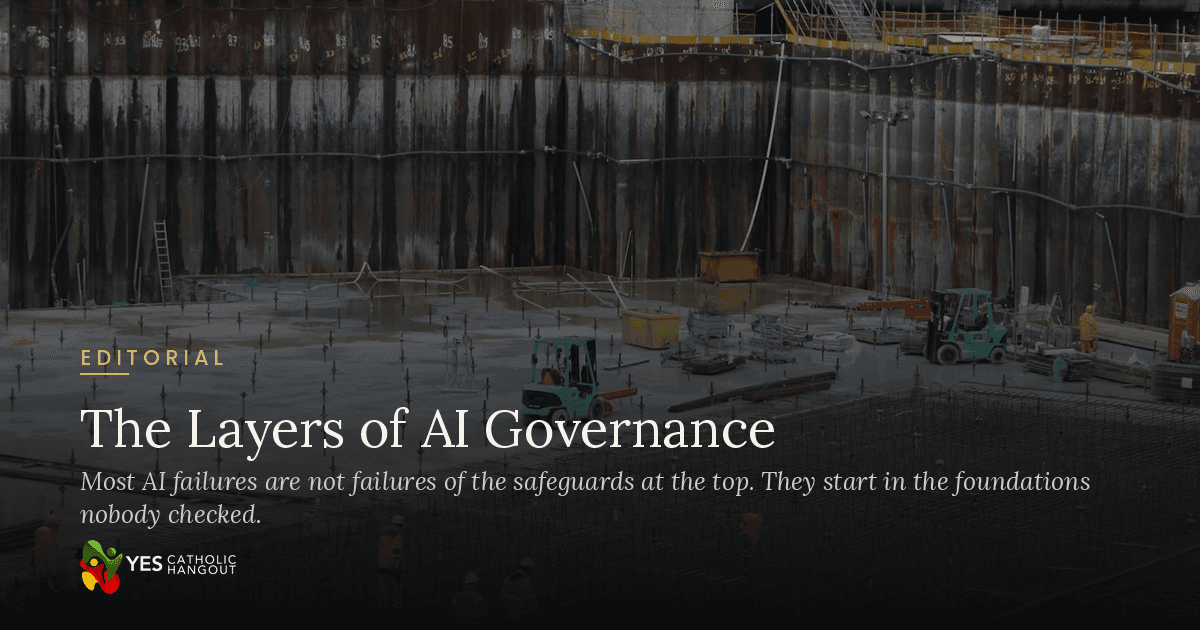
Most AI failures are not failures of the sophisticated safeguards at the top. They are failures of the boring foundations nobody checked at the bottom
When an AI system fails publicly, the response almost always looks the same. A statement about improved bias checks. New confidence thresholds. A promise to add human review for a category of decision that clearly needed it from the outset. The visible fixes concentrate on the outer layer of governance, the part that touches the output everyone saw.
This pattern deserves suspicion, because it treats the symptom as though it were the disease. Most serious AI failures do not originate in the sophisticated safeguards that get the most attention after something goes wrong. They originate much further down, in foundations so unglamorous that nobody thought to check them until the failure forced an audit.
Governance built as a set of nested layers, each depending entirely on the integrity of the one beneath it, offers a clearer way to see why this keeps happening, and what to actually fix.
Layer One: The Data Foundation
Before any question of fairness, bias, or output quality can be meaningfully addressed, an organisation needs to answer a much plainer question: what does this system actually learn from?
This means a source registry, a record of where every piece of training and reference data came from. It means a data dictionary that defines what each field actually represents, since a field labelled “income” can mean gross, net, household, or individual depending on who entered it, and a model that does not distinguish will produce confidently wrong outputs built on a confusion nobody noticed. It means clean training data, free of the duplicate, corrupted, or mislabelled records that accumulate in any dataset over time. And it means clear data ownership, an answer to who is accountable for this information being accurate and appropriately used.
If an organisation cannot answer “where did this data come from,” nothing built above that gap will hold, regardless of how sophisticated it appears. A beautifully engineered fairness check running on data nobody can trace is theatre, not governance.
Layer Two: The Governance Layer
Once the data foundation is solid, the next layer asks who decides what, and on what authority.
Definition locks establish that key terms mean one specific thing across the organisation, rather than shifting depending on which team is using them. Retrieval boundaries specify what a system is permitted to access for a given task, so a customer service tool cannot inadvertently pull from a database containing information it has no legitimate reason to touch. Input validation checks that what enters a system meets basic sanity requirements before it is processed at all, catching obvious errors before they propagate into an output someone might act on.
This layer also requires assigning a data steward, a specific person or role accountable for the integrity of a given dataset, and a definition authority, someone with the standing to resolve disputes about what a term or category actually means when two teams disagree. Without named accountability here, decisions get made by whoever happened to write the code, which is a form of governance by accident.
Layer Three: Trusted Outputs
With the first two layers solid, an organisation can begin defending what the system actually says, which is where most public attention typically starts and, unfortunately, often stops.
Confidence thresholds determine how certain a system must be before it acts autonomously versus flagging a case for human review. Output guardrails constrain what a system can produce, preventing certain categories of response regardless of what the underlying model might otherwise generate. Bias and fairness checks test whether outputs differ systematically across groups in ways that are not justified by legitimate factors. Explainable outputs ensure that when a system produces a decision, there is an actual account of why, sufficient to stand behind in front of a customer, an auditor, or a regulator, rather than a shrug and a reference to model complexity.
This is the layer where “the AI said so” becomes something an organisation can actually defend, but only because the two layers beneath it were already trustworthy. Confidence thresholds calibrated against unreliable data measure nothing real. Bias checks run against a dataset with undocumented provenance are checking the wrong thing carefully.
Layer Four: Responsible AI
Only once the first three layers are solid does it make sense to talk about the outer ring: autonomous agents acting with minimal supervision, high-risk decisions with serious consequences for the people affected, and regulated use cases subject to external legal requirements.
This is where formal compliance obligations become the operative concern, incident response plans for when something goes wrong despite every precaution, and systematic checks for hallucination, the tendency of generative systems to produce fluent, confident, and entirely fabricated content. These matter enormously, and they are also the layer most likely to receive attention first, precisely because they are the most visible and the most directly tied to regulatory and reputational risk.
But they only work because everything underneath is already solid. An incident response plan is only as good as the organisation’s ability to trace what actually happened, which depends on the audit trails and data provenance established at Layer One. Compliance with a regulation like the EU AI Act requires documenting a system’s data sources, training process, and decision logic, all of which are foundation-layer concerns wearing a compliance-layer label.
Why Organisations Build From the Top Down Anyway
Despite this logic, most organisations build governance from the outside in, addressing the visible, regulated, high-profile layer first and treating the foundation as an afterthought, if it is addressed at all. The reasons are understandable even where the sequence is wrong.
The outer layer is where regulators, journalists, and customers actually look, so it is where the incentive to demonstrate visible progress is strongest. The foundation is unglamorous, produces no announcement-worthy milestone, and its absence is invisible until something built on top of it fails. And foundational work, cleaning data, documenting provenance, assigning stewardship, is genuinely tedious in a way that no one finds rewarding to fund or to lead.
The cost of this inversion shows up eventually, and it shows up as a fairness audit that cannot explain its own methodology, an incident response that cannot reconstruct what the system actually did, or a compliance filing built on data lineage nobody can fully trace. Each of these looks, from the outside, like a failure of the outer layer. It is almost always a failure of the layers underneath that the outer layer was quietly assuming were solid.
What This Means in Practice
For any organisation assessing its own AI governance honestly, the diagnostic question is not “do we have a responsible AI policy,” which almost every organisation of any size now has in some form. The diagnostic question is whether that policy rests on layers that would survive scrutiny: can we trace where our data came from, do we know who owns what, is there a named person accountable for each critical dataset, and can we actually explain a given output to someone with the standing to demand an explanation.
An organisation that answers honestly and finds gaps at Layer One or Two has identified its real priority, however unglamorous fixing it will be compared to announcing a new ethics framework. Good governance, like good building, is judged eventually by what happens to be resting on the parts nobody can see. The visible layer only holds if the foundation does.