
The Illusion of Visibility: Rediscovering Faith in the Digital Age
A reflection on human dignity, ethical artificial intelligence, and the Church’s mission in an age where seeing often precedes believing.
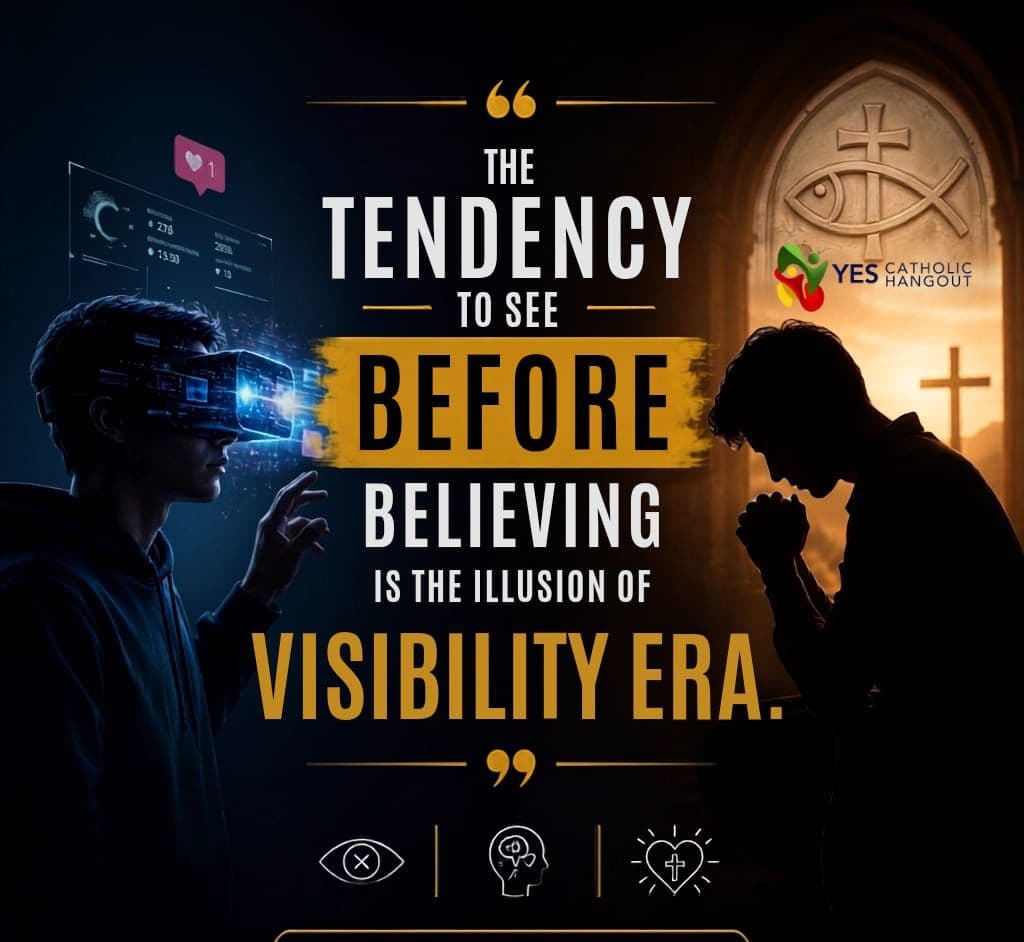
“The tendency to see before believing is the illusion of the visibility era.”
This observation captures one of the defining spiritual challenges of the digital age. Humanity now inhabits a culture where images, algorithms, metrics, and constant streams of information shape perception. Visibility is often mistaken for truth, popularity for credibility, and technological capability for wisdom.
Yet the Christian faith has always invited humanity beyond what can merely be seen.
The Gospel reminds believers that faith is not blind acceptance but a relationship of trust rooted in the encounter with the living Christ. While the Apostle Thomas sought visible proof before believing, Jesus responded with words that continue to echo through every generation: “Blessed are those who have not seen and yet have believed” (John 20:29).
Today, this Gospel challenge takes on renewed significance. Artificial intelligence, social media, immersive technologies, and digital ecosystems have transformed the way people communicate, learn, work, and form relationships. These innovations offer remarkable opportunities for human flourishing, yet they also risk creating what may be described as an “illusion of visibility”—the assumption that only what is measurable, viral, or visually verified deserves trust.
Such a mindset can gradually weaken humanity’s capacity for contemplation, silence, discernment, and hope.
The Church therefore continues to proclaim that authentic knowledge involves more than information. Human wisdom grows through prayer, conscience, dialogue, community, reason, and openness to God’s grace. Faith does not reject science or technological progress; rather, it places them within a broader vision of the human person created in the image and likeness of God.
Within this context, Magnifica Humanitas is presented as an independent Vatican-inspired ethical AI initiative seeking to encourage dialogue between faith and technological innovation. Drawing inspiration from the Gospel, Catholic Social Teaching, Laudato Si’, Fratelli Tutti, Ecclesia in Africa, and the Church’s synodal journey, the initiative proposes that digital transformation should always remain at the service of human dignity, solidarity, and integral human development.
Its vision is founded upon five complementary pathways.
First, Synodal Listening encourages communities to listen before judging, cultivating cultures of encounter in both physical and digital spaces.
Second, Relational Evangelization promotes authentic accompaniment, mentorship, catechesis, and community as an antidote to algorithmic isolation.
Third, Ethical AI Governance calls for transparency, accountability, meaningful human oversight, and respect for the dignity of every person in the design and deployment of digital systems.
Fourth, Integral Human Development directs technological innovation toward education, healthcare, environmental stewardship, dignified work, poverty reduction, and the common good.
Finally, Digital Missionary Formation equips both young people and adults with ethical, technological, entrepreneurial, and evangelizing skills so that they may become builders of peace within an interconnected world.
These priorities reflect a broader conviction: technology must remain humanity’s servant and never become its master.
The rapid expansion of artificial intelligence also presents a profound moral responsibility. Digital manipulation, misinformation, autonomous systems, and polarization remind societies that technological progress alone cannot guarantee justice or peace. Ethical discernment remains indispensable.
Likewise, every conflict and every war reveal the tragic consequences of forgetting our shared humanity. Lasting peace is not simply the absence of violence but the presence of justice, truth, mercy, solidarity, reconciliation, and authentic fraternity. The digital age should therefore become an opportunity to strengthen relationships rather than deepen division.
For the Church, adaptation does not mean abandoning the Gospel. It means proclaiming the timeless truth of Christ through new methods capable of reaching today’s world.
Faithful to the Message, Flexible in the Method.
This principle expresses the missionary vocation of the Church in every generation. New technologies may change the means of communication, but they cannot replace the encounter between persons, the witness of Christian charity, or the transforming power of the Gospel.
As humanity continues its digital journey, believers are invited to cultivate the virtues that no algorithm can automate: faith, hope, love, wisdom, compassion, humility, forgiveness, and communion.
The future will not ultimately be secured by technological dominance or systems of control. It will be shaped by peoples and communities who choose dialogue over division, solidarity over isolation, ethical innovation over exploitation, and the inviolable dignity of every human person.
In an age captivated by visibility, the Church continues to proclaim an enduring truth: the deepest realities of human life—God’s grace, authentic love, hope, mercy, and eternal life—cannot always be seen, yet they remain the strongest foundations upon which humanity can build its future.