
The Development Tool Nothing Else Matches
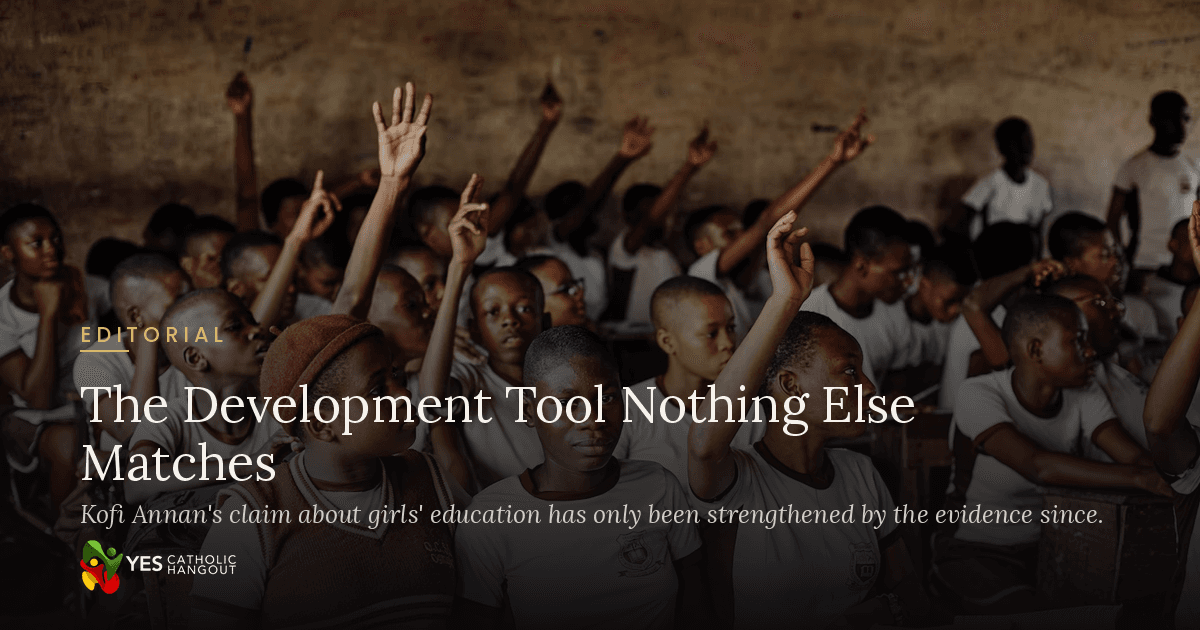
Kofi Annan said there is no tool for development more effective than the education of girls and the empowerment of women. The evidence has only strengthened since
Kofi Annan, who served eight years as Secretary-General of the United Nations, said something during his tenure that has outlasted most policy pronouncements of the era: there is no tool for development more effective than the education of girls and the empowerment of women.
It is the kind of line that risks becoming a slogan, repeated at conferences and printed on posters until its content wears smooth. It deserves better than that, because the claim is not a sentiment. It is closer to a finding, and the evidence behind it has only accumulated in the years since.
Why This Particular Claim Holds Up
Development economics has tested a great many interventions against a great many outcomes: infrastructure spending, microfinance, agricultural subsidies, direct cash transfers, vocational training. Few interventions produce effects that compound across as many domains simultaneously as girls’ education does.
An educated girl marries later, which reduces maternal mortality and gives her body more time to mature before childbearing begins. She has fewer children, and the children she has are more likely to survive infancy and more likely to be educated themselves, because an educated mother is one of the strongest predictors of whether her own children complete school. Her household income rises, and the money she controls is disproportionately spent on nutrition, health, and her children’s education rather than on discretionary consumption, a pattern documented across dramatically different cultures and continents.
The effects extend beyond her own household. Communities with higher rates of female education show greater resilience to economic shocks, better public health outcomes, and, in several studies, lower rates of political violence. This is not one good outcome among many competing goods. It is closer to a master variable, one that shifts a cluster of other outcomes at once in a way that few single interventions manage.
What Empowerment Actually Requires
Annan’s formulation paired two things: education and empowerment. The pairing was deliberate, because education alone has proven insufficient in places where it is not accompanied by a genuine widening of what a woman is permitted to do with what she has learned.
A girl can complete secondary school and still be married before she has any say in the matter. A woman can hold a degree and still be excluded from land ownership, from inheritance, from the ability to open a bank account without a male relative’s signature, from standing as a candidate for local office. Education that is not met by expanded agency produces frustration rather than transformation: capable people trained for participation they are then denied.
This is why empowerment cannot be treated as a downstream consequence of education that will simply follow if enough girls attend enough school. It requires deliberate change to the legal, economic, and social structures that determine what a woman can do once she is educated: property and inheritance law, protection from forced and early marriage, access to credit and formal employment, and genuine political representation. Education opens the door. These structures determine whether anyone is permitted to walk through it.
Where the Digital Economy Fits
This history matters directly for anyone thinking seriously about digital inclusion, financial technology, or online education, because the same failure mode is repeating in digital form.
Digital literacy programmes are frequently designed and marketed as though access were the whole problem: distribute the devices, provide the connectivity, and inclusion follows. But a woman who gains access to a smartphone in a household where her husband controls its use, or in a community where her presence in an internet café draws unwanted attention, or in a culture where digital financial tools are marketed and explained exclusively to men, has been given access without empowerment. The device changes nothing about what she is permitted to do with it.
Financial technology built to expand access to banking, credit, and digital payments faces the identical structural test that girls’ education faced for decades. Distributing the tool is necessary and is not sufficient. The tool must reach women specifically, be usable within the actual constraints of their days, and be paired with the legal and social standing that lets them use it without needing anyone else’s permission.
This is why the strongest digital inclusion initiatives increasingly design for women explicitly rather than assuming general access will reach them by default: financial products that do not require a male co-signer, digital literacy training conducted in women-only settings where cultural norms make mixed settings a barrier to participation, and identity systems that register women independently rather than as dependents attached to a male relative’s registration. None of this is a departure from good design. It is what good design looks like once the evidence about how exclusion actually operates is taken seriously.
The Catholic Case for This Priority
Catholic social teaching offers a framework that arrives at Annan’s conclusion from a different direction and reinforces it.
The dignity of every person is not contingent on sex, and Church teaching has been unambiguous that women possess this dignity as fully as men, entitled to the same fundamental respect and the same access to the goods necessary for a full life. The preferential option for the poor, meanwhile, directs attention specifically toward those bearing the heaviest burden of any given injustice, and in most of the world’s poorest regions, women and girls bear a disproportionate share of the burden of poverty: less schooling, less inheritance, less say in decisions that determine their own futures, more unpaid labour absorbed into a household economy that credits it to no one.
Put these together and the conclusion is not merely that educating and empowering women is an effective development strategy, though it is. It is that failing to do so represents a specific and correctable injustice, one that development professionals have documented with unusual precision and that faith communities have a direct obligation to address rather than merely commend from a distance.
What This Asks of Institutions Today
For schools and educational programmes, particularly in regions where girls’ enrolment lags behind boys’, the practical response is direct: remove the specific barriers that keep girls out, whether that is school fees, distance and safety of travel, absence of sanitation facilities that keep girls home during menstruation, or family expectations that a daughter’s education matters less than a son’s.
For technology companies and development organisations building the next generation of financial and educational tools, the response is to stop treating “reaches everyone” as equivalent to “reaches women,” and to measure specifically whether women are adopting, retaining, and controlling the use of what has been built, rather than assuming general uptake numbers tell the whole story.
For faith communities, the response includes advocacy, but is not limited to it. Parishes and dioceses run schools, clinics, and microfinance initiatives across some of the regions where this gap is widest, and each of those institutions can ask directly whether its own practice reaches girls and women as deliberately as Annan’s claim would demand, or whether it has quietly assumed that general provision is enough.
The claim has held up for over two decades of scrutiny for a reason. It names something true about how change actually happens in a community: not from the top down through infrastructure alone, but through the compounding effect of educating and empowering the people who, given the chance, invest most reliably in everyone around them.