
The Beautiful Game, The Beautiful Peace: Why the World Cup 2026 Must Become Humanity’s Turning Point
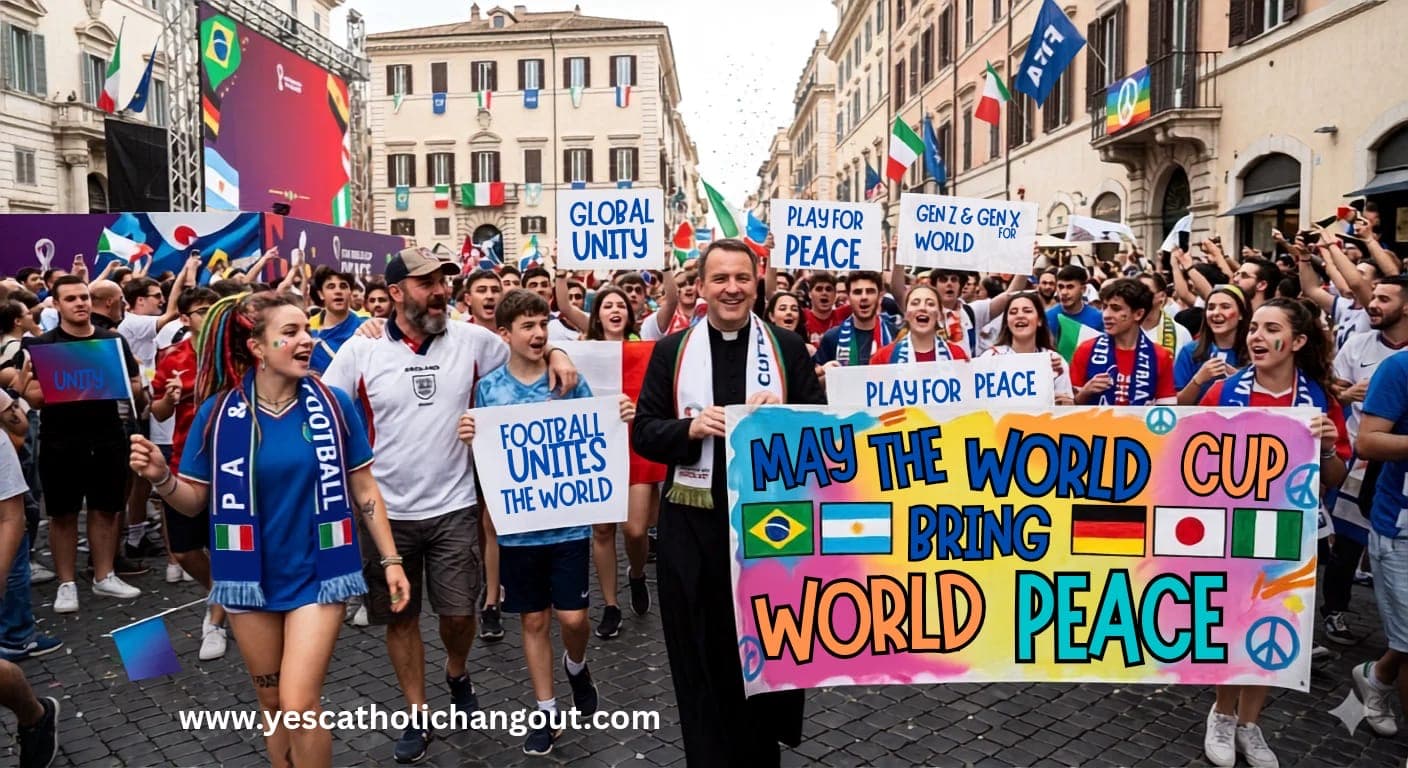
A call for nations, communities, and generations to choose fraternity over division — one match at a time.
The World Gathers, and So Does Hope
In the summer of 2026, something extraordinary will happen. Forty-eight nations representing billions of people across every continent, creed, and culture will converge on the stadiums of the United States, Mexico, and Canada for the FIFA World Cup. For one month, the planet will share a common heartbeat. The question before us is profound: will this be merely a tournament, or will it become a watershed moment for human solidarity?
The world has never needed peace more urgently. Conflicts rage across continents. Displacement has reached historic levels. Economic inequality widens. Digital polarization fractures communities that once found common ground. Yet amid this turbulence, football, the world’s most universal language, offers something that diplomacy, economics, and technology alone cannot: a shared experience of joy, suspense, and belonging that transcends every border humanity has ever drawn.
Football: The Last Common Ground
Consider what happens when a World Cup match begins. In living rooms in Lagos and London, in cafés in Cairo and Caracas, in village squares and skyscraper lounges, strangers become companions. They cheer together. They hold their breath together. They embrace in celebration or console one another in defeat. For ninety minutes, the walls that separate us, nationality, religion, ideology, class, dissolve into irrelevance.
This is not sentimentality. This is anthropology. Human beings are wired for shared ritual, for collective emotion, for the experience of belonging to something larger than themselves. Football provides this at a scale no other cultural phenomenon can match. With an estimated five billion viewers worldwide, the World Cup is the single largest shared human experience on Earth. No political summit, no religious gathering, no technological platform commands this breadth of attention.
The question is whether we will waste this extraordinary convergence on mere entertainment, or whether we will harness it as a catalyst for lasting peace.
Lessons from History: When Sport Changed the World
History teaches us that sport has always carried the seeds of reconciliation. In 1914, soldiers from opposing trenches laid down their weapons on Christmas Day to play football in no man’s land, a spontaneous act of humanity that reminded enemies they were brothers. In 1995, Nelson Mandela donned a Springbok jersey and united a fractured South Africa through rugby. In 2018, the unified Korean team at the Winter Olympics offered a fleeting but powerful image of what reconciliation might look like on the peninsula.
These were not accidents. They were moments when the spirit of competition yielded to the deeper truth of our shared humanity. The World Cup 2026, with its unprecedented scale and its hosting across three nations that share one of the world’s longest peaceful borders, is positioned to deliver such a moment on a global stage.
From Stadiums to Streets: A Peace That Lasts
A single tournament cannot end wars. But it can shift consciousness. It can remind political leaders that their citizens hunger for cooperation, not conflict. It can demonstrate to young people that national pride and international friendship are not contradictions. It can prove to cynics that billions of human beings, given the choice, will choose celebration over hatred.
For this to happen, the World Cup 2026 must be intentionally designed as a platform for peace. This means more than slogans on LED boards.
Governments should use the tournament as a backdrop for diplomatic breakthroughs, ceasefire agreements, humanitarian corridors, and refugee resettlement commitments announced during the global spotlight of the competition.
FIFA and its partners should dedicate a meaningful portion of tournament revenue to peacebuilding initiatives in conflict zones, youth development programs in underserved communities, and grassroots football projects that bring divided communities together.
Media organizations should choose to tell stories of unity alongside stories of competition, profiling players who have overcome war, highlighting fan friendships across national lines, and amplifying the voices of those who use football as a tool for social healing.
Technology companies should deploy their platforms to connect rather than divide, using the World Cup moment to promote cross-cultural dialogue, combat online hate speech, and demonstrate that algorithms can serve human fraternity rather than exploit human division.
Faith communities and civil society should organize parallel events, interfaith gatherings, community service projects, and cultural exchanges that extend the spirit of the tournament beyond the stadium walls and into neighborhoods where peace is built one relationship at a time.
A Message to the Young and the Wise
The World Cup 2026 belongs especially to two generations. Generation Z, digital natives who carry the world in their pockets and possess an instinctive understanding of global interconnection, and Generation X, who remember a world before the internet and carry the institutional wisdom to translate idealism into action.
To Gen Z: your creativity, your refusal to accept inherited hatreds, and your mastery of digital communication make you the natural architects of a new peace culture. Use the World Cup as your canvas. Create content that celebrates unity. Build digital communities around shared fandom that cross every line of division. Show the world that your generation chooses teammates over enemies.
To Gen X: your experience, your leadership positions, and your understanding of how systems work give you the power to make structural change. Use the World Cup moment to push for policy shifts, to fund peace initiatives, to mentor young leaders, and to ensure that the energy of the tournament translates into lasting institutional commitments.
Together, these generations can transform a sporting event into a civilizational statement.
The Moral Imperative
Every war begins with the belief that the other side is less than human. Every peace begins with the recognition that we share a common dignity. Football, with its universal rules, its demand for fair play, its celebration of diverse talent, and its insistence that the game belongs to everyone, is a living laboratory for this recognition.
When a Nigerian striker embraces a Japanese goalkeeper after a hard-fought match, when Argentine and Saudi fans share meals and laughter after an upset, when a refugee who fled violence scores a goal wearing the jersey of his adopted nation, these are not trivial moments. They are prophecies of what the world could be if we chose cooperation over domination.
Pope Leo XIV, in his encyclical Magnifica Humanitas, reminded the world that “true fulfilment is not achieved by eliminating weakness but through harmonious growth.” The World Cup embodies this truth. Every team that takes the field is a mosaic of different talents, temperaments, and backgrounds united by a common purpose. Every match is a demonstration that competition need not produce enemies, only worthy opponents who elevate one another through the contest.
A World Cup Legacy Measured in Peace
The legacy of the World Cup 2026 should not be measured solely in goals scored, records broken, or revenue generated. Its true legacy should be measured in how many diplomatic conversations it catalyzed, how many young people it inspired to choose service over cynicism, how many communities it brought together across lines of division, how many resources it directed toward the forgotten and the vulnerable, and how much closer it brought humanity to the understanding that we are one family, sharing one planet, responsible for one another.
The Final Whistle Is a Beginning
When the final whistle blows in the championship match, the world will have a choice. We can return to our divisions, our grievances, our walls. Or we can carry forward the spirit of what we experienced together, the proof that billions of people can share a common joy without a single shot being fired.
The World Cup 2026 is not just a tournament. It is an invitation. An invitation to remember that the same humanity that invented war also invented football, and that the instinct to play together is as deep and as ancient as the instinct to fight. The question is which instinct we will feed.
Let every stadium become a cathedral of peace. Let every anthem sung be a prayer for understanding. Let every goal celebrated be a declaration that joy shared is joy multiplied. And let the world remember, long after the trophies are lifted and the confetti settles, that in the summer of 2026, humanity chose to be teammates.
May the World Cup bring World Peace.
For the common good. For human dignity. For future generations. For one human family.