
Synodality Without Ethical Digitality Will Be Amputated, It Cannot Walk not to talk of implementing walking together.
The Provocation: A Quote That Demands Attention
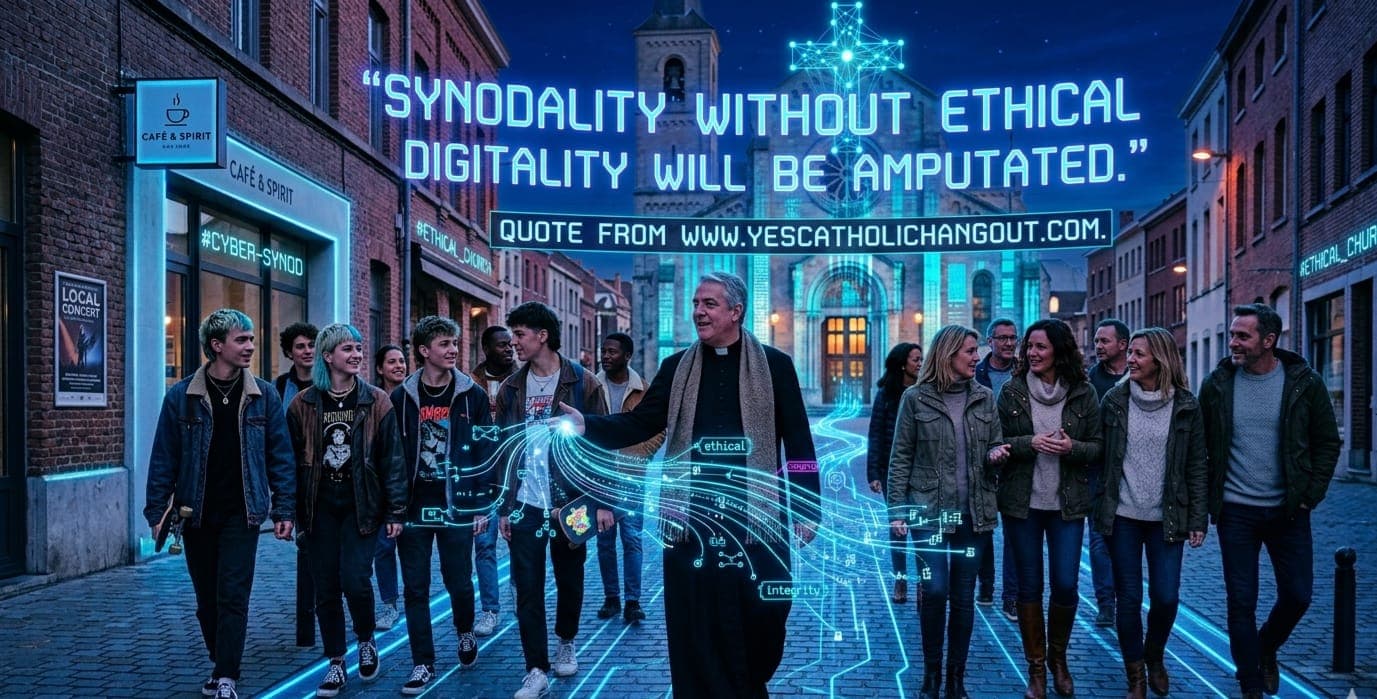
“Synodality without ethical digitality will be amputated, it can’t walk.”
The phrase, attributed to the Magnifica Humanitas movement and circulating through the Yes Catholic Hangout network, captures in a single sentence the challenge facing the Church in 2026. It is not a rejection of tradition. It is a diagnosis: a Church that walks together (synodality) but ignores the ethical architecture of the digital world (ethical digitality) is a body missing a limb.
The image accompanying this message — a diverse, intergenerational group walking through a cobblestone street at dusk, led by a smiling priest, with electric-blue data streams connecting them beneath a glowing digital cross — visually renders the thesis. The Church is already walking. The question is whether it walks with or without ethical digital consciousness.
The Synodal Mandate: Digital Mission Is Not Optional
In March 2026, Study Group 3 of the Synod of Bishops released its final report, The Mission in the Digital Environment, as part of the ongoing implementation of the 16th General Assembly’s call for “a Synodal Church: Communion, Participation, Mission” Synod.va, March 2026.
The report’s central insight is unambiguous: “The digital environment is not simply a collection of technological tools but a cultural space with its own language, dynamics, and ways of forming relationships” Vatican News, March 2026. It is, the study group concluded, “a new missionary field where the Church is called to proclaim the Gospel.”
Five essential themes emerged from the synodal discernment:
The digital environment is a culture, not merely a set of tools to be mastered.
Digital engagement enables listening to and raising the voices of those who are not heard — an expression of the Church’s social mission.
Digital culture requires intentionality, formation, and missionary spirit comparable to cross-cultural ministry.
Digital engagement naturally fosters synodality through listening, participation, and shared responsibility.
The digital environment poses immense challenges — algorithms that isolate, echo chambers that polarize, and platforms that manipulate.
The report went further, recommending the creation of a “Pontifical Commission for Digital Culture and New Technologies” to monitor emerging theological, pastoral, and canonical questions; prepare guidelines for bishops, priests, religious, and laypeople; and support episcopal conferences in integrating digital mission into pastoral plans OSV News, March 2026.
Magnifica humanitas: An Encyclical for the Digital Age
The synodal study group’s recommendations did not emerge in a vacuum. On 25 May 2026, Pope Leo XIV published his first encyclical, Magnifica humanitas: On Safeguarding the Human Person in the Time of Artificial Intelligence, signed on 15 May — the 135th anniversary of Leo XIII’s Rerum novarum.
The encyclical’s opening words set its tone: “Humanity, created by God in all its grandeur, is today facing a pivotal choice: either to construct a new Tower of Babel or to build the city in which God and humanity dwell together” Vatican.va, May 2026.
Divided into five chapters, Magnifica humanitas develops a comprehensive ethical framework for the digital age. Its key affirmations include:
Technology is never neutral: “It takes on the characteristics of those who devise, finance, regulate, and use it” (4).
AI must be “disarmed”: “To disarm means discrediting the assumption that technical power automatically confers the right to govern. To disarm does not mean rejecting technology, but preventing it from dominating humanity” (110).
An ethical code is necessary but insufficient: “A more moral AI is not enough if that morality is determined by a few” (107).
The dignity of work must be protected: “While AI promises to boost productivity by taking over mundane tasks, it frequently forces workers to adapt to the speed and demands of machines, rather than machines being designed to support those who work” (150).
The “just war” theory must be overcome: “There is no algorithm that can make war morally acceptable. AI does not remove the intrinsic inhumanity of conflict; indeed, it can only bring about conflict more quickly and render it more impersonal” (199).
Pope Leo XIV also addressed what he called the “architecture of visibility” — the algorithmic systems that amplify only what is visible, shape opinions, and risk discriminating against the weakest. He warned against new forms of slavery in the extraction of rare earth minerals for technology, and against a new “colonialism” that turns personal data into exploitable information Vatican News, May 2026.
Magnifica Humanitas: A Grassroots Movement in the Pope’s Footsteps
The Magnifica Humanitas movement — distinct from the encyclical but deeply resonant with its themes — has emerged as a Vatican-inspired ethical AI mission dedicated to serving human dignity, integral development, synodality, and relational evangelization in the digital economy.
Rooted in the Gospel, Catholic Social Teaching, Laudato Si’, Fratelli Tutti, Ecclesia in Africa, and the vision of a listening Church, Magnifica Humanitas seeks to bridge the wisdom of Generation X and the digital creativity of Generation Z through ethical technology.
The movement’s core affirmation is striking: “There is no truly just war in a world capable of dialogue, cooperation, and synodal discernment. Every war is a sin against magnificent humanity because it destroys lives, families, cultures, ecosystems, and future generations.”
This echoes Pope Leo XIV’s call to overcome the “just war” theory and his insistence that “peace is not merely the absence of violence; it is the presence of justice, solidarity, truth, mercy, and authentic human relationships.”
Five Pathways: Where Synodality and Ethical Digitality Converge
The Magnifica Humanitas movement proposes five pathways that operationalize the convergence of synodality and ethical digitality:
Synodal Listening
Creating digital and physical spaces where people, communities, nations, and generations listen before judging. This directly embodies the synodal method — but insists that digital spaces be designed ethically so that listening is genuine, not algorithmically manipulated.
Relational Evangelization
Replacing algorithmic isolation with authentic accompaniment, mentorship, catechesis, and community building. The Synod study group’s report similarly emphasized that “the Church’s presence in the digital sphere can be a sign of communion and a witness of hope, capable of reflecting the merciful face of Christ.”
Ethical AI Governance
Ensuring transparency, accountability, human oversight, and protection of human dignity in all digital systems. Pope Leo XIV’s encyclical devotes an entire chapter to this, calling for “independent oversight, and user education” alongside “adequate AI policies and legal frameworks.”
Integral Human Development
Directing technological innovation toward education, healthcare, environmental stewardship, poverty reduction, and dignified work. The encyclical insists that development cannot be measured by GDP alone but by “the dignity of work, shared prosperity, the reduction of inequalities, and environmental protection” (159-160).
Digital Missionary Formation
Equipping young people and adults with skills in technology, data, entrepreneurship, and evangelization to become builders of peace. The Synod study group called for “formation to the priesthood and mission in the digital environment,” and the Magnifica Humanitas movement extends this to all the baptized.
The Amputation Thesis: Why This Matters Now
The metaphor is surgical: a body with two legs can walk. A body with one cannot. Synodality — walking together, listening together, discerning together — is one leg. Ethical digitality — ensuring that the digital spaces where humanity increasingly dwells are governed by transparency, dignity, and the common good — is the other.
Without ethical digitality, synodality becomes a beautiful interior exercise that never reaches the digital public square where billions of people spend their waking hours. Without synodality, ethical digitality becomes a technocratic project without a soul — rules without relationships, governance without grace.
The Church’s own synodal process has recognized this. The study group report noted that clergy “felt ill-equipped to navigate digital spaces” and called for “canonical adaptations to accommodate supraterritorial digital realities.” The proposed Pontifical Commission for Digital Culture and New Technologies represents an institutional acknowledgment that the digital is not a peripheral concern but a central missionary frontier.
A Civilization of Love in the Digital Age
Pope Leo XIV concludes Magnifica humanitas by calling Christians to build “the civilization of love” — a phrase that echoes Pope St. Paul VI and Pope St. John Paul II, now applied to the digital era. He identifies five paths of responsibility: disarming words by speaking truth; building peace in justice; adopting the perspective of victims; cultivating a healthy realism that seeks practicable paths of peace; and relaunching dialogue through a culture of negotiation.
The Magnifica Humanitas movement, in its own idiom, says the same: “The future does not belong to weapons, domination, or technological control. The future belongs to fraternity, dialogue, ethical innovation, and the flourishing of every human person from conception to natural death.”
Both the papal magisterium and the grassroots movement converge on a single conviction: adaptation is not betrayal. As the movement’s motto puts it: “Faithful to the Message, Flexible in the Method.”
Conclusion: Two Legs for One Mission
The Church in 2026 stands at a crossroads. The synodal journey has awakened a deep desire for communion, participation, and mission. The digital revolution has created a new cultural continent that demands evangelization. Neither can be pursued in isolation.
“Synodality without ethical digitality will be amputated, it cannot walk.” The phrase is not a slogan. It is a summons. The body of Christ — the People of God — needs both legs to move forward into a future where technology serves humanity, not the reverse; where algorithms do not replace accompaniment; and where the digital public square becomes, in the words of the Synod study group, a place where the Church “reflects the merciful face of Christ.”
Sources
Pope Leo XIV, Magnifica humanitas, 15 May 2026 — Vatican.va
Vatican News, “Pope Leo’s ‘Magnifica humanitas’: AI must serve humanity not concentrate power,” 25 May 2026 — Vatican News
Vatican News, “Synod releases Report on Mission in the Digital Environment,” 16 March 2026 — Vatican News
Synod.va, Study Group 3 Final Report: “The Mission in the Digital Environment,” March 2026 — Synod.va
OSV News, “Vatican synod study group proposes creation of pontifical commission for new technologies,” 3 March 2026 — OSV News
Magnifica Humanitas / Yes Catholic Hangout — referenced throughout the analysis