
Stop Exposing Nigerians to Electoral Insecurity
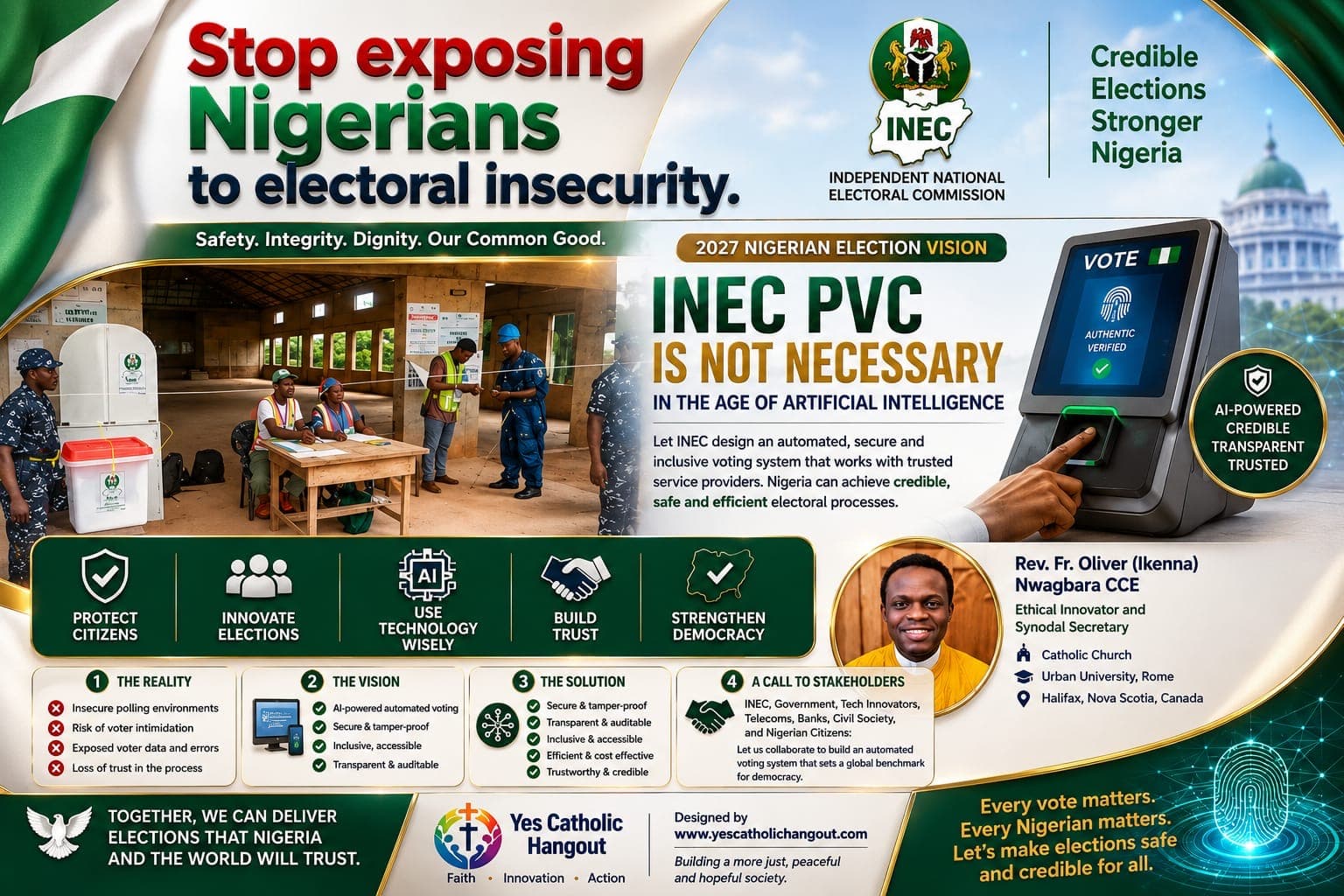
Nigeria’s democracy should never require citizens to choose between exercising their right to vote and protecting their personal safety
By Fr. Oliver CCE | Ethical Innovator & Synodal Secretary | Founder, www.yescatholichangout.com
There is a calculation that millions of Nigerians make quietly before every election. It is not about parties or candidates or policies. It is simpler and more troubling than that: is it safe to go out and vote?
In some places the answer is yes. In others, in particular constituencies, particular local government areas, particular years, the honest answer has been no. Voters have weighed the possibility of violence at polling units, the risk of travelling to collect a card, the danger of being present at a collation centre when a result is contested. Some have stayed home. Their absence is recorded as apathy.
It is not apathy. It is a rational response to a state that has not guaranteed the physical safety of the act it asks its citizens to perform.
This is the foundation on which any conversation about electoral reform must begin. Not with technology, but with the recognition that a democracy which quietly requires courage of its ordinary participants has already conceded something important.
Beyond Digitisation
As 2027 approaches, the reform conversation has increasingly turned technical. There is talk of biometric authentication, of digital identity, of blockchain-verified results, of rendering the Permanent Voter Card obsolete. Some of these proposals are serious and worth pursuing.
But the national conversation must move beyond simply digitising elections, because digitisation on its own answers none of the questions that matter most. A system can be entirely electronic and entirely untrustworthy. Nigeria has some experience of this already: card readers that failed at scale, electronic transmission that was promised and then did not arrive, technical glitches that appeared with suspicious regularity at exactly the moments when transparency mattered most.
Each of those failures was technological. None of them was solved by technology. They were failures of accountability, and accountability is not a feature you can install.
The deeper ethical question is therefore not whether elections can be automated. It is this: how can technology serve the voter, protect human dignity, strengthen transparency and restore public trust?
Those four tests are harder than they sound, and a proposal can satisfy one while failing the others. A biometric system may strengthen verification while creating a national database that endangers the very citizens it registered. A results platform may be transparent to experts and opaque to the public. Speed of collation is not the same as credibility of collation.
Technology Is Not Automatically Ethical
The most persistent error in this debate is the assumption that introducing a machine removes the possibility of manipulation. It does not. It relocates it.
An election rigged by ballot-box snatching requires people, presence, and visible violence. It is crude, and its crudeness is a kind of accountability: witnesses see it, cameras record it, and it can be described. An election compromised at the level of a database, an algorithm, or a transmission protocol requires none of that. It happens without a scene, leaves no image, and can be explained afterwards in language that most citizens and many journalists cannot evaluate.
This is why any innovation introduced into Nigerian elections must satisfy conditions that are not negotiable:
Human-centred. Designed around the actual conditions of Nigerian voters, including those with no smartphone, unreliable electricity, poor connectivity, limited literacy, or a disability. A system that works beautifully in Lagos and fails in a riverine community has not solved the problem. It has redistributed it.
Independently auditable. By bodies that do not answer to the government, the vendor, or the commission deploying it. An audit conducted by those with an interest in the outcome is not an audit.
Privacy-preserving. A national biometric electoral database is one of the most sensitive collections of personal data a state can hold. In a country that has known ethnic and religious targeting, a database recording where every citizen lives and how they are identified is not a neutral asset. It must be governed under the NDPR and NDPA with real enforcement, not aspirational compliance.
Inclusive. Every eligible citizen, not only those the technology finds convenient to serve.
Transparent. Meaning the logic of the system can be explained and examined, not merely that the results are published quickly.
Accountable under Nigerian law. With named responsibility, real remedies, and consequences that apply to vendors and officials alike.
A proposal that cannot meet these conditions should not be deployed, however impressive its demonstration.
What the Goal Actually Is
The goal is not to eliminate the PVC. The goal is not to automate voting. Those are means, and treating a means as the objective is how reforms end up satisfying their own metrics while failing the country.
The goal is an electoral ecosystem in which:
Citizens are protected, physically and digitally, in the exercise of their franchise
Every legitimate vote counts, and is counted where it was cast
Results can be verified by ordinary citizens, not only by experts and litigators
Personal data is safeguarded against the state as well as against criminals
Technology serves democracy rather than democracy adapting itself to technology
That last point deserves emphasis. When a system’s limitations begin to determine what democratic participation looks like, the relationship has inverted. Voters should not be excluded because the platform cannot accommodate them.
The Collaboration This Requires
None of this can be delivered by one institution. INEC cannot secure polling units by itself. Government cannot design trustworthy systems without technical expertise it does not internally possess. Technology firms cannot be left to define what counts as adequate safeguards for the citizens whose data they will hold. Cybersecurity professionals see risks that administrators do not. Civil society and journalists surface failures that official channels bury.
Faith communities have a particular contribution here, and it is not partisan. Churches and mosques reach into nearly every community in the country. They can form consciences, insist that violence in pursuit of political advantage is not made acceptable by its outcome, and accompany citizens toward participation rather than withdrawal. They can also say what politicians find costly to say: that a result obtained through intimidation is illegitimate regardless of who benefits.
And citizens themselves are not merely the objects of electoral reform. They are its authors. A system designed for Nigerians without consulting Nigerians will reproduce the distance that produced the crisis of trust in the first place.
This is what subsidiarity means in practice. Decisions belong as close as possible to those affected by them, with higher authorities providing what local capacity cannot.
The Two Failures to Avoid
There are two ways to get this wrong, and they are opposites.
Innovation without ethics creates new vulnerabilities. A rushed deployment, a poorly secured database, an algorithm nobody can audit, a vendor contract signed without scrutiny. These do not merely fail. They fail in ways that are harder to detect and harder to contest than the failures they replaced.
Ethics without courageous innovation leaves old problems untouched. It is possible to raise concerns so persistently that nothing is ever attempted, while ballot boxes continue to be snatched and results continue to be disbelieved. Caution that protects a broken status quo is not integrity. It is a different kind of failure, and it is paid for by the same citizens.
Nigeria deserves both: ethical innovation and credible democracy. Neither is achievable without the other. Innovation without ethics produces sophisticated fraud. Ethics without innovation produces principled stagnation.
Participation Without Fear
The measure of electoral reform is not the sophistication of the technology deployed. It is whether a farmer in Benue, a trader in Aba, a student in Maiduguri and a nurse in Port Harcourt can vote without weighing the risk of doing so, and can believe the result without waiting for a court to tell them whether to.
That is a demanding standard, and Nigeria is not yet close to it. But it is the right one, and stating it clearly matters more than announcing a new platform.
Let us build an electoral future where Nigerians participate not in fear but in freedom, not with suspicion but with justified trust.
Every vote matters. Every Nigerian matters. Human dignity must remain the first algorithm.