
Prioritize What Lasts Forever Over What Fades Away: Wisdom, Friendship with Christ, and the Kingdom of God in the Age of Artificial Intelligence
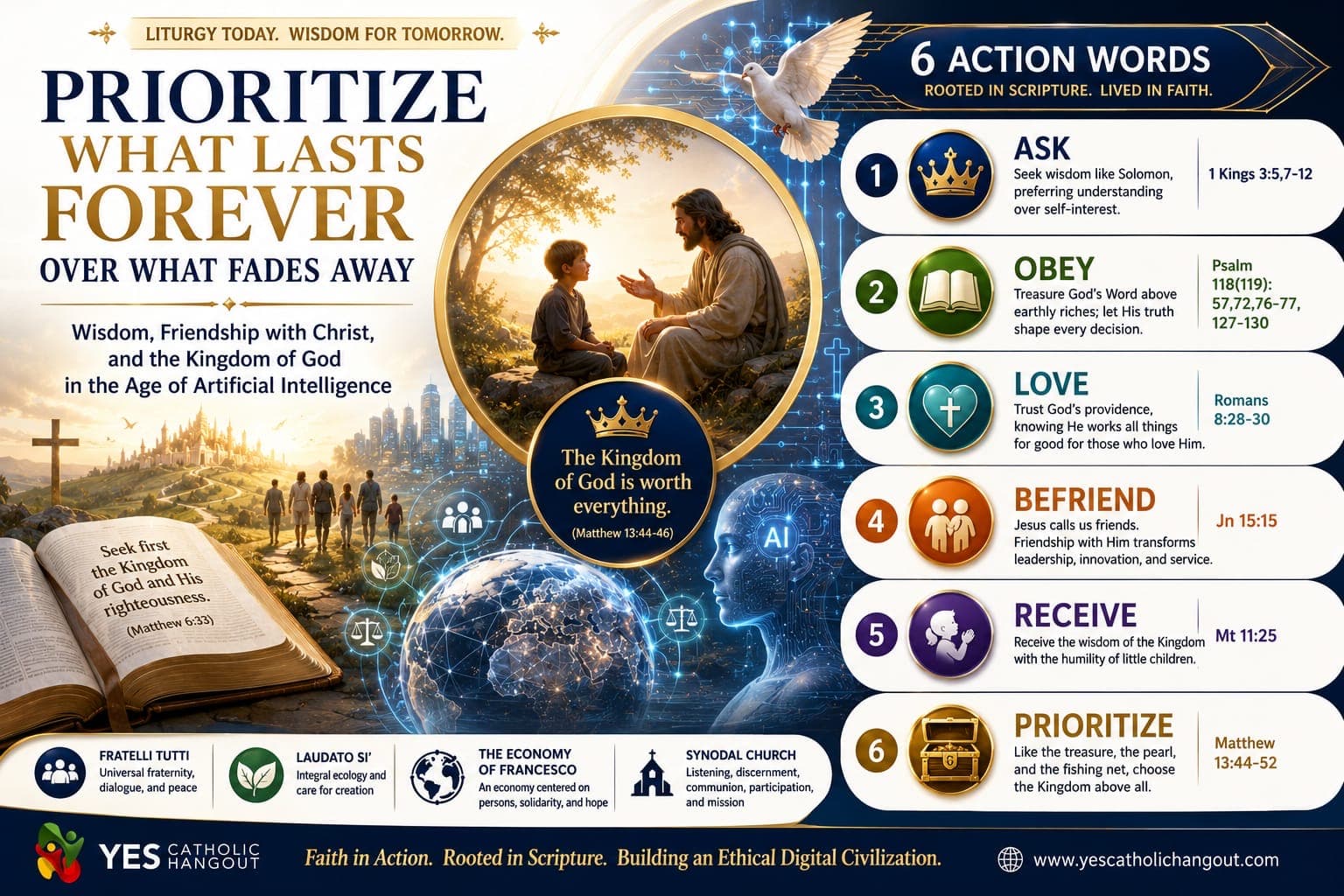
Artificial Intelligence is rapidly reshaping our civilization. Algorithms increasingly influence education, healthcare, finance, governance, communication, commerce, and even personal relationships. Yet beneath every technological revolution lies an older and more enduring question: what truly deserves the human heart?
The liturgy invites us to answer that question with remarkable clarity. Across the wisdom of Solomon, the poetry of the Psalmist, the hope proclaimed by St. Paul, the friendship offered by Christ, the humility of little children, and the Kingdom parables of Jesus, Scripture proposes a single principle capable of guiding every generation:
Prioritize what lasts forever over what fades away.
This is not merely a spiritual slogan. It is an ethical framework for humanity at a time when digital innovation often moves faster than moral reflection. The future of Artificial Intelligence will ultimately be determined not by processors, data centres, or algorithms, but by the character of the people who design, govern, and use them.
Within the vision of Magnifica Humanitas, the central question remains profoundly anthropological: what kind of human person is technology meant to serve? The Gospel answers that question not with technical specifications but with conversion of heart.
Ask: Wisdom Before Power
When God invited Solomon to ask for whatever he desired, the young king did not seek military strength, political dominance, wealth, or revenge. Instead, he asked for an understanding heart capable of discerning good from evil.
That prayer remains one of the most relevant prayers for the digital age.
Today’s world possesses unprecedented computational intelligence, yet it frequently lacks moral wisdom. Artificial Intelligence can process enormous quantities of information, but it cannot replace prudence, conscience, compassion, or virtue.
Every engineer, policymaker, entrepreneur, educator, and Church leader should imitate Solomon by asking first for wisdom. Technological excellence without ethical wisdom produces efficient injustice. Innovation without moral discernment eventually becomes domination rather than service.
The first responsibility of ethical innovation is therefore not to create smarter machines but wiser human beings.
Obey: Truth Above Profit
The Psalmist declares God’s law more precious than gold. Modern societies often reverse this order.
Economic success increasingly determines ethical decisions rather than ethical principles directing economic life. Algorithms frequently optimise engagement instead of truth, consumption instead of contentment, speed instead of wisdom.
Yet authentic freedom does not arise from unlimited technological capability. Freedom flourishes when human creativity remains obedient to truth. Obedience to God’s wisdom protects human dignity from becoming another market commodity.
This insight lies at the heart of Laudato Si’, which reminds us that technological progress detached from moral responsibility inevitably damages both humanity and creation. The greatest digital innovation is not one that merely increases productivity but one that safeguards the human person.
Love: Providence in an Uncertain World
St. Paul offers extraordinary reassurance:
“We know that all things work together for good for those who love God.”
Artificial Intelligence introduces uncertainty into labour markets, education, healthcare, security, and international relations. Many fear replacement. Others fear irrelevance. Still others fear losing control over systems that increasingly appear autonomous.
The Christian response is neither naive optimism nor fearful pessimism. It is confident trust. Love anchors hope. Human history remains guided not by algorithms but by Divine Providence. Technology may alter the landscape of civilization, but it never replaces God’s governance of creation.
This confidence enables Christians to engage innovation responsibly without surrendering either their hope or their humanity.
Befriend: Leadership Through Relationship
Jesus makes an astonishing declaration:
“I no longer call you servants… I have called you friends.”
Friendship changes everything. Servants merely execute instructions. Friends share purpose.
The future requires leaders who govern not through manipulation but through relationship. Artificial Intelligence increasingly mediates communication, yet authentic human flourishing still depends upon trust, dialogue, listening, compassion, and communion.
This insight resonates deeply with Fratelli Tutti, where Pope Francis proposes social friendship as the foundation of lasting peace. Algorithms may connect networks. Only friendship builds communities.
The Church’s Synodal journey similarly reminds us that listening is not weakness but wisdom. Ethical leadership begins where genuine friendship flourishes.
Receive: The Humility to Learn
Jesus rejoices because the mysteries of the Kingdom are revealed to little children rather than to those convinced of their own superiority.
Artificial Intelligence tempts humanity toward intellectual pride. Knowledge expands rapidly. Information multiplies endlessly. Yet information alone does not produce wisdom.
The Kingdom belongs to those humble enough to receive truth before attempting to control it. Humility remains humanity’s greatest safeguard against technological arrogance.
Within Magnifica Humanitas, ethical innovation begins not with the illusion of mastering everything but with gratitude for the gift of being human. Only humble people can responsibly govern powerful technologies.
Prioritize: Invest in Eternity
Jesus concludes with three unforgettable images: a treasure hidden in a field, a pearl of great price, and a fishing net separating what endures from what does not.
Each parable speaks of discernment. Each demands decisive action. Each teaches that eternity is worth every sacrifice.
The Kingdom of God is not one value among many. It is the supreme value that rightly orders every other value.
Consumer culture encourages accumulation. The Gospel encourages discernment. Digital culture rewards constant attention. Christ invites focused devotion. Artificial Intelligence rewards optimisation. The Kingdom rewards transformation.
The question confronting modern civilization is therefore not whether Artificial Intelligence will become more powerful. The deeper question is whether humanity will remain wise enough to know what deserves ultimate priority.
The Economy of Francesco offers a compelling answer. Economies exist for persons. Markets serve communities. Innovation promotes the common good. Technology strengthens solidarity. Development respects creation. Growth never comes at the expense of human dignity.
When economic life reflects these principles, progress becomes genuinely sustainable.
Magnifica Humanitas: A Synodal Path for Ethical AI
The vision of Magnifies Humanitas proposes that Artificial Intelligence must remain permanently anchored in the dignity of the human person. Its foundation is neither technological determinism nor economic competition. Its foundation is the Gospel.
Human dignity precedes digital efficiency. Conscience precedes computation. Relationship precedes automation. The common good precedes private advantage. Ethics precedes innovation.
This vision harmonises naturally with Fratelli Tutti, Laudato Si’, The Economy of Francesco, Catholic Social Teaching, and the Church’s Synodal mission. Together they offer not isolated documents but an integrated moral compass capable of guiding humanity through the digital age.
They remind us that technological civilization will remain truly human only when it protects the poor, strengthens families, promotes justice, safeguards creation, fosters peace, and places every innovation at the service of life.
A Mission for Our Time
The age of Artificial Intelligence is not ultimately a technological crisis. It is an anthropological and spiritual moment of decision.
Every generation chooses its treasure. Every society chooses its priorities. Every civilization chooses what it will ultimately worship.
The Gospel invites us to choose differently: ask for wisdom, obey God’s truth, love with confidence, live as friends of Christ, receive His Kingdom with childlike humility, and prioritize what lasts forever over what fades away.
If humanity embraces this path, Artificial Intelligence will become not a rival to human dignity but a responsible instrument of integral human development. Such a future will reflect the deepest aspirations of Magnifica Humanitas, embody the fraternity of Fratelli Tutti, honour the ecological vision of Laudato Si’, and advance the human-centred economy envisioned by The Economy of Francesco.
In doing so, the Church will continue her enduring mission: proclaiming that every technological age, no matter how advanced, ultimately finds its true meaning in Jesus Christ, the eternal Treasure, the Pearl beyond all price, and the Wisdom that never fades.