
Prayer, Human Dignity, and the Common Good: A Catholic Response to Public Worship in Military Service
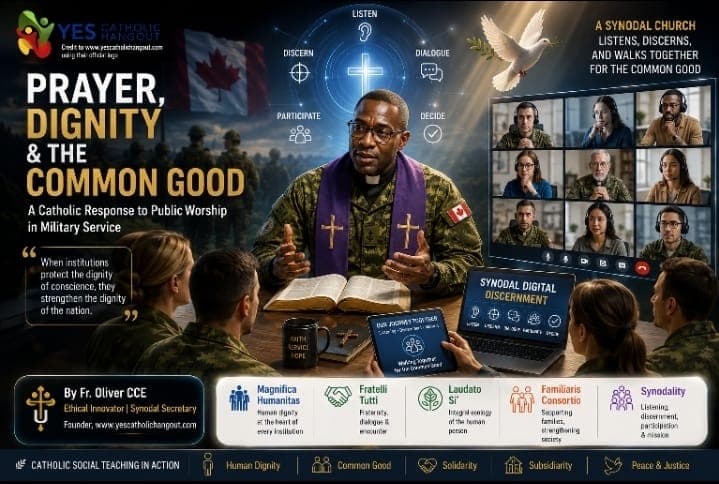
Prayer in public life is not a demand for privilege. It is a question about how a democratic society makes room for conscience, service, and hope.
1. A Question That Deserves Truth Before Outrage
Public prayer can carry a nation’s gratitude, grief, and hope. It can accompany those who serve, remember the dead, and help communities name the moral weight of decisions made in their name. It can also become a source of anxiety when people fear that an official ceremony is asking them to participate in a faith they do not share. Both concerns deserve to be heard.
That is why the public discussion about prayer and spiritual expression in the Canadian Armed Forces should begin with verification, not polarization. Reports and social-media claims have described changes to chaplain-led reflections at official ceremonies, sometimes using the phrase “No prayer allowed.” Other accounts describe a more limited distinction between mandatory public events, voluntary worship, private prayer, and pastoral care. The precise facts require verification through current official policies, responsible reporting, and the testimony of service members and chaplains themselves. No article should turn an unverified online claim into a settled institutional fact.
The question, however, is larger than one country or one directive. Across sectors, institutions are deciding how to express neutrality, include people of different convictions, and protect professional integrity. Military service makes these questions especially urgent. Service members encounter danger, bereavement, moral injury, displacement, family separation, and the burden of decisions that may affect life and peace. A serious public ethic must ask what forms of support preserve their dignity without coercing their conscience.
The Catholic response is therefore neither a slogan for religious dominance nor a quiet acceptance of religious exclusion. It is a call to truth, freedom, responsibility, and the common good.
2. An Exact Response to “No Prayer Allowed”
The phrase “No prayer allowed” is too blunt to guide public policy. If it means that no service member may pray, no chaplain may offer private or pastoral care, or no person may express a faith voluntarily and respectfully, it would raise serious concerns about religious freedom and human dignity. If it means that a mandatory ceremony organized by the state should not require participants to profess a particular creed, the concern is different and can be legitimate. Public institutions have a duty to serve everyone, including those who believe differently and those who do not profess a religion.
The necessary distinction is between institutional neutrality and hostility to religion. Neutrality should prevent the state from imposing belief or conferring unequal status. It should not turn religion into a disfavoured form of conscience, nor assume that a non-religious vocabulary is automatically neutral while religious language is automatically coercive. Nor should chaplaincy become a vehicle for pressure. Worship must remain voluntary; pastoral care must respect the person; and official authority must never be used to compel religious participation.
Four settings should be considered separately. An official ceremony may require an inclusive protocol, particularly when attendance is mandatory. A chaplaincy service exists to provide voluntary, faith-sensitive pastoral care. Personal prayer and religious dress belong to the freedom of the individual, subject to ordinary requirements of safety and professional conduct. Equal access means that diverse religious and non-religious convictions are treated with fairness, while practical arrangements remain clear and accountable.
A wise policy can therefore permit a moment of silence, an inclusive reflection, or multiple forms of contribution at a public event while preserving the chaplain’s ability to pray with people who freely request prayer. It can offer opt-in services, make the character of an event clear, and prevent any single tradition from being presented as the belief of the whole institution. The aim should be participation without coercion, and inclusion without erasure.
3. Five Principles for a Catholic Discernment
Catholic Social Teaching offers a disciplined way to test policy. It begins not with institutional convenience but with the person. Five principles are especially relevant.
Human dignity. Every service member is more than a role, rank, security classification, or operational asset. The dignity of the human person includes the freedom to seek truth, form conscience, worship, refrain from worship, and receive care. Gaudium et Spes teaches that conscience is the most secret core of the person, where one is alone with God. Public authority must respect that interior space even while regulating its own ceremonies.
The common good. The common good is not the comfort of the majority or the absence of visible difference. It is the set of social conditions that allow persons and communities to flourish. A military institution needs trust, discipline, mutual respect, and a credible account of why its rules exist. A policy that protects inclusion can serve the common good; a policy perceived as contempt for faith can weaken it. The test is not whether religious language is present or absent, but whether the arrangement protects the equal dignity and genuine participation of all.
Solidarity. Solidarity asks people to stand with those whose experience they do not share. A believer should be able to defend a non-believer’s freedom not to pray; a non-believer should be able to defend a believer’s freedom to pray voluntarily. Chaplains often work at precisely this boundary, accompanying people in sorrow and uncertainty without reducing them to categories. Solidarity is incompatible with both religious coercion and contempt for religion.
Subsidiarity. Decisions should be made at the most responsible level capable of addressing the matter. A national policy may set safeguards for official ceremonies, but local commanders, chaplaincies, families, and service members may need room to respond to concrete pastoral realities. Subsidiarity does not mean a lack of standards. It means that standards should not eliminate responsible judgment where circumstances differ.
Peace, justice, and religious freedom. Dignitatis Humanae grounds religious freedom in the dignity of the person, not in the state’s approval of a particular belief. Peace requires justice, and justice requires that conscience not be manipulated. Military institutions entrusted with force should be especially attentive to the moral formation and spiritual care of those who serve. This is not a claim that prayer sanctifies every military action. It is an insistence that moral scrutiny and pastoral support belong within a humane account of service.
4. Chaplains as Builders of Fraternity
In Fratelli Tutti, Pope Francis describes fraternity and social friendship as practices that cross boundaries without denying difference. Such fraternity is not sentimental agreement. It is the patient work of recognizing another person as a neighbour, even amid disagreement. Military chaplains can contribute to this work when they accompany people across religious, cultural, and political lines.
The chaplain’s vocation is not exhausted by public words at a ceremony. It includes listening after a traumatic deployment, sitting with a family awaiting news, helping a person name a moral wound, supporting reconciliation after conflict, and accompanying a community in mourning. A chaplain may pray according to a person’s faith when that care is freely sought, while also serving people of other traditions and people without religious belief. The strength of this ministry lies in presence and trust, not in institutional privilege.
Dialogue is stronger than ideological conflict because it can hold two truths together: no one should be compelled to worship, and no one should be treated as suspect simply because prayer is central to their conscience. Accompaniment through sacrifice, peacekeeping, trauma, and reconciliation requires language that is intelligible to the person being served. Sometimes that language will be explicitly religious. Sometimes it will be silence, listening, a practical referral, or a shared commitment to human dignity.
This is why a public debate should not define chaplaincy only by the most visible ceremony. The real question is whether a policy enables chaplains to be professionally accountable and pastorally authentic while ensuring that service members remain free. Fraternity grows when institutions make room for truthful service rather than forcing every conscience into one approved vocabulary.
5. Integral Ecology and the Life of Families
Laudato Si’ widens the meaning of care. Human beings do not flourish in isolation from their relationships, communities, work, and environment. Integral ecology includes the spiritual, emotional, relational, and moral dimensions of life. For service members, these dimensions are not decorative additions to operational readiness. They are part of the conditions in which courage, judgment, resilience, and responsibility are formed.
A person returning from danger may need clinical care, but may also need a trusted listener, a language for guilt, a community of welcome, or the freedom to ask what gives life meaning. A policy that protects professional boundaries and equal access should not make such care harder to find. Nor should it assume that spiritual care can be reduced to a generic formula without loss. A humane institution can offer a broad, inclusive public setting and still protect the depth of voluntary pastoral care.
The same principle applies to military families. Familiaris Consortio speaks of the family as a community of life and love, a “domestic Church” in the Christian understanding. Military families carry the effects of deployment, bereavement, relocation, reintegration, disrupted parenting, and strain within marriage. Chaplains and family-support networks cannot remove these burdens, but they can accompany families through them. They can make room for prayer, sacramental life, grief, practical counsel, and respectful referral according to each family’s convictions.
Strong families strengthen nations not because families are instruments of the state, but because persons first learn belonging, responsibility, forgiveness, and hope in relationships. Public policy should therefore ask whether its approach to chaplaincy supports family stability and moral resilience. This does not prove that every restriction on public religious expression causes harm. It does mean that blanket policies deserve careful assessment of their indirect effects on trust, pastoral access, and the long-term health of communities.
6. Synodality in a Contested Public Square
Synodality offers a practical method for approaching disagreement. It means listening, discerning, participating, and seeking truth together. It does not require the Church to abandon conviction, and it does not require institutions to avoid decisions. It asks whether those affected by a policy have been heard, whether evidence has been tested, and whether disagreement has been handled with respect.
For the Canadian discussion, synodal discernment would include service members, chaplains from different traditions, military families, commanders, legal and human-rights specialists, Indigenous representatives where relevant, and people who hold no religious belief. It would distinguish evidence from interpretation. It would publish the policy language that actually governs a setting, explain the reasons for it, and provide a channel for correction when public summaries are inaccurate.
Respectful disagreement is not a weakness in governance. It is a sign that people understand the stakes. A Catholic contribution should be willing to hear why some participants feel pressured by prayers at mandatory events, while also hearing why a faith-specific chaplain may experience a prohibition on authentic prayer as a wound to vocation and conscience. Neither experience should be dismissed by a label. Truth-seeking requires the patient work of identifying the precise setting, the actual rule, the available exemption, and the remedy when a person’s dignity is compromised.
7. Magnifica Humanitas as a Proposed Lens
The author’s proposal of “Magnifica Humanitas” can serve as a conceptual lens for this conversation. It should not be presented as an official magisterial document or as an established Vatican teaching unless independently established through authoritative sources. As a proposed contribution, the phrase points to a simple conviction: authentic greatness is measured not by technological, political, or military power alone, but by fidelity to human dignity, moral responsibility, compassion, and openness to God.
This lens asks institutions to examine the human meaning of their procedures. Does a rule protect a person’s freedom, or merely simplify administration? Does it create belonging, or only remove visible difference? Does it protect the vulnerable, including those whose faith is unpopular or unfamiliar? Ethical leadership does not confuse cohesion with uniformity. It protects conscience as a source of responsibility and protects institutional trust as a public good.
The same questions apply to every sector making decisions about artificial intelligence, health care, education, policing, security, and work. Systems can become efficient while becoming less humane. “Magnifica Humanitas,” understood as a proposed conceptual contribution, calls for a measure of greatness that remains close to the person. A nation is not diminished by the presence of conscience in public life. It is diminished when people must hide conscience in order to be treated as full members of the community.
8. The Anthropological Theoalgorithm
The “Anthropological Theoalgorithm” is likewise the author’s proposed ethical test, not an established academic or ecclesial term. Its central question is: “Who is the human person this policy is meant to serve?”
The proposal begins with the Catholic conviction that the human person is created in the image of God. Yet the question can also be understood by people who do not share that theological premise. Any responsible policy should be able to identify the person it serves, the vulnerability it addresses, the freedom it protects, and the harm it seeks to prevent. A policy that cannot answer these questions may be administratively clear while ethically underdeveloped.
Applied to public prayer, the test requires several inquiries. Who is affected by a mandatory ceremony? Who needs voluntary pastoral care? Whose conscience could be coerced? Whose faith could be marginalized? What arrangements allow a person to participate without pretending to believe? What evidence will show whether the policy improves inclusion, trust, and wellbeing over time?
This test does not decide every issue in advance. It disciplines the decision-making process. It prevents both religious language and secular language from being treated as automatic solutions. It insists that governance begin with persons rather than abstractions. In an era of ethical decision-making across sectors, such a test can help institutions connect rights, responsibilities, and outcomes with the lived reality of human beings.
9. Sustainable Development and Future Generations
Sustainable development is not only a matter of infrastructure, budgets, or environmental targets. It concerns whether institutions can sustain trust, health, family life, peace, and a moral vocabulary capable of guiding difficult choices. The Sustainable Development Goals are often discussed in technical terms, but durable development also depends on people believing that institutions see them as persons rather than as instruments.
Blanket anti-prayer policies may carry risks when they are experienced as hostility to religion, even if their stated purpose is inclusion. They can contribute to a loss of moral vocabulary, weakened pastoral support, reduced resilience, alienation, and mistrust. These are possible weaknesses to investigate, not universal conclusions to announce. The effects will depend on the exact policy, its implementation, the availability of voluntary services, and the culture surrounding it.
The more careful concern is institutional: if a policy removes a form of care without providing an adequate and inclusive alternative, it may increase isolation. If it silences chaplains in settings where they are expected to accompany grief, it may reduce the credibility of pastoral support. If it treats faith as a problem rather than a dimension of human life, it may damage cooperation with religious communities that contribute to peacebuilding, mental-health support, family stability, and reconciliation.
Intergenerational justice asks what kind of institutions today’s decisions will leave to those who come after us. Young service members and future families will inherit not only rules but habits of trust. They will learn whether disagreement can be handled without humiliation, whether freedom is protected for everyone, and whether public authority can be both neutral and humane. Care for future generations therefore includes care for conscience, community, and the moral imagination needed for peace.
10. A Constructive Policy Pathway
A constructive response can move beyond the binary of “prayer everywhere” and “prayer nowhere.” It can begin with factual transparency. Institutions should publish the current wording of relevant directives, identify where each rule applies, explain the difference between official ceremony and voluntary worship, and correct public misunderstandings without dismissing the concerns that produced them.
Second, consultation should be real and recurring. Chaplaincies, service members, families, commanders, religious communities, Indigenous partners, and people without religious affiliation should be invited to describe the consequences of policy in practice. Consultation is not a veto. It is a way to discover effects that may not be visible from headquarters or from social media.
Third, institutions need religious literacy. Leaders who understand the difference between worship, pastoral care, public ceremony, personal prayer, and cultural observance are better equipped to protect both neutrality and freedom. Religious literacy should include non-religious convictions and the diversity within traditions. It should be joined to training in conscience, trauma-informed care, and respectful disagreement.
Fourth, protocols should make voluntary participation unmistakable. An official ceremony can include an inclusive reflection or moment of silence, while separate opt-in services allow faith communities to worship according to their traditions. Chaplains should be able to use the language appropriate to the person they are serving, subject to professional accountability and the absence of coercion. People who do not wish to participate should never be penalized or shamed.
Fifth, conscience protections and accountability must work together. A chaplain should not be required to misrepresent a religious ministry as something it is not, and a service member should not be required to receive religious ministry. Clear complaint processes, independent review, and periodic evaluation can identify whether a rule is meeting its stated purpose. Metrics should include trust, pastoral access, family support, inclusion, and the experiences of minority and non-religious participants, without reducing human dignity to a score.
Finally, policies should be reviewed in the light of peacebuilding and human flourishing. The question is not only whether a ceremony appears neutral on one day. It is whether the institution is building the conditions in which people can serve responsibly, return with support, sustain family relationships, and participate in reconciliation. A policy that is technically even-handed but practically alienating should be improved. A policy that protects worship but permits pressure should also be improved.
11. The Common Good Requires Room for Conscience
The Catholic tradition does not ask the state to become a church. It asks public authority to remember that the person is prior to the institution and that freedom is not complete when conscience is tolerated only in private. Gaudium et Spes places human dignity at the centre of social life. Dignitatis Humanae defends religious freedom. Fratelli Tutti calls societies toward fraternity and social friendship. Laudato Si’ reminds us that integral care includes the human interior and relational world. Familiaris Consortio highlights the family’s role in forming persons and sustaining communities. These teachings converge in a practical claim: the common good is served when institutions protect the person in the fullness of life.
For governments and military leaders, this means resisting both coercion and reductionism. For chaplains, it means serving without seeking power and speaking with integrity. For faith communities, it means defending freedom for neighbours, not only for themselves. For civil society, it means replacing viral certainty with patient verification and making space for responsible disagreement.
Prayer should not become a weapon of division. Nor should it become a casualty of a false choice between neutrality and conscience. The public task is to build arrangements in which no one is compelled to pray, no one is excluded because they pray, and everyone can receive humane support in moments of fear, grief, moral struggle, and hope.
12. Editorial Note on Sources and Terminology
This article relies on authoritative Church teaching and on the need for verified public information. The Canadian military-prayer discussion is treated as a case study in public discernment, not as settled fact. Reports, online claims, and summaries should be checked against current official policies and responsible reporting before being used to establish what an institution has decided or what a person has said.
“Magnifica Humanitas” and “Anthropological Theoalgorithm” are presented here as conceptual language in the author’s proposal. They are not identified as official magisterial documents, established Vatican terms, or settled academic categories. The Church documents named below are the authoritative reference points for the Catholic principles discussed in this article.
13. Selected References
Second Vatican Council, Dignitatis Humanae: Declaration on Religious Freedom, 1965. Vatican website: vatican.va/archive/hist_councils/ii_vatican_council/documents/vat-ii_decl_19651207_dignitatis-humanae_en.html
Second Vatican Council, Gaudium et Spes: Pastoral Constitution on the Church in the Modern World, 1965. Vatican website: vatican.va/archive/hist_councils/ii_vatican_council/documents/vat-ii_const_19651207_gaudium-et-spes_en.html
Pope Francis, Fratelli Tutti: On Fraternity and Social Friendship, 2020. Vatican website: vatican.va/content/francesco/en/encyclicals/documents/papa-francesco_20201003_enciclica-fratelli-tutti.html
Pope Francis, Laudato Si’: On Care for Our Common Home, 2015. Vatican website: vatican.va/content/francesco/en/encyclicals/documents/papa-francesco_20150524_enciclica-laudato-si.html
Pope John Paul II, Familiaris Consortio: The Role of the Christian Family in the Modern World, 1981. Vatican website: vatican.va/content/john-paul-ii/en/apost_exhortations/documents/hf_jp-ii_exh_19811122_familiaris-consortio.html
Catechism of the Catholic Church, especially paragraphs 1776-1802 on conscience and 2104-2109 on religious freedom. Vatican website: vatican.va/archive/ENG0015/_INDEX.HTM
Government of Canada and Canadian Armed Forces materials concerning chaplaincy, public ceremonies, and spiritual care should be consulted in their current official form. Public discussion and secondary reporting should not substitute for the governing text.
When institutions protect the dignity of conscience, they strengthen the dignity of the nation. Prayer should never become a weapon of division nor a casualty of polarization. It should remain a witness to hope, service, reconciliation, and peace.