
Open Letter to His Excellency, the President of the Federal Republic of Nigeria
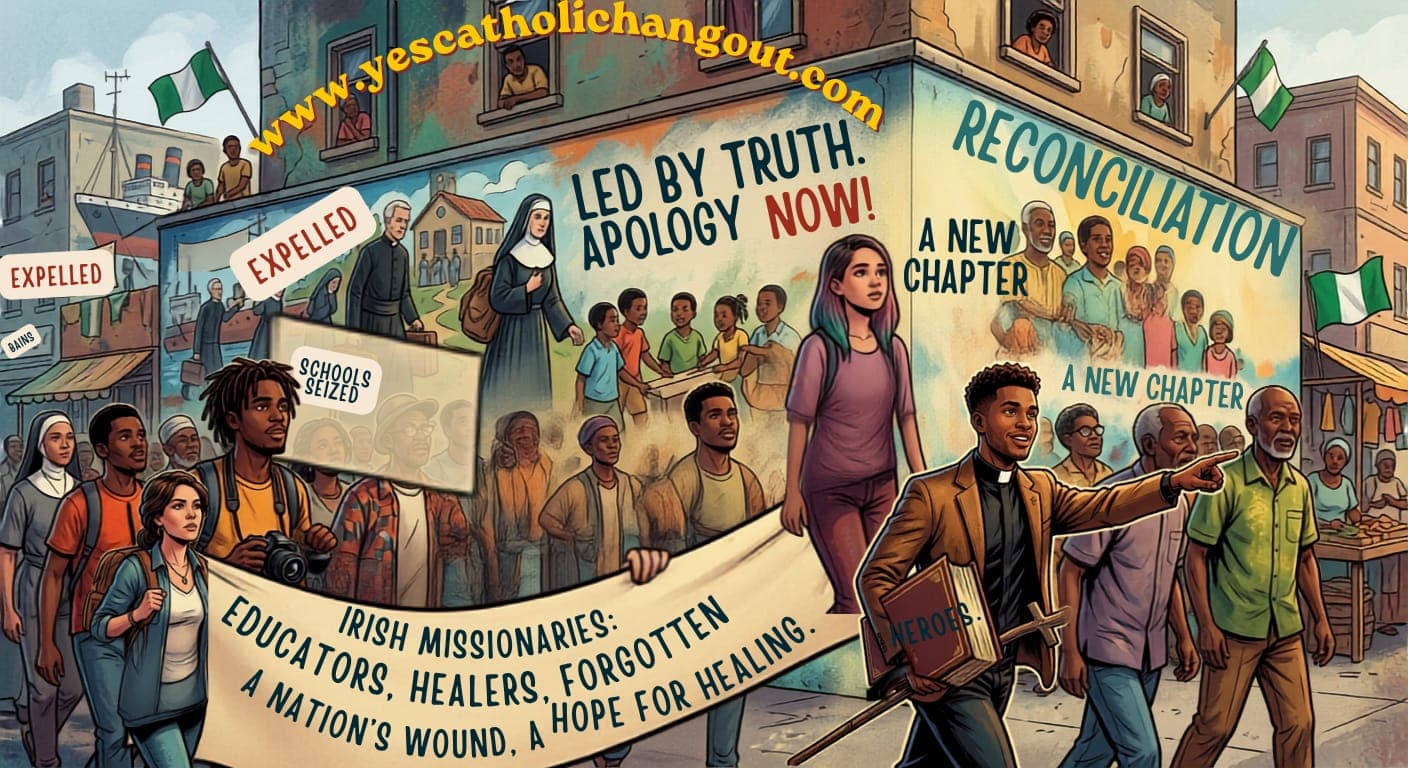
An Appeal for a National Apology to Expatriate Missionary Heroes — A Lesson from Pope Leo XIV’s Magnifica Humanitas
Your Excellency,
Warm greetings in the spirit of justice, truth, and national healing.
I am Fr. Oliver CCE, an ethical Artificial Intelligence Generalist, a missionary priest of the Emmanuelites Community, serving in the Archdiocese of Halifax-Yarmouth, and the founder of Yes Catholic Hangout. I write to you today not as a foreign critic, but as a devoted son of the Church and an enduring friend of Nigeria’s soul. This letter is born of a story my father told me, a story of extraordinary generosity met with a profound rupture of trust, and it is a story that Nigeria, in its maturity, must finally confront.
I. The Prophetic Moment: Pope Leo XIV and Magnifica Humanitas
On 25 May 2026, His Holiness Pope Leo XIV released his inaugural encyclical, Magnifica Humanitas, a sweeping manifesto on safeguarding the human person in the age of artificial intelligence. Within that document, the Holy Father offered a historic and unprecedented apology for the Catholic Church’s role in legitimizing the transatlantic slave trade. He wrote:
“It is impossible not to feel deep sorrow when contemplating the immense suffering and humiliation endured by so many in stark contrast to their immeasurable dignity as persons infinitely loved by the Lord. For this, in the name of the Church, I sincerely ask for pardon.”
No previous pontiff had ever publicly acknowledged, much less apologized for, the role that past popes played in granting European sovereigns explicit authority to subjugate and enslave entire peoples. That singular act of humble penitence has echoed across the world. It compels all institutions, secular and sacred alike, to revisit their own histories with transparency, recognizing that true strength lies in the admission of historical fault.
Your Excellency, Nigeria has its own unresolved history to address.
II. The Expatriate Missionaries: A Legacy of Selfless Service
The story of expatriate Catholic missionaries in Nigeria, predominantly Irish but encompassing men and women from across Europe and beyond, is one of the most remarkable chapters of selfless devotion in modern African history. Beginning in the late nineteenth century, members of the Holy Ghost Fathers (Spiritans), the St. Patrick’s Missionary Society (Kiltegan Fathers), and numerous orders of religious sisters crossed the Atlantic with an unshakeable commitment to the people of Nigeria.
By the mid-twentieth century, their contribution had become foundational to Nigerian society. Of Nigeria’s 800 Catholic priests, 500 were Irish expatriates. They built and operated 2,419 primary schools serving 561,318 Nigerian pupils and 47 hospitals serving 714,441 Nigerian patients. Their foundational work contributed to Nigeria becoming home to 29 million Catholics today.
These men and women were not agents of the colonial state. They were educators, healers, and spiritual parents. They learned local languages, adopted local customs, and poured their lives into a land they loved. Many arrived young and never returned home. They died on Nigerian soil, buried among the people they served, because they became Nigerian in every way that truly mattered.
III. The Rupture: Deportation and Expropriation
At the close of the Nigerian Civil War in January 1970, the Federal Military Government initiated the deportation of hundreds of expatriate missionaries. This included approximately 300 Irish Spiritans, alongside British, Dutch, and other foreign religious personnel whose passports bore the stamp of the secessionist enclave.
These missionaries had remained with their flocks through the horrors of war, facilitating humanitarian relief, food, and medical supplies to a starving civilian population. For their commitment to preserving human life amidst a catastrophic conflict, they were treated as political adversaries. They were detained, charged with illegal entry, and summarily deported from the country they had helped build.
The rupture was compounded shortly thereafter. Beginning with the Public Education Edict of 1970 in the East Central State, and culminating in a nationwide policy by the mid-1970s, the government systematically seized mission schools and placed them under state control.
This was not merely a shift in administrative policy. It was a profound severance of a vital social partnership. The deportation of the missionaries and the expropriation of their institutions were driven by the political anxieties of a fractured post-war state, rather than by gratitude for decades of foundational service.
IV. The Consequence: A Nation’s Educational Crisis
Today, the consequences of that rupture are visible across Nigeria. The educational system that the missionaries built with such care has deteriorated into a state of severe crisis. Millions of children remain out of school, deprived of quality learning. Primary school completion rates hover at 59 percent for boys and 51 percent for girls. Over 2 million children have been displaced from schools in the northeast alone due to ongoing insecurity. The moral fabric of society strains under the weight of corruption, banditry, and a profound deficit of ethical leadership.
One must ask the difficult question: did the abrupt deportation of those missionary educators, and the state seizure of the institutions they built, create a moral and structural vacuum that bureaucratic administration has been unable to fill?
V. The Appeal: A Call for Diplomatic and Moral Courage
In the spirit of Magnifica Humanitas, which reminds us that peace is the active presence of justice, solidarity, truth, and authentic human relationships, I respectfully and earnestly appeal to you, Mr. President.
Follow the courageous example of Pope Leo XIV. Issue a formal state apology to the expatriate missionary families, to their respective societies, and to the Catholic Church in Nigeria.
Acknowledge that the post-war government, acting in the heat of political consolidation, dealt unjustly with those whose primary allegiance was to human dignity and the Gospel. Acknowledge that the seizure of their schools severed a lifeline of moral and academic excellence that generations of Nigerian children depended upon.
Such an apology would not diminish the sovereignty of Nigeria. It would profoundly elevate it. It would signal to the international community that your administration respects historical truth over political convenience, honors humanitarian sacrifice even when offered in complex political contexts, possesses the diplomatic maturity to say we erred, and embraces reconciliation as the indispensable foundation for national renewal.
VI. A Vision for the Future
Let us invite the spirit of healing into our national discourse. Let Nigeria become a model for Africa, a nation that apologizes not out of weakness, but out of immense moral courage. Let this apology become the seed of a renewed partnership between the Nigerian State and the global Catholic community, one that can help rebuild our schools, restore our hospitals, and renew the ethical foundations of our society.
As Magnifica Humanitas declares: “The future does not belong to weapons, domination, or technological control. The future belongs to fraternity, dialogue, ethical innovation, and the flourishing of every human person from conception to natural death.”
Your Excellency, the Sacred Heart of Jesus is an inexhaustible fountain of mercy. May Nigeria draw deeply from that fountain as we navigate the complexities of our time, remaining faithful to our shared humanity while adapting courageously to the future.
Adaptation: Faithful to the Message, Flexible in the Method.
With profound respect and enduring hope,
Fr. Oliver CCE
Ethical AI Generalist and Missionary Priest
Emmanuelites Community — www.emmanuelites.org
Archdiocese of Halifax-Yarmouth
Founder: www.yescatholichangout.com
“The past does not die when we ignore it. It dies when we make peace with it.”
On the Feast of the Immaculate Heart of Mary.
Appendix: About Magnifica Humanitas
Magnifica Humanitas is a Vatican-inspired Ethical AI mission dedicated to serving human dignity, integral development, synodality, and relational evangelization in the Digital Economy. Rooted in the Gospel, Catholic Social Teaching, Laudato Si’, Fratelli Tutti, Ecclesia in Africa, and the vision of a listening Church, it seeks to bridge Gen X wisdom and Gen Z digital creativity through ethical technology.
Magnifica Humanitas recognizes war as one of humanity’s greatest moral failures. Every war represents a rupture of fraternity, a wound against human dignity, and a rejection of our shared vocation as one human family. In the age of artificial intelligence, digital manipulation, autonomous systems, economic exploitation, and ideological polarization, humanity must reject the normalization of conflict and embrace a culture of encounter.
We affirm that there is no truly just war in a world capable of dialogue, cooperation, and synodal discernment. Every war is a sin against magnificent humanity because it destroys lives, families, cultures, ecosystems, and future generations. Peace is not merely the absence of violence; it is the presence of justice, solidarity, truth, mercy, and authentic human relationships.
Magnifica Humanitas proposes five pathways forward.
Synodal Listening creates digital and physical spaces where people, communities, nations, and generations listen before judging. Relational Evangelization replaces algorithmic isolation with authentic accompaniment, mentorship, catechesis, and community building. Ethical AI Governance ensures transparency, accountability, human oversight, and protection of human dignity in all digital systems. Integral Human Development directs technological innovation toward education, healthcare, environmental stewardship, poverty reduction, and dignified work. Digital Missionary Formation equips young people and adults with skills in technology, data, entrepreneurship, and evangelization to become builders of peace.
Magnifica Humanitas serves as a bridge between faith and innovation, ensuring that technology remains a servant of humanity rather than its master. Through human-AI collaboration, transparent governance, and community participation, it seeks to transform digital spaces into places of encounter, healing, learning, and conversion. This mission supports Yes Catholic Hangout, the Economy of Francesco movement, synodal engagement, and a global ethical technology ecosystem where every person is welcomed, valued, heard, and empowered.
Join the movement for Ethical Technology, Synodality, and Integral Human Development at www.yescatholichangout.com.