
Nigeria Urged to Embrace ‘Moral Renewal’ in Open Appeal to President Tinubu
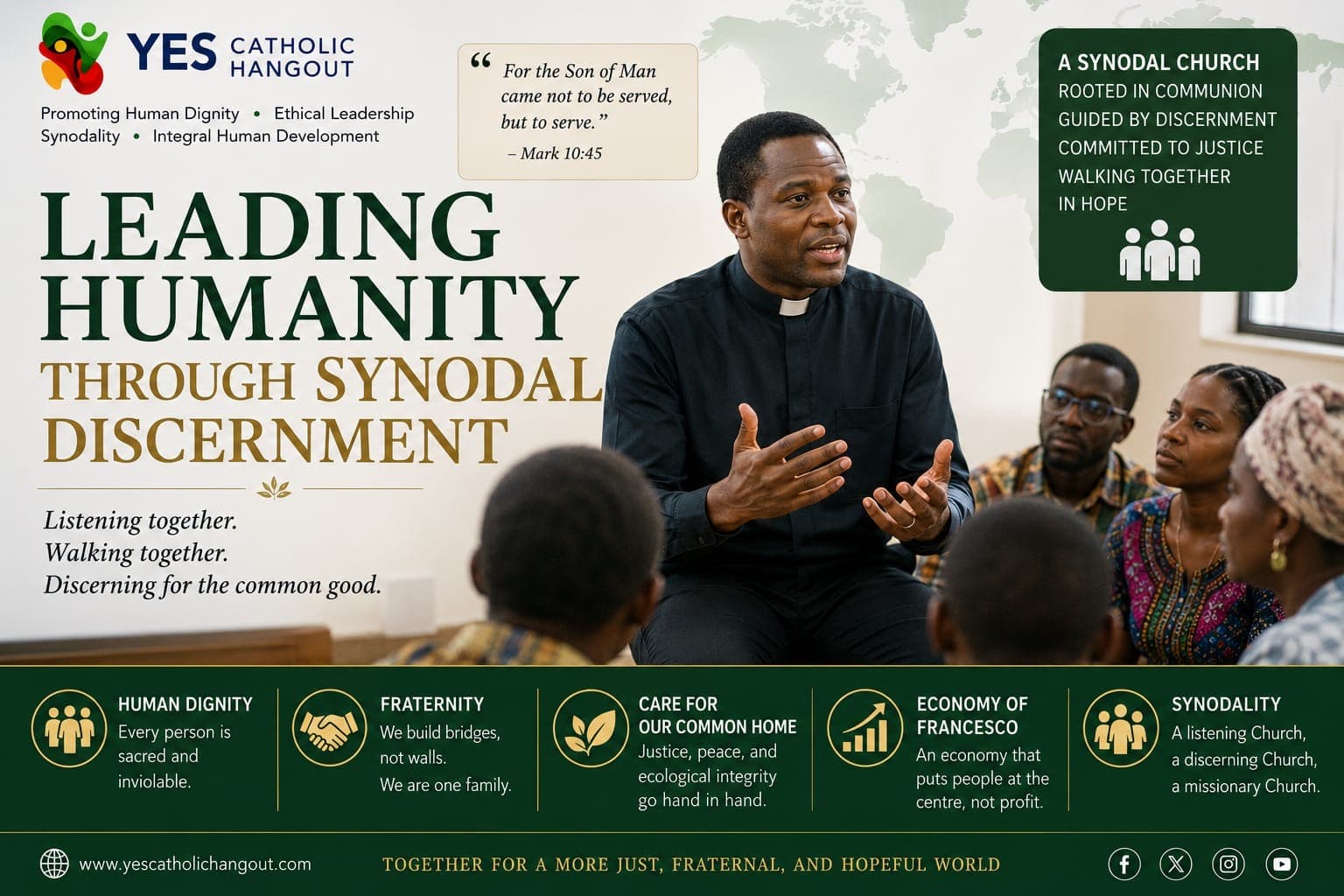
By Fr. Oliver CCE | Ethical Innovator | Synodal Secretary | Founder, www.yescatholichangout.com
A Call to Conscience for a Nation at a Defining Moment
At a decisive moment in Nigeria’s democratic journey, the Yes Catholic Hangout community has issued an open appeal to President Bola Ahmed Tinubu, inviting the nation’s leadership to embrace what it describes as a path of “moral renewal” rooted in justice, reconciliation, ethical governance, and authentic service to the common good.
Rather than advancing partisan political arguments, the appeal presents a vision inspired by Catholic Social Teaching, proposing that the long-term stability of Nigeria depends not only on economic reforms, institutional restructuring, or technological advancement, but also upon the moral character that guides public leadership. It is an invitation to place human dignity at the heart of governance and to build institutions capable of serving every Nigerian with justice, transparency, and compassion.
Authored by Fr. Oliver CCE, Ethical Innovator, Synodal Secretary, and Founder of www.yescatholichangout.com, the letter reflects the Church’s longstanding understanding that politics, at its best, is a noble vocation dedicated to promoting the common good. It draws inspiration from the principles of Magnifica Humanitas, Fratelli Tutti, Laudato Si’, the Economy of Francesco, and the Synodal vision of a Church, and by extension a society, that listens, discerns, and walks together.
The appeal argues that Nigeria possesses extraordinary human and natural resources, remarkable entrepreneurial energy, and vibrant religious traditions. Yet these gifts can flourish fully only when accompanied by institutions rooted in justice and leaders animated by ethical responsibility.
“Leadership reaches its fullest expression when it seeks justice with humility, governs with integrity, and promotes the flourishing of every citizen,” Fr. Oliver writes.
The document therefore presents four carefully considered moral requests intended not as political demands but as constructive proposals for national renewal.
Four Pillars for National Reconciliation
1. A National Apology to the Irish Missionaries
The first proposal invites the Federal Government to consider a formal national apology acknowledging the sacrifices and historic contributions of Irish missionaries who helped shape modern Nigeria through education, healthcare, evangelisation, and community development.
For generations, missionaries travelled far from their homeland to establish schools that educated future leaders, hospitals that cared for the sick, seminaries that formed clergy, and social institutions that strengthened communities across the country.
Their work extended beyond religious ministry. They contributed significantly to literacy, public health, social cohesion, and nation-building, often serving in difficult conditions with remarkable dedication.
The appeal recognises that history also records moments of misunderstanding, hostility, violence, and injustice experienced by some missionaries. While history cannot be rewritten, it can be honestly acknowledged.
Fr. Oliver argues that a national apology should never be interpreted as an admission of perpetual national failure but rather as an expression of moral confidence.
“A mature nation,” he writes, “is not weakened by acknowledging historical wounds. Rather, it demonstrates the courage to transform memory into reconciliation.”
Around the world, official apologies have often become important milestones in healing fractured relationships. They preserve historical truth while opening new paths of friendship. Within the Christian tradition, reconciliation is never merely sentimental. It is an ethical commitment that restores relationships through truth, humility, forgiveness, and renewed trust.
Such an initiative, the appeal suggests, would honour not only Irish missionaries but all those whose selfless service contributed to Nigeria’s social and spiritual development.
2. Justice Through National Reparation
The second pillar argues that reconciliation requires more than symbolic words. Apologies acquire greater meaning when accompanied by practical initiatives that preserve historical memory and educate future generations.
Fr. Oliver therefore proposes a carefully designed programme of national reparation, not primarily financial compensation, but moral restoration rooted in remembrance, education, historical preservation, and civic formation.
The proposal includes the preservation of missionary archives, historical documentation, educational programmes, interfaith commemorations, scholarly research, and national memorial initiatives that honour those whose sacrifices helped build Nigeria.
Such efforts would enable future generations to understand the nation’s history honestly, appreciating both its achievements and its failures.
Catholic Social Teaching consistently emphasises restorative justice over revenge. Justice seeks not simply punishment but restoration. Communities become stronger when they learn from history rather than erase it.
The appeal argues that preserving historical truth encourages reconciliation because it prevents the repetition of past mistakes while inspiring greater national solidarity. Rather than dividing society, historical remembrance can become a source of unity when approached with humility and respect.
In this way, national reparation becomes an investment in Nigeria’s moral memory.
3. Ethical Technology and the Future of Nigerian Democracy
The third proposal addresses one of the defining questions of contemporary governance: how digital technology should serve democracy.
Recognising the increasing importance of technology in public administration, the appeal advocates for the ethical implementation of a secure Electronic Permanent Voter Card (E-PVC) system capable of strengthening electoral credibility and public confidence.
Fr. Oliver observes that technology itself possesses no inherent moral direction. Artificial intelligence, digital identity systems, and electoral technologies become beneficial only when designed around the dignity of the human person.
“Technology is never morally neutral,” the document notes. Its moral value depends entirely upon whether it protects human dignity, promotes justice, safeguards transparency, and strengthens public trust.
The proposed E-PVC system is therefore presented not merely as a technological innovation but as an ethical instrument. If implemented transparently, inclusively, and securely, it could improve electoral participation, reduce administrative inefficiencies, strengthen voter confidence, and reinforce democratic legitimacy.
The proposal also stresses that digital innovation must remain accountable to ethical principles. Privacy protections, cybersecurity safeguards, accessibility for vulnerable populations, and transparency in implementation are essential conditions for success. Technology should never become a mechanism for exclusion, surveillance, or manipulation. Rather, it should expand democratic participation while respecting the fundamental rights of every citizen.
Drawing upon emerging Catholic reflection on artificial intelligence and digital ethics, the appeal argues that innovation should always remain subordinate to humanity rather than humanity becoming subordinate to technology.
4. Constitutional Autonomy and the Principle of Subsidiarity
The fourth pillar focuses upon strengthening governance through greater constitutional autonomy for state and local governments.
Central to this proposal is the Catholic principle of subsidiarity, which teaches that decisions should ordinarily be made at the lowest competent level closest to those directly affected. Subsidiarity recognises that local communities often possess the knowledge, relationships, and practical understanding necessary to address their own needs more effectively than distant bureaucratic structures.
Empowering local governments within constitutional limits therefore strengthens democratic participation rather than weakening national unity.
Fr. Oliver argues that meaningful autonomy must always be accompanied by accountability, transparency, prudent financial management, and effective public oversight. Autonomy without accountability merely decentralises inefficiency. But autonomy combined with responsibility can stimulate community development, improve healthcare, strengthen education, expand infrastructure, encourage local entrepreneurship, and increase public confidence in government.
The proposal sees constitutional autonomy not as a political concession but as an ethical commitment to human participation. When citizens experience government close to their communities, democratic institutions become more responsive and more trusted.
The principle ultimately reflects a profound respect for human dignity by recognising that people should actively participate in shaping the decisions affecting their own lives.
A Politics of Hope Rather Than Division
Beyond these four proposals lies a broader vision. The appeal invites Nigeria to rediscover politics as a vocation of service rather than competition for power. It encourages leaders across political parties, religious traditions, and civil society to embrace dialogue over hostility, collaboration over polarization, and ethical responsibility over partisan advantage.
This vision resonates strongly with Pope Francis’ call in Fratelli Tutti for a politics rooted in social friendship and the common good. Politics becomes noble whenever it seeks to unite rather than divide.
Similarly, the principles of Laudato Si’ remind political leaders that social ecology cannot flourish where institutions are weakened by injustice or corruption. Healthy societies require healthy institutions grounded in trust.
The Economy of Francesco likewise proposes economic and political systems centred upon persons rather than abstract structures. Magnifica Humanitas extends these principles into the age of artificial intelligence by insisting that technological and political development alike must always safeguard human dignity.
Together, these frameworks provide a coherent ethical vision capable of guiding public leadership within an increasingly complex world.
Nigeria’s Opportunity Before History
The open appeal concludes by observing that every generation receives defining historical opportunities. For Nigeria, the present moment represents one such opportunity.
Economic reforms, constitutional reforms, technological innovation, and democratic strengthening remain important. Yet none of these alone can secure lasting national renewal. Institutions ultimately reflect the moral imagination of those who lead them.
Consequently, the appeal respectfully invites President Bola Ahmed Tinubu to consider these four proposals as opportunities to shape a legacy extending beyond political achievements. History often remembers leaders less for the offices they held than for the moral courage they demonstrated.
The measure of leadership is not merely administrative competence but the ability to heal divisions, strengthen justice, inspire trust, and leave institutions more humane than they were inherited.
Fr. Oliver therefore concludes with a hopeful appeal grounded in both faith and civic responsibility.
“Nigeria’s future will be secured not only by stronger institutions but by stronger consciences. Nations flourish when leaders possess the courage to reconcile history, renew democracy, empower communities, and place the dignity of every human person at the centre of public life.”
In an era increasingly marked by technological transformation, democratic uncertainty, and global polarization, this vision of ethical politics offers more than a national conversation. It contributes to a wider global reflection on how leadership can be renewed through conscience, dialogue, subsidiarity, justice, and solidarity.
Ultimately, the Yes Catholic Hangout initiative reminds both leaders and citizens that authentic development begins with moral responsibility. For the greatest monuments of leadership are not built from concrete or steel, but from justice remembered, reconciliation embraced, democracy strengthened, institutions renewed, and communities empowered.
Such leadership does more than govern a nation. It shapes history, inspires hope, and becomes an enduring gift to future generations.