
Magnifica Humanitas: A Vatican-Inspired Ethical AI Mission for Human Dignity, Synodality, and Peace
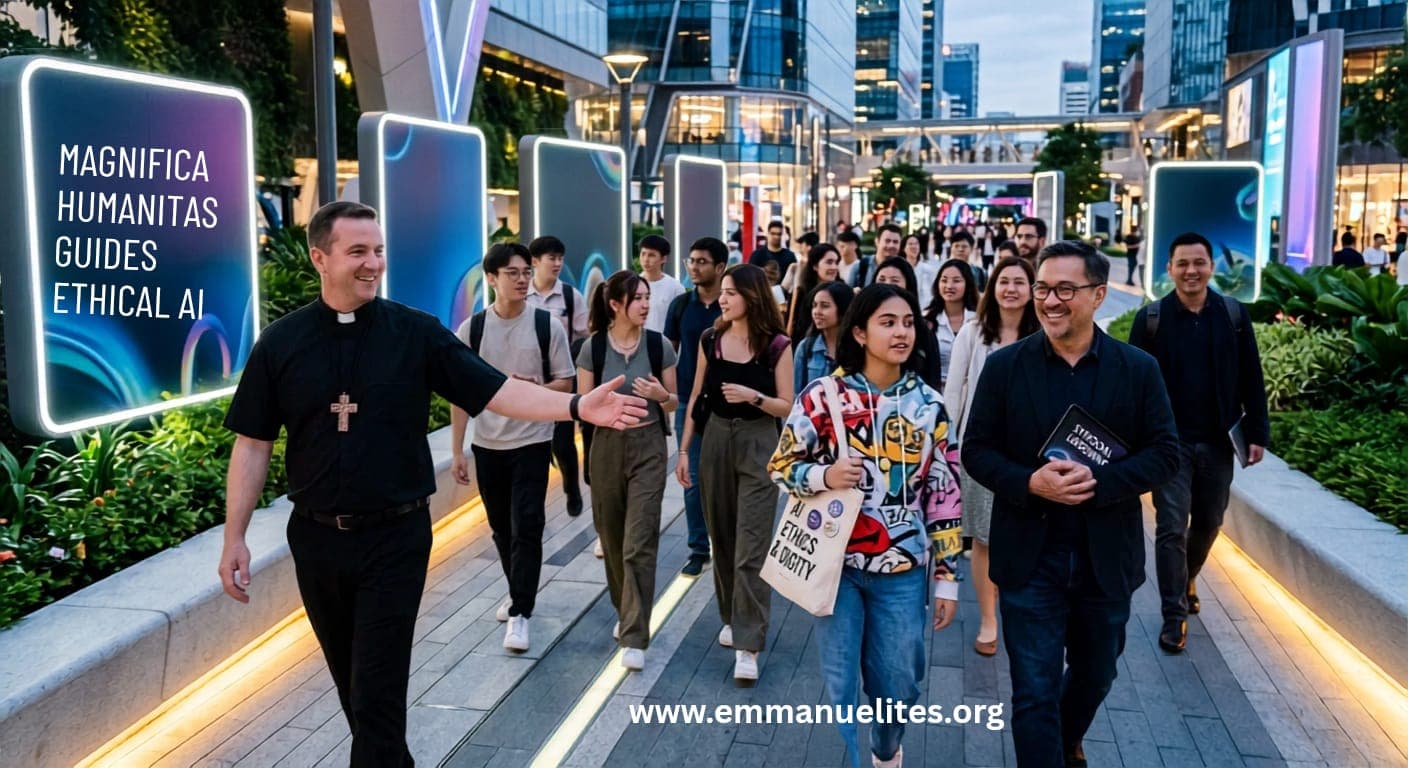
Executive Summary
Magnifica Humanitas is a Vatican-inspired ethical AI mission dedicated to serving human dignity, integral development, synodality, relational evangelization, and peace within the digital economy. Rooted in the Gospel and in the moral vision of Catholic social teaching, it seeks to ensure that artificial intelligence and digital innovation remain servants of humanity rather than instruments of domination, exclusion, manipulation, or war.
The mission draws inspiration from the Church's enduring concern for peace, the dignity of the human person, the care of creation, fraternity, and the integral development of peoples. Pacem in Terris teaches that peace must be established in truth, justice, charity, and liberty. Laudato Si' calls humanity to care for our common home. Fratelli Tutti renews the call to fraternity and social friendship. Antiqua et Nova emphasizes that AI must uphold human dignity and promote integral human development.
Magnifica Humanitas therefore proposes a missionary and ethical framework in which technology becomes a tool of encounter, healing, learning, participation, and peace. It bridges Gen X wisdom and Gen Z digital creativity, connecting pastoral experience, entrepreneurial courage, and technical skill for the service of the common good.
Mission Statement
Magnifica Humanitas exists to transform artificial intelligence and digital technology into instruments of human dignity, synodal listening, integral development, relational evangelization, and peace. It affirms that the human person is never a data point, never a consumer unit, never a replaceable worker, and never a target in a system of conflict. Every person is a bearer of dignity, called to communion, creativity, responsibility, and love.
This mission recognizes that the digital economy can either deepen fragmentation or become a new field of fraternity. It can isolate people through algorithmic manipulation, or it can help communities listen, learn, collaborate, and serve. Magnifica Humanitas chooses the second path: the conversion of digital power into a human-centered, Gospel-shaped, ethically governed culture of encounter.
The Principle of Adaptation
Adaptation is the missionary discipline through which the Church learns the languages, tools, and habits of the digital age without surrendering the Gospel it proclaims. It means that methods may change, platforms may change, and technologies may change, but the core message of human dignity, truth, mercy, justice, and communion must not change.
Adaptation is not compromise. It is missionary fidelity expressed through new methods.
In the spirit of Magnifica Humanitas, adaptation means simplifying technology so that it can be used by all, especially those who are excluded by age, poverty, disability, geography, education, or lack of digital access. Technology must not become a gatekeeping language understood only by experts. It must become a bridge through which people can participate more fully in ecclesial life, education, work, community, and peacebuilding.
Six dimensions define what adaptation means in practice. The faithful message means the Gospel, human dignity, moral truth, and the call to communion remain unchanged regardless of the platform or medium. The flexible method means tools, platforms, pedagogies, and digital formats evolve to meet people where they are. Human-centered simplicity means complex systems are translated into accessible tools for ordinary people and vulnerable communities. The intergenerational bridge means Gen X wisdom, pastoral memory, and institutional experience meet Gen Z creativity, digital fluency, and entrepreneurial energy. Missionary presence means the Church enters digital spaces not to dominate attention, but to accompany, listen, teach, and heal. And ethical governance means every adaptation must be tested against the principles of transparency, accountability, inclusion, and human dignity.
A Prophetic Commitment to Peace
Magnifica Humanitas rejects the normalization of war and treats war as a profound moral failure: a rupture of fraternity, a wound against human dignity, a destruction of families and cultures, and a betrayal of our shared vocation as one human family. In an age of autonomous systems, cyber conflict, disinformation, digital surveillance, economic exploitation, and ideological polarization, peace cannot be treated as an abstract ideal. It must become a practical architecture of technology, education, governance, and community life.
The mission therefore affirms that humanity must move beyond the logic of domination. Digital systems must not be designed to manipulate fear, amplify hatred, automate violence, or reduce persons to strategic objects. AI must be governed by transparency, accountability, human oversight, and a preferential concern for those most at risk of harm. This is consistent with the Church's insistence that scientific and technological advances be ordered toward the human person and the common good.
Peace is not merely the absence of violence. It is the presence of truth, justice, solidarity, mercy, ecological responsibility, and authentic human relationships. It requires a digital culture in which people are formed not as isolated users, but as neighbors, disciples, citizens, builders, and peacemakers.
Five Pathways of Magnifica Humanitas
Magnifica Humanitas proposes five pathways for transforming technology into a servant of fraternity and peace. These pathways are not isolated programs. They are mutually reinforcing practices that can guide parishes, schools, universities, dioceses, startups, youth movements, social enterprises, and digital ministries.
The first pathway is Synodal Listening. Its core purpose is to create digital and physical spaces where people, communities, nations, and generations listen before judging. In practice this means listening forums, intergenerational dialogues, parish digital consultations, youth assemblies, and community feedback systems.
The second pathway is Relational Evangelization. Its core purpose is to replace algorithmic isolation with authentic accompaniment, mentorship, catechesis, and community building. In practice this means digital small groups, mentorship networks, online catechesis, pastoral care channels, and community-based evangelization.
The third pathway is Ethical AI Governance. Its core purpose is to ensure transparency, accountability, human oversight, and protection of human dignity in digital systems. In practice this means AI ethics policies, human review standards, data protection practices, bias audits, and technology impact assessments.
The fourth pathway is Integral Human Development. Its core purpose is to direct innovation toward education, healthcare, environmental stewardship, poverty reduction, dignified work, and shared flourishing. In practice this means skills training, social entrepreneurship, digital access initiatives, climate action tools, and inclusive economic projects.
The fifth pathway is Digital Missionary Formation. Its core purpose is to equip young people and adults with skills in technology, data, entrepreneurship, communication, and evangelization. In practice this means training academies, AI literacy workshops, Catholic innovation labs, entrepreneurship formation, and peacebuilding curricula.
The synodal dimension of this mission reflects the Church's broader commitment to participation, discernment, and implementation in the life of the People of God. The African ecclesial inspiration of the mission also resonates with Ecclesia in Africa, which emphasized evangelization, justice, peace, dialogue, inculturation, and social communication as urgent dimensions of mission.
Relationship to Yes Catholic Hangout and the Economy of Francesco
Magnifica Humanitas supports Yes Catholic Hangout as a living space for relational evangelization, digital formation, and Catholic community building. It also aligns naturally with the spirit of the Economy of Francesco, which describes itself as an international movement of young economists, entrepreneurs, and change-makers working toward an economy that leaves no one behind.
In this sense, Magnifica Humanitas is not merely a technology project. It is an ecosystem of formation, governance, entrepreneurship, and pastoral imagination. It asks whether AI can help build an economy of life rather than an economy of exclusion; an economy of fraternity rather than an economy of conflict; and an economy of peace rather than an economy of domination.
Core Convictions
Six convictions anchor everything Magnifica Humanitas does and proposes.
The human person is sacred. No technology may reduce a person to data, profit, productivity, ideology, or military utility. The person is always more than the system that seeks to define them.
Technology must serve communion. Digital tools should strengthen relationships, not replace them. A platform that isolates people while appearing to connect them has already failed its most important test.
AI requires moral governance. Innovation without accountability risks becoming a mechanism of harm. The speed of development does not exempt systems from the demands of justice and transparency.
Peace is a digital responsibility. Platforms, algorithms, and AI systems must not normalize hatred, manipulation, or violence. The architecture of digital culture shapes the conscience of society.
The poor and excluded come first. Digital transformation must prioritize those most vulnerable to exclusion or exploitation. An innovation that benefits only those already ahead is not progress; it is a widening of injustice.
The Church must adapt without losing herself. The mission remains timeless, but methods must be renewed for each generation. Fidelity and creativity are not opposites; they are companions in missionary life.
One-Line Formula
Magnifica Humanitas: Faithful to the Message, Flexible in the Method — Turning Technology into a Servant of Human Dignity, Fraternity, and Peace.
Short Public Version
Magnifica Humanitas is a Vatican-inspired ethical AI mission bridging faith and digital innovation. Rooted in the Gospel and Catholic social teaching, it champions human dignity, synodality, relational evangelization, integral development, and peace. Through five pathways of listening, accompaniment, ethical governance, integral development, and digital formation, it seeks to transform technology into a servant of fraternity rather than a tool of domination. Its guiding principle is Adaptation: Faithful to the Message, Flexible in the Method.
Call to Action
The future does not belong to weapons, domination, or technological control. The future belongs to fraternity, dialogue, ethical innovation, and the flourishing of every human person from conception to natural death. Magnifica Humanitas invites Catholics, technologists, educators, entrepreneurs, pastoral leaders, families, and young people to build digital spaces where every person is welcomed, valued, heard, protected, and empowered.
Join the movement for Ethical Technology, Synodality, and Integral Human Development at Yes Catholic Hangout: www.yescatholichangout.com