
From Fragmented Algorithms to Providential Flourishing: A Synodal Path to Digital Abundance
A young university graduate reviews a job application that has already been evaluated by artificial intelligence before it reaches human consideration. A notification appears: "Your profile was not selected." The question that follows is no longer merely professional. It is deeply personal. If an algorithm can measure my skills, can it also measure my vocation?
This quiet anxiety has become one of the defining experiences of our age. Across the world, employers report talent shortages while millions of capable young people struggle to secure meaningful employment. Artificial intelligence promises unprecedented productivity, yet many fear becoming increasingly invisible within systems designed primarily for efficiency rather than human connection. Communities experience growing fragmentation. Generations often navigate distinct digital cultures. Technology advances at extraordinary speed while ethical reflection and collective wisdom struggle to keep pace.
Yet for people of faith, periods of disruption are not necessarily signs of divine absence. They can become opportunities for providential discernment and renewal. History reminds us that God often works through seasons of uncertainty to prepare humanity for deeper transformation. What appears to be disorder may become an invitation to pursue a more faithful and responsible future.
The present digital transition calls for precisely such discernment. Rather than asking whether artificial intelligence will replace humanity, perhaps the more important question is whether humanity will remain faithful to its vocation and remember what it was created to become.
A Moral Choice at the Heart of Every Revolution
Every technological revolution presents a moral choice. We may design systems that concentrate power, intensify inequality, and reduce persons to data points. Or we may develop technologies that expand participation, strengthen communities, and uphold the dignity of every human person. The responsibility remains profoundly human.
This is why digital supremacy requires a renewed definition. Too often, supremacy is measured by processing speed, market dominance, computational capacity, or geopolitical influence. Such measures remain incomplete because they evaluate technological capability while overlooking human flourishing. Authentic digital leadership is not defined by the creation of the fastest algorithms. It is defined by the cultivation of the wisest society.
The CCE Framework: Contemplation, Collaboration, Execution
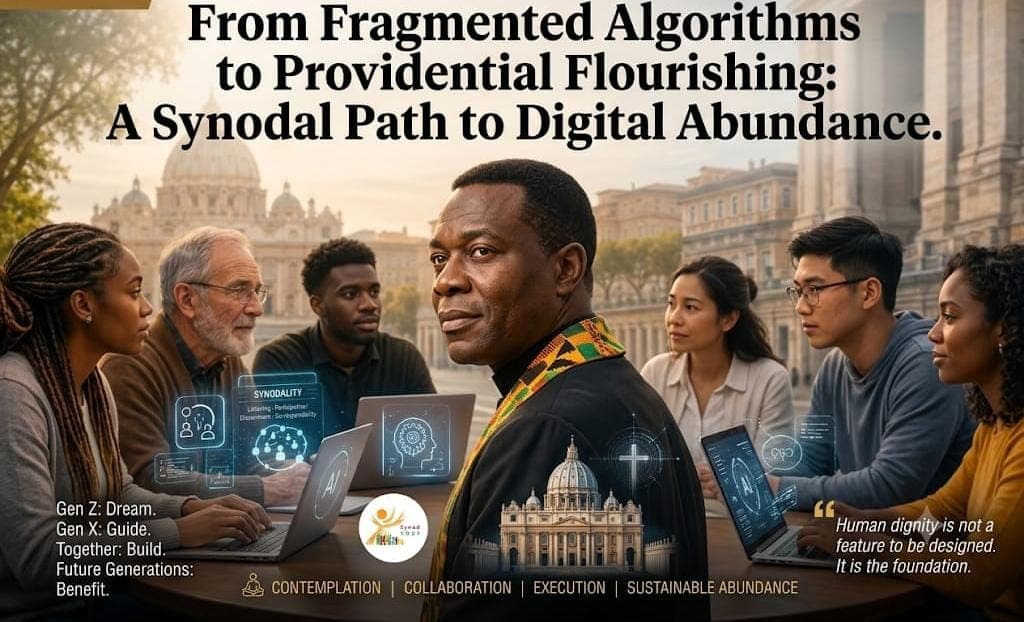
This vision can be understood through the CCE framework: Contemplation, Collaboration, and Execution.
Contemplation reminds us that no algorithm possesses conscience. Artificial intelligence can identify patterns, calculate probabilities, and generate remarkable outputs, but it cannot replace moral judgment shaped by experience, prayer, compassion, and responsibility. Human contemplation remains the foundation through which technology receives ethical purpose and direction. The Pentium chip must always serve the Pentecost heart. Innovation without contemplation risks becoming efficient without becoming truly beneficial.
Collaboration reflects the deeply synodal character of authentic progress. The digital future cannot belong solely to engineers, governments, corporations, or academic institutions. Every generation carries gifts that others need.
Generation X contributes resilience shaped by decades of technological transition. They understand adaptation, institutional memory, and sustained craftsmanship. Their experience provides stability in an era of constant disruption.
Generation Z contributes creativity, digital fluency, and an intuitive understanding of emerging technologies. They recognize both the opportunities and challenges of algorithmic culture. Their desire for authenticity, transparency, and meaningful participation should not be dismissed as idealism. It represents a valuable moral resource for society.
Future generations contribute something even more profound: silent accountability. Every decision made today becomes part of the world they will inherit. Intergenerational collaboration therefore becomes more than effective leadership. It becomes an expression of justice.
Execution recognizes that technology should assume tasks that diminish human potential rather than replace the uniquely human vocation to love, create, educate, heal, accompany, and serve. Artificial intelligence should reduce unnecessary scarcity. It should never diminish human significance.
When repetitive administrative work is automated, teachers gain more time for students. Physicians gain greater capacity to focus on patients. Pastoral ministers become more available to accompany families. Researchers discover solutions more efficiently. Entrepreneurs create opportunities that once seemed unattainable. Technology becomes truly ethical when it expands our capacity for care.
Redefining Abundance
Such a vision also challenges our understanding of abundance. Modern economies often define abundance through accumulation. The Gospel proposes a different measure. Abundance is the capacity to give.
A digitally abundant society is one that continually develops human potential rather than exhausting it. It shares knowledge rather than restricting it. It expands opportunity rather than limiting access. It restores ecological balance while encouraging responsible innovation. It protects the vulnerable while fostering creativity and enterprise.
Such abundance is neither naïve nor utopian. It is rooted in the conviction that every person possesses gifts entrusted not merely for personal achievement but for the service of the common good.
This perspective resonates deeply with the Church's social teaching. Human dignity remains the foundation of every technological decision. Care for our common home requires innovation that respects ecological boundaries. Solidarity reminds us that digital transformation must not exclude entire communities. Subsidiarity encourages solutions that empower local initiative while strengthening global cooperation.
Technology therefore becomes not an alternative to faith but a field of faithful stewardship.
The Digital Continent: A Missionary Frontier
The digital continent is now one of the great missionary frontiers of our time. Its language is code. Its culture is connectivity. Its greatest need is wisdom.
Young people frequently express exhaustion with endless scrolling, algorithmic manipulation, misinformation, and online comparison. They do not simply seek better applications. They seek trustworthy relationships, meaningful purpose, and communities where they are genuinely heard.
Synodal listening offers an unexpected response. Listening is not passive. Listening is design. Every ethical system begins by asking whose voice has been overlooked.
When families listen across generations, digital habits become healthier. When workplaces invite younger professionals into decision-making, innovation becomes more responsible. When parishes accompany both digital natives and digital migrants, technology becomes an instrument of communion rather than division. Listening transforms systems because it transforms people.
Providential flourishing therefore begins not with better software but with stronger relationships. Perhaps the greatest digital innovation of the coming century will not be a faster processor or a more powerful model. It will be communities that refuse to sacrifice persons for performance, communities that recognize every human being as infinitely more valuable than any dataset, communities courageous enough to place ethics before efficiency and wisdom before speed. Such communities already exist wherever compassion guides innovation.
The Synodal Digital Exam
As readers continue their journey through this rapidly changing digital age, they might consider a simple Synodal Digital Exam.
First, pause before you automate. Ask whether this technology strengthens or weakens human dignity.
Second, listen before you optimise. Invite perspectives from younger and older generations alike before making important digital decisions.
Third, serve before you scale. Measure success not only by growth or productivity but by whether your work increases hope, participation, and care for others.
These practices can reshape families, workplaces, classrooms, research institutions, businesses, and parish communities. They remind us that technology is never destiny. It is always stewardship.
From Halifax to Rome
Standing between the rugged shores of Halifax and the universal horizon of Rome, one encounters a shared lesson. Oceans connect continents just as dialogue connects generations. Strong bridges are not built by eliminating differences but by giving every voice a meaningful place within the journey.
Our baptism has already planted within us the seeds of sustainable abundance. The invitation before us is not simply to write better code. It is to align our code with God's covenant.
When contemplation guides innovation, collaboration shapes progress, and execution serves the common good, fragmented algorithms become instruments of providential flourishing. The future then belongs not to the most powerful machines, but to the most faithful stewards of the human person.