
From Dial-Up to Deep Learning: Keep the Soul Online
Abstract
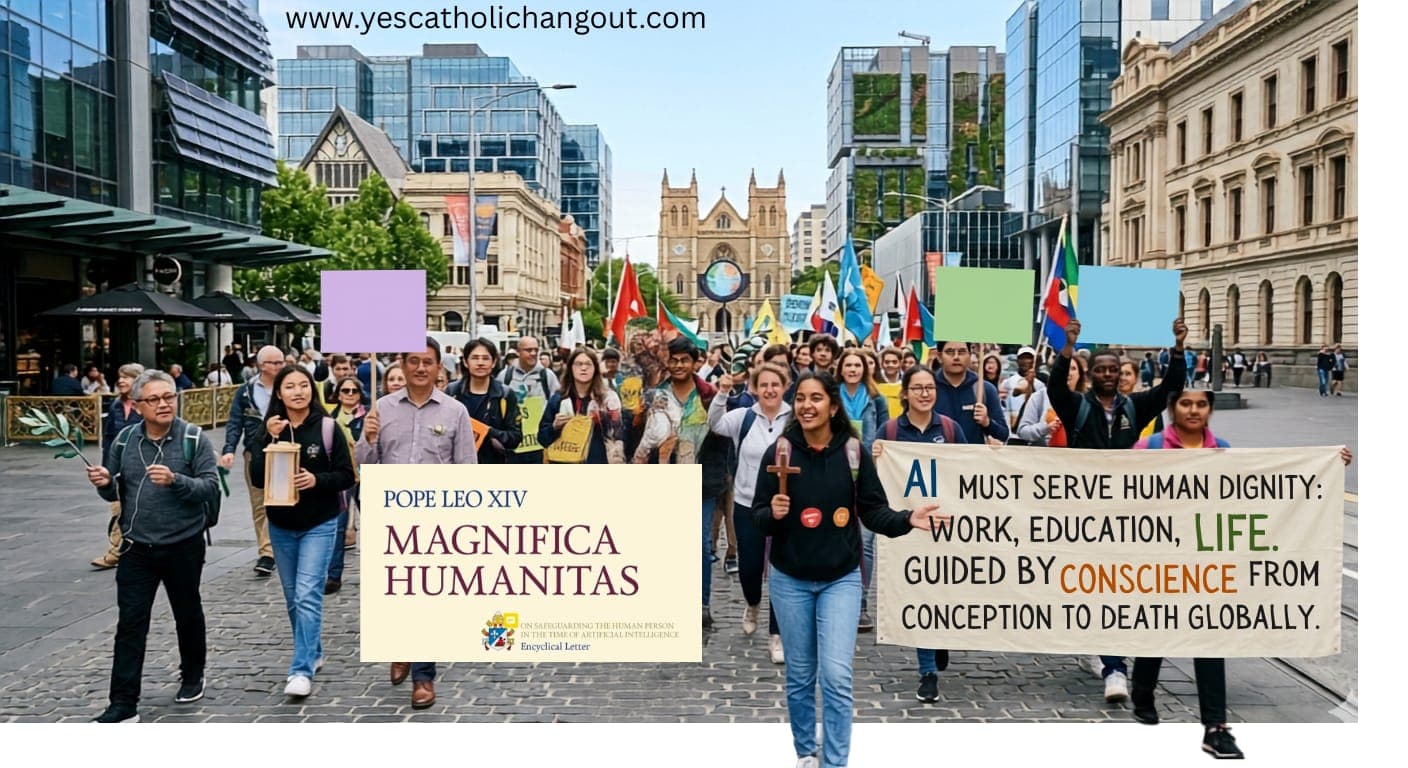
The public debate about employees seeking religious or ethical exemptions from compulsory Artificial Intelligence use at work reveals a deeper question: who governs technology, and for whose good? Catholic social teaching does not authorize fear of technology, nor does it permit blind surrender to technological power. Instead, the Church proposes a moral path in which AI remains a tool ordered to truth, human dignity, the common good, the dignity of work, conscience, family life, ecological responsibility, and integral human development.
In this sense, Pope Leo XIII's Rerum Novarum remains foundational for the AI age: it addressed the industrial crisis of capital and labor, while Magnifica Humanitas addresses the algorithmic crisis of technology and humanity.
The Church's response must therefore be neither technophobic nor technocratic. It must be:
Synodal
Pro-life
Pro-worker
Pro-family
Pro-truth
Pro-conscience
Pro-education
Pro-poor
It must defend every human being from conception to natural death, protect moral conscience in the workplace, form digital disciples, reform education, and require transparent, accountable, and humane administration across Church, state, and economy.
1. The New Social Question: From Industrial Capital to Algorithmic Capital
In 1891, Rerum Novarum described a world disturbed by industrial change, scientific discoveries, new relations between employers and workers, immense fortunes held by a few, poverty among the masses, and moral disorder. That encyclical did not reject industry itself; rather, it judged the social order by whether capital served human life or degraded labor.
The same judgment must now be applied to AI. The question is no longer only the ownership of factories, land, and wages. It is also the ownership of:
Data and predictive models
Compute power and digital platforms
Behavioral prediction and surveillance infrastructure
Algorithmic decision-making
In this sense, Rerum Novarum and Magnifica Humanitas belong together. The first confronted the industrial question; the second confronts the algorithmic question. Both insist that economic power must not treat the worker as an instrument. Both require that technology and markets be ordered by moral truth. Both call the Church to speak with clarity where human dignity is threatened by the concentration of power.
The social doctrine axis across both encyclicals:
Human dignity. Rerum Novarum: the worker is not a machine for profit. Magnifica Humanitas: AI does not possess moral conscience, empathy, relationality, or spiritual capacity. Response: keep human beings responsible for judgment, care, worship, education, justice, and mercy.
Work and wages. Rerum Novarum: justice requires that workers can live with dignity. Magnifica Humanitas: AI productivity must not produce unemployment, deskilling, or machine-paced exploitation. Response: require fair transitions, reskilling, family-supporting wages, and worker participation in AI deployment.
Conscience and religion. Rerum Novarum: work must allow worship, rest, and moral life. Magnifica Humanitas: AI must not dominate humanity or silence moral responsibility. Response: recognize conscientious objection where AI use would require deception, injustice, or cooperation with grave evil.
Associations. Rerum Novarum: workers have a natural right to form associations for mutual aid and justice. Magnifica Humanitas: AI governance needs shared standards, independent oversight, and user education. Response: create Catholic AI guilds, diocesan digital ethics councils, worker councils, and synodal review boards.
Common good. Rerum Novarum: public authority must serve public well-being, justice, religion, morality, and the poor. Magnifica Humanitas: AI must serve human progress and the common good, not merely profit or control. Response: reform public and ecclesial administration through transparency, accountability, appeal, and human oversight.
2. Religious Conscience Is Not an Escape from Work; It Is a Witness to Truth
A contemporary workplace story about a software engineer seeking a religious exemption from mandatory AI use should not be read superficially as a Catholic "excuse" to avoid technology. The deeper issue is whether a worker may be forced to use tools that violate a well-formed conscience. Catholic teaching gives a serious answer: conscience is not personal preference, but the sanctuary where the human person hears and responds to moral truth.
The Church should teach that there is no automatic religious duty to reject AI. AI can assist medicine, education, administration, accessibility, environmental monitoring, translation, pastoral planning, and economic inclusion when ordered rightly. Yet the Church must also teach that no employer, government, school, platform, or church office may force a person to participate in uses of AI that directly or materially support:
Grave violations of human dignity
Deception or exploitation
Unjust surveillance or discrimination
Manipulation of conscience
Attacks on life
The replacement of pastoral care with simulated companionship
This is precisely where Rerum Novarum remains prophetic. Pope Leo XIII taught that the worker's soul must be protected, that no one may outrage the dignity God reverences, and that labor agreements must not require a person to surrender duties owed to God and self. Applied to the AI age, this means the Church should defend qualified conscience protections without encouraging laziness, ideology, fear, or anti-scientific suspicion.
A Catholic employee may not simply say, "I dislike AI." But a Catholic employee may rightly say: "I cannot in good conscience use this system for deception, exploitation, unjust discrimination, anti-life decisions, surveillance of the vulnerable, or the erosion of human responsibility."
Pastoral principle: A Catholic response to AI must distinguish between tools that assist human responsibility and systems that replace, manipulate, or silence human moral agency.
3. Magnifica Humanitas: The Human Person Must Not Be Replaced
Pope Leo XIV frames the AI age through a decisive choice: humanity may build a new Babel of domination or a city where God and humanity dwell together. The encyclical's teaching is balanced: technology is not inherently evil, but it is never morally neutral, because it takes on the intentions, interests, financing, governance, and use-patterns of those who create and deploy it.
AI systems are not moral persons. Antiqua et Nova teaches that AI can perform sophisticated tasks but does not think as a human person thinks; human intelligence belongs to the whole embodied, relational, free, truth-seeking, and God-oriented person. Therefore, a Church that uses AI must always preserve the primacy of the human person.
The distinction between proper and improper uses of AI:
Proper use: AI assists research, translation, accessibility, scheduling, financial analysis, document drafting, and pastoral mapping under human review.
Improper use: AI makes final moral, sacramental, juridical, medical, educational, or employment decisions without accountable human judgment.
Proper use: AI helps identify needs among the poor, elderly, migrants, youth, and families so that humans may respond with charity.
Improper use: AI profiles persons as risks, consumers, voters, labor units, or data resources without regard for dignity.
Proper use: AI strengthens transparency by detecting fraud, waste, bias, and administrative delay.
Improper use: AI hides responsibility behind "the system," making no one answerable for injustice.
Proper use: AI supports education by widening access to knowledge and personalized learning.
Improper use: AI extinguishes the desire to think, read, question, pray, discern, and seek truth.
The Church's standard must be simple and demanding: AI may be welcomed where it helps human beings become more truthful, more just, more capable of love, more protective of life, more responsible for creation, and more attentive to the poor. AI must be resisted where it makes human beings less human.
4. Human Dignity from Conception to Natural Death
The Catholic position on AI cannot be separated from the defense of life. Magnifica Humanitas reaffirms the right to life "from conception to its natural end" and identifies abortion, the killing of the innocent, and euthanasia as gravely wrong. Dignitas Infinita likewise teaches that every human person possesses infinite, inalienable ontological dignity beyond every circumstance, state, or situation.
This teaching has direct AI implications. AI must not be used to:
Identify unborn children for selective destruction
Pressure the sick toward euthanasia
Ration care by utilitarian scoring
Reduce the disabled to cost categories
Manipulate children
Commodify women and men
Normalize loneliness through synthetic substitutes for love
The Church must not permit "innovation" to become a polite name for abandonment of the weak. A truly Catholic AI ethic must protect the human person across the entire arc of life:
Conception and prenatal life. Risk: genetic or diagnostic tools used for eugenic selection or abortion pressure. Safeguard: prohibit anti-life uses; support parents with truth, counseling, healthcare, and material solidarity.
Childhood and youth. Risk: algorithmic addiction, sexual exploitation, deepfakes, surveillance, and loss of attention. Safeguard: protect minors by design; require age-appropriate systems, parental rights, digital chastity, and school-based moral formation.
Work and adulthood. Risk: deskilling, job displacement, machine-paced labor, unjust monitoring, and discriminatory hiring. Safeguard: demand worker participation, just wages, retraining, human appeal, and limits on surveillance.
Sickness, disability, and aging. Risk: AI triage that reduces persons to cost, productivity, or probability of recovery. Safeguard: defend care, accompaniment, palliative support, and the equal dignity of disabled and elderly persons.
End of life. Risk: systems that normalize euthanasia, isolation, or abandonment. Safeguard: promote natural death, spiritual care, family presence, sacramental ministry, and human companionship.
5. How the Church Can Respond Without Losing Souls
The Church loses souls when she appears afraid of the modern world, but she also loses souls when she sounds indistinguishable from it. The task is not to chase relevance, nor to retreat into nostalgia. The task is to form Christian adults capable of living in the AI age with moral courage, intellectual discipline, sacramental life, and evangelical charity.
A synodal approach should help the Church listen without surrendering doctrine. In the AI age, the Church should gather testimonies from:
Employees pressured to violate conscience
Teachers struggling with automated cheating
Parents facing algorithmic addiction
Priests confronting online isolation
Workers displaced by automation
Entrepreneurs seeking moral clarity
Every episcopal conference and diocese should develop an AI pastoral charter rooted in Scripture, Catholic social teaching, Rerum Novarum, Dignitas Infinita, Antiqua et Nova, the Rome Call for AI Ethics, and Magnifica Humanitas. This charter should state what the Church blesses, what she permits with caution, what she rejects, and how she accompanies those caught in moral conflict.
The Church challenges and their pastoral responses:
Mandatory AI at work. Risk: workers may feel forced to violate conscience or abandon faith. Response: provide conscience-formation guides, pastoral letters, legal-literacy resources, and mediation support.
AI in schools. Risk: students may lose truth-seeking habits and mistake output for wisdom. Response: teach digital literacy, academic honesty, philosophy, theology, logic, and contemplative attention.
AI in parish life. Risk: pastoral care may become automated, impersonal, or performative. Response: use AI only for support tasks; keep preaching, confession, spiritual direction, and accompaniment human.
AI in public discourse. Risk: deepfakes, disinformation, and outrage may weaken democratic and ecclesial communion. Response: build an ecology of communication based on verification, charity, transparency, and truth.
AI and youth culture. Risk: loneliness, addiction, pornography, and identity confusion may increase. Response: offer digital discipleship, family formation, youth mentorship, and communities of embodied friendship.
6. A Healthy and Sustainable Digital Economy
A Catholic digital economy begins from the truth that the economy exists for the human person, not the human person for the economy. Dignitas Infinita cites Pope Benedict XVI's teaching that economy and finance are instruments whose end is the human person and his or her total fulfillment in dignity. Rerum Novarum already taught that the labor question cannot be reduced to contract, competition, or profit.
The Church should therefore advocate an AI economy that is:
Productive but not predatory
Innovative but not idolatrous
Competitive but not exploitative
Profitable but not anti-human
Productivity gains from AI should support workers, families, and communities through:
Fair wages and shorter excessive burdens where possible
Retraining and worker ownership
Cooperative platforms
Investment in local economies
The economic reform areas and their Catholic standards:
Labor transition. No worker should be discarded as a mere cost. Fruit: social peace, loyalty, reduced inequality, and renewed dignity of work.
Data governance. Personal data must be treated as connected to human dignity, privacy, conscience, and freedom. Fruit: trustworthy services, reduced exploitation, and stronger civil rights.
Platform power. Concentrated technological power must be accountable to the common good. Fruit: wider participation, fairer markets, and protection from digital monopolies.
Ecological cost. AI energy and water use must be judged within integral ecology. Fruit: sustainable innovation and protection of poor communities affected by environmental burdens.
Entrepreneurship. Innovation should expand meaningful work, not eliminate human purpose. Fruit: ethical startups, local opportunity, and a culture of service.
7. Reforming Education: From Information Retrieval to Wisdom Formation
The AI age exposes a crisis already present in education: many systems train students to produce answers without forming persons who love truth. Magnifica Humanitas warns that perfect machines may extinguish the desire to ask questions. Antiqua et Nova likewise emphasizes that human intelligence belongs to the whole person in reason, embodiment, relationality, truth, freedom, and vocation.
Education reform must therefore move from content delivery to wisdom formation. Students should learn:
How AI works, but also why truth matters
Prompt engineering, but also conscience formation
Coding, but also moral philosophy
Entrepreneurship, but also Catholic social teaching
Digital productivity, but also silence, prayer, reading, memory, debate, service, and human friendship
A Catholic AI curriculum should be built on five pillars:
Truth. Students must distinguish knowledge, probability, opinion, propaganda, and wisdom. Application: teach logic, verification, source criticism, rhetoric, and theological anthropology.
Conscience. Students must learn to judge whether a tool, command, or output is morally permissible. Application: use case studies on cheating, deepfakes, plagiarism, surveillance, and anti-life technologies.
Creativity. AI should not replace human imagination but discipline and extend it. Application: require human drafts, oral defense, project-based learning, arts, design, and community problem-solving.
Solidarity. Technology must serve the poor, disabled, rural communities, migrants, and excluded people. Application: build service-learning projects using AI for accessibility, healthcare support, local languages, and inclusion.
Contemplation. Attention is a moral and spiritual faculty. Application: protect device-free learning, prayer, silence, nature, manual work, and embodied community.
This educational reform will produce graduates who can use AI without worshipping it, question systems without cynicism, innovate without exploiting, and evangelize without manipulation.
8. Reforming Administration Globally: Human Appeal, Transparency, and Subsidiarity
AI will increasingly shape administration in governments, courts, hospitals, universities, dioceses, charities, companies, banks, and immigration systems. The Church should insist on a universal administrative norm: no person should be governed by an opaque machine without human explanation, human appeal, and human responsibility.
Global administrative reform should be built on four safeguards:
Disclosure: people know when AI is involved
Explanation: decisions can be understood
Appeal: persons can challenge errors
Responsibility: human authorities cannot hide behind systems
The administrative procedures and their required reforms:
Automated decisions. Every consequential AI decision must have a named human authority responsible for review. Machines do not possess conscience; persons must answer for justice.
Public services. Citizens must know when AI is used and must have access to appeal. Administration exists for the person and the common good, not bureaucratic convenience.
Church offices. AI may assist filing, translation, statistics, and planning, but not replace pastoral discernment. The Church is communion, not merely management.
Education systems. AI detection and grading must be transparent and contestable. Students deserve justice, formation, and due process.
Healthcare systems. AI triage must never override the equal dignity of patients. The sick, disabled, elderly, unborn, and dying possess inalienable dignity.
Migration and security. Profiling must be limited, reviewed, and protected from bias. Migrants and refugees are tests of social justice and fraternity.
9. The Ecclesial Path: A Magnifica Humanitas Program for the Church
To respond as Church without losing souls, weakening conscience, or silencing Christian voices in society, the Church should adopt a practical program grounded in Rerum Novarum and Magnifica Humanitas. This program should be evangelical in purpose, synodal in method, juridically prudent, educationally serious, economically realistic, and pastorally tender.
The proposed actions at each level of the Church:
Universal Church. Establish shared Catholic AI principles for life, work, education, communication, economy, ecology, and peace. Purpose: provide a unified moral voice in global AI governance.
Episcopal conferences. Issue pastoral guidelines on AI and conscience, including workplace, school, healthcare, and public administration cases. Purpose: help Catholics discern without panic or confusion.
Dioceses. Create AI ethics and digital pastoral councils including theologians, technologists, workers, youth, parents, educators, lawyers, and the poor. Purpose: practice synodality while preserving doctrinal clarity.
Parishes. Offer digital discipleship formation on truth, attention, chastity, family life, work, and conscience. Purpose: protect souls through accompaniment and community.
Catholic schools. Integrate AI literacy with philosophy, theology, ethics, social doctrine, and academic integrity. Purpose: form wise persons, not merely efficient users.
Catholic employers. Adopt conscience accommodation procedures, worker consultation, transparency, privacy, and retraining policies. Purpose: humanize workplaces and prevent scandal.
Catholic entrepreneurs. Build AI tools for accessibility, health, education, local languages, agriculture, anti-corruption, and pastoral service. Purpose: direct innovation toward integral human development.
10. A Moral Rule for the AI Age
The Catholic response can be summarized in a rule suitable for Gen X, Gen Z, workers, pastors, educators, founders, civil servants, and families:
Use AI when it serves truth, life, dignity, justice, work, family, education, peace, creation, and the poor. Refuse or reform AI when it attacks conscience, replaces love, hides responsibility, exploits labor, manipulates the vulnerable, denies life, or concentrates power against the common good.
This rule does not weaken moral conscience; it trains conscience. It does not lose souls; it seeks them. It does not reject the digital economy; it purifies it. It does not abolish administrative efficiency; it humanizes it. It does not oppose education reform; it restores education to its highest purpose: the formation of persons capable of truth, freedom, love, service, and communion with God.
Conclusion: The Church Must Be Neither Analog Nostalgia nor Algorithmic Captivity
The Church entered the industrial age with Rerum Novarum, defending workers, families, private property with social responsibility, just wages, associations, religion, and the poor. The Church now enters the AI age with a renewed duty to defend the same human person under new conditions. Magnifica Humanitas should therefore be read not as a permission slip for religious withdrawal from technology, but as a charter for moral governance, evangelization, and integral human development in the algorithmic era.
The Church must say to the world:
To companies: productivity without dignity is not progress.
To governments: efficiency without justice is not administration.
To schools: answers without truth are not education.
To technologists: intelligence without conscience is not wisdom.
To workers: conscience is sacred, but it must be formed.
To families: the human heart cannot be outsourced.
To the young: you are not data, content, labor, consumers, or profiles; you are persons created in the image of God.
To the world: technology must serve the magnificent humanity God has created and Christ has redeemed.
The proper Catholic posture is therefore clear: do not fear AI, do not idolize AI, do not obey AI blindly, and do not let AI define the human person. Govern it, humanize it, moralize its use, educate its users, protect the vulnerable, and keep the soul online.