
From Analog Grit to Algorithmic Grace: A Synodal and Entrepreneurial Moral Conscience for the AI Age
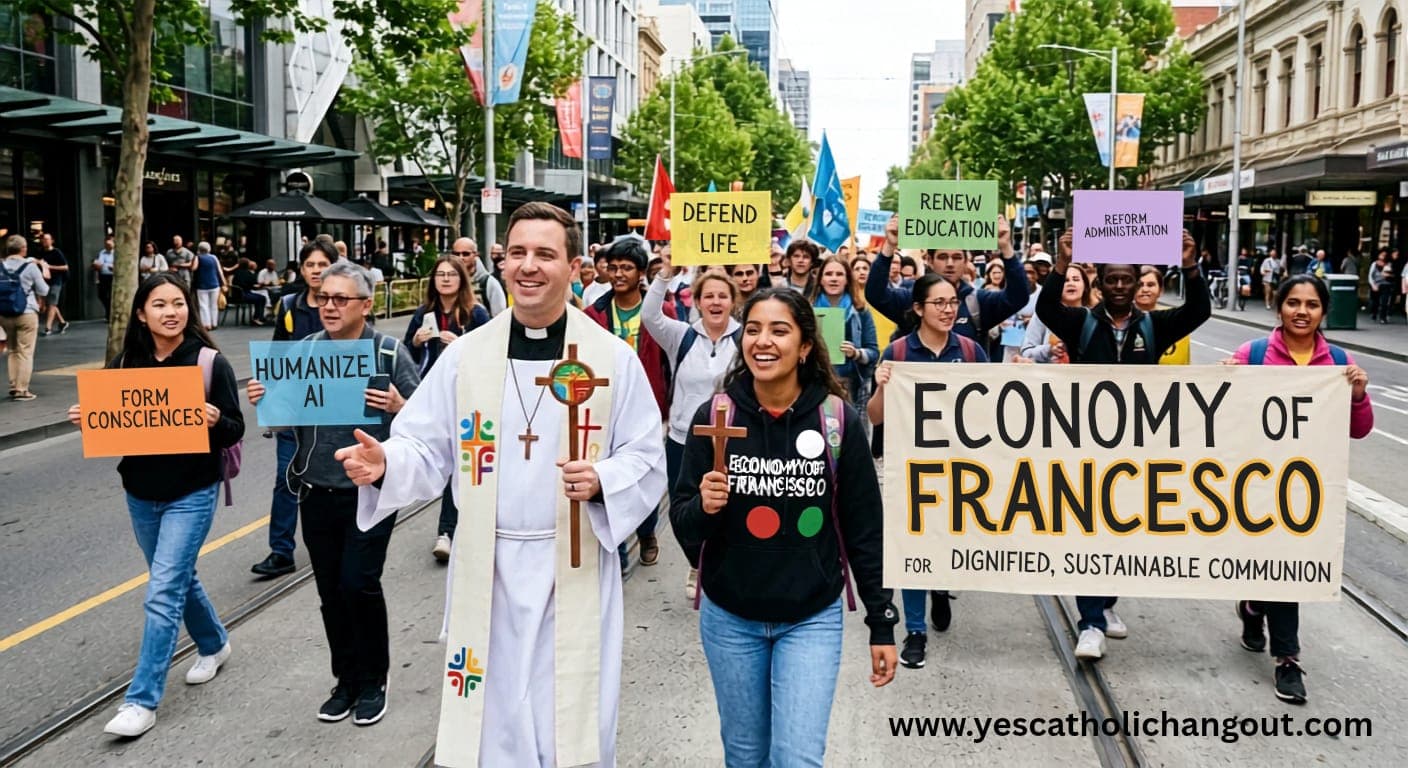
"Towards a synodal and entrepreneurial moral conscience" becomes, in the age of artificial intelligence, not merely a theme for reflection but a programme of conversion: a call to build an economy, an educational culture, and administrative systems where technology serves the human person, the family, life, the poor, creation, truth, work, and peace.
Introduction: The Human Person at the Crossroads of Babel and Jerusalem
Humanity stands once again before a decisive moral choice. In the language of Magnifica Humanitas, the question of artificial intelligence is not simply whether the Church will "accept" or "reject" technology, but whether humanity will construct a new Tower of Babel or rebuild Jerusalem as a city of communion, participation, mission, justice, and peace. The Babel option is the dream of power without God, efficiency without conscience, data without wisdom, and economic growth without the poor. The Jerusalem option is the patient work of rebuilding human society through shared responsibility, listening, moral formation, care for the vulnerable, and reverence for the mystery of the human person.
The concept "towards a synodal and entrepreneurial moral conscience" must therefore be reconciled with Magnifica Humanitas by placing every digital, economic, educational, and administrative innovation under one non-negotiable criterion: the inviolable dignity of every human being from conception to natural death. In a time when machines imitate intelligence, economies reward speed, and platforms shape consciousness, the Church is called to form persons who can distinguish:
Calculation from wisdom
Visibility from truth
Productivity from vocation
Connectivity from communion
This is not a retreat from the digital world. It is a missionary entrance into it with the mind of Christ, the heart of the Church, and the courage of Saint Francis.
Pope Francis' note accompanying the Final Document of the XVI Ordinary General Assembly of the Synod of Bishops states that the document forms part of the ordinary Magisterium of the Successor of Peter and should be accepted as an authoritative orientation for the Church's life and mission. This gives the Church a path: not isolated voices shouting into the digital storm, but a listening, discerning, accountable, missionary people capable of giving society a moral compass.
Magnifica Humanitas: The Grandeur of Humanity Before Artificial Intelligence
The starting point of any Christian response to AI must be theological anthropology. The human person is not an advanced machine, a biological dataset, a consumer profile, a labour unit, or an economic variable. The human person is created in the image of God, redeemed in Christ, called to communion, and destined for eternal life. Dignitas Infinita teaches that every human person possesses an infinite and inalienable dignity grounded in his or her very being, beyond every circumstance, state, or situation. Magnifica Humanitas develops this same principle for the AI age by insisting that technological development must be judged by its service to the dignity of persons and the common good.
This matters because AI can imitate many external functions of intelligence while lacking the interiority of the person. Antiqua et Nova explains that human intelligence belongs to the whole person, while AI "intelligence" is functional and task-oriented; AI can perform tasks, but it does not think in the full human sense. The distinction is essential. A machine can generate text, classify images, predict behaviour, draft policies, recommend loans, triage medical data, or simulate empathy. Yet it does not possess:
Conscience
Spiritual freedom
Moral responsibility
Contrition
Hope
Sacramental life
The capacity to love as a person loves
For this reason, the Church must resist every ideology that quietly transfers human authority to systems that cannot bear moral responsibility. AI may support discernment, but it cannot replace conscience. AI may assist pastors, teachers, doctors, judges, administrators, entrepreneurs, and parents, but it cannot replace the human vocation to seek truth and choose the good.
Therefore, a synodal and entrepreneurial moral conscience must become a living culture that teaches society to ask:
Who benefits?
Who is harmed?
Who is excluded?
Who is responsible?
What truth is being served?
What human dignity is at stake?
The key ethical questions and their Catholic criteria:
What is the human person? Image of God, never a thing or instrument. No person may be reduced to data, productivity, biometric identity, or market value.
What is intelligence? Embodied, relational, moral, spiritual, and open to truth. AI may assist human reasoning but cannot possess the fullness of human intelligence or moral conscience.
What is progress? Integral human development and the common good. Innovation must be measured by dignity, justice, inclusion, truth, work, peace, and care for creation.
What is responsibility? Personal and institutional accountability before God and society. Every AI system must have accountable human stewards, transparent governance, and moral oversight.
What is freedom? The capacity to choose the true and the good. Digital systems must not manipulate dependency, addiction, consumerism, political fear, or social control.
The Economy of Francesco as Antidote to the Technocratic Economy
The Economy of Francesco is an antidote. It contests the spiritual sickness at the root of a dehumanized digital economy: the belief that profit, speed, extraction, and control can define progress. Pope Francis first invited young economists and entrepreneurs to build "a different kind of economy," one that:
Brings life rather than death
Is inclusive rather than exclusive
Is humane rather than dehumanizing
Cares for the environment rather than despoiling it
In his 2024 address to the Economy of Francesco delegation, Pope Francis said that the world of economics needs change and that young people will change it especially by loving the economy in the light of God, concretely loving workers, the poor, and situations of greatest suffering. He also urged them not to be "administrators of fears," but "entrepreneurs of dreams," and spoke of giving "a soul to the economy of tomorrow."
The Economy of Francesco Covenant endorsed in Assisi calls for:
An economy of peace rather than war
Care for creation rather than misuse
Service to the human person, family, and life
Dignified work for all
Finance as a friend of the real economy and labour
Reduction of poverty and inequality
An ethics open to transcendence
In the context of AI, the contrast between the Babel economy and the Economy of Francesco is clear:
Profit without dignity must give way to an economy of life, where AI investments are assessed by their impact on life, family, workers, the poor, and creation.
Automation without transition must give way to dignified work, where businesses fund reskilling, job redesign, worker participation, and social protection.
Finance detached from labour must give way to finance serving the real economy, supporting productive enterprise, cooperatives, families, and local communities.
Data extraction and surveillance must give way to care and fraternity, where data governance protects privacy, consent, minors, and vulnerable persons.
Arms race and algorithmic warfare must give way to an economy of peace, rejecting dehumanizing weapons, propaganda, and technologies that normalize war.
Ecological cost ignored must give way to friendship with the earth, where AI infrastructure accounts for energy, water, minerals, e-waste, and environmental justice.
This antidote is Franciscan because it begins not with domination but with poverty of spirit, fraternity, and care for creation. Saint Francis of Assisi stripped himself of worldliness not to despise the world but to receive it rightly: as gift, not possession; as fraternity, not exploitation; as praise, not commodity. Therefore, the Economy of Francesco offers not merely an economic programme but a spiritual medicine for the digital age: it heals the imagination of entrepreneurs, economists, policymakers, technologists, and young people so that they may build without worshipping what they build.
A Church Response That Does Not Lose Souls or Weaken Moral Conscience
The Church's response must be missionary without being naive, prophetic without being reactionary, and pastoral without becoming morally silent. To avoid losing souls, the Church must not abandon the digital continent to influencers, ideologues, commercial platforms, and disembodied spiritualities. Yet to avoid weakening moral conscience, the Church must not baptize every innovation as progress. The task is to enter the AI age:
With discernment, not panic
With formation, not slogans
With presence, not retreat
With truth in charity, not cultural fear
A synodal digital pastoral strategy should begin with listening, but it cannot end with listening alone. Applied to AI, this means every diocese, parish, Catholic school, university, hospital, media office, and charitable institution should examine how digital tools shape attention, conscience, relationships, authority, privacy, and the poor. The question is not simply, "Can we use AI?" but "Can we use it in a way that forms saints, protects the vulnerable, serves truth, strengthens families, and evangelizes without manipulation?"
The Church must also speak clearly for human life. Magnifica Humanitas reaffirms that the first human right is the right to life "from conception to its natural end," and identifies abortion, the killing of the innocent, and euthanasia as choices the Church considers gravely wrong. In the AI age, this teaching has new applications. Predictive health systems must not become instruments for eliminating:
The disabled
The unborn
The elderly
The poor
Those judged "less efficient"
A Church that protects dignity from conception to natural death is not against science; she is against the loss of moral sight that turns the weakest into objects of calculation.
The Church's moral voice will remain strong only if her own structures become credible signs of the Gospel. Magnifica Humanitas calls the Church to an examination of conscience, including purification from abuse of power, lack of transparency, inequality, and violations of conscience. Therefore, the Church's witness in AI ethics must be accompanied by internal reform. She cannot call the world to accountability while neglecting accountability in her own governance, finances, communications, schools, and ministries.
Digital Pastoral Strategy: Presence, Formation, and Discernment
A Catholic digital pastoral strategy for the AI age must be more than posting religious content online. It should become a ministry of presence, formation, accompaniment, and public conscience. Gen X often carries the memory of institutions, analog discipline, and face-to-face community. Gen Z often carries the experience of digital immediacy, networked identity, and algorithmic formation. The Church must bring these generations together as co-responsible missionary disciples:
Gen X can offer patience, history, embodied mentorship, and institutional memory.
Gen Z can offer creativity, digital fluency, social urgency, and new forms of solidarity.
This strategy must make conscience formation central. The following groups need formation in digital anthropology: children, adolescents, university students, seminarians, catechists, parents, clergy, religious, professionals, and policymakers. They need to understand:
How platforms monetize attention
How algorithms shape desire
How disinformation wounds democracy
How pornography and addictive design deform relationships
How deepfakes assault truth
How AI companions can simulate intimacy without communion
How data systems can discriminate against the poor
The pastoral fields and their AI-age responses:
Evangelization. The challenge of digital noise and shallow attention. Create spaces of silence, truth, beauty, and credible witness rather than mere content multiplication.
Catechesis. The challenge of information without conversion. Teach doctrine with moral reasoning, prayer, testimony, and practical digital discernment.
Youth ministry. The challenge of loneliness, anxiety, and identity fragmentation. Build embodied communities where digital tools support, but do not replace, real belonging.
Family life. The challenge of screens mediating relationships. Form parents and children in digital temperance, Sabbath rest, privacy, and human conversation.
Vocations. The challenge of algorithmic distraction and fear of commitment. Offer mentorship, spiritual direction, and spaces for deep listening beyond performance culture.
Public witness. The challenge of polarization and disinformation. Train Catholics to speak truthfully, verify sources, resist outrage economies, and disarm words.
The Rome Call for AI Ethics offers practical principles that Catholics can receive and deepen: transparency, inclusion, accountability, impartiality, reliability, security, and privacy. These are not merely technical standards; they are expressions of human dignity in governance. Yet the Church must also go further by insisting that ethics cannot be determined only by those who own the systems. As Magnifica Humanitas warns, a "more moral AI" is not enough if that morality is determined by a few. Synodality therefore has social significance: it teaches the world that those affected by decisions must not be excluded from discernment.
Reforming Education: From Information Systems to Wisdom Communities
The educational system must be reformed globally because AI exposes a crisis that existed before AI: many schools have confused information transfer with wisdom, credentials with formation, and employability with vocation. Magnifica Humanitas calls attention to an educational alliance for the digital age and the central role of schools. Such an alliance should not ask only how students can use AI more efficiently; it must ask how education can form persons capable of truth, freedom, responsibility, solidarity, creativity, and moral judgment.
Catholic education should therefore become a laboratory of integral human development. Students must learn not only:
Coding, data literacy, robotics, entrepreneurship, and digital economy
But also:
Philosophy, theology, ethics, history, literature, ecology, civic responsibility, and the dignity of work
A curriculum that teaches AI without anthropology risks producing powerful technicians without moral depth. A curriculum that teaches morality without technological literacy risks leaving students unprepared to evangelize and serve in the world they actually inhabit. The Church should bring both together.
The areas of educational reform needed:
Curriculum. From STEM alone to STEM integrated with ethics, theology, humanities, and social doctrine. Students gain technical competence with moral conscience.
Assessment. From memorization to discernment, creativity, collaboration, and service. Learning becomes humanizing rather than merely competitive.
AI use. From plagiarism panic to guided responsible use. Students learn transparency, authorship, verification, and intellectual honesty.
Teacher formation. From tool training alone to anthropological and pastoral formation. Educators become guardians of wisdom, not just managers of platforms.
University mission. From market prestige to integral development. Research serves the poor, creation, peace, family, and human dignity.
Youth entrepreneurship. From disruption as a slogan to innovation as service. Young entrepreneurs build businesses with conscience, fraternity, and sustainability.
Reforming Administrative Procedures: From Opaque Control to Accountable Service
Administrative systems across the world increasingly use data analytics, automation, identity systems, predictive models, and algorithmic decision-making. These tools can reduce corruption, accelerate service delivery, improve health planning, support disaster response, and expand access. Yet they can also create new bureaucratic injustices when:
Decisions become opaque
Appeals disappear
Vulnerable persons are profiled
Human discretion is replaced by automated denial
Catholic social doctrine requires that administration be judged by service to persons, especially the poor, rather than by efficiency alone.
The principle of subsidiarity is crucial here. AI-enabled administration should not centralize all power in distant systems controlled by a few governments or corporations. It should empower local communities, families, workers, parishes, municipalities, schools, and civil society to participate in decisions that affect them.
Church institutions themselves should lead by example. Dioceses and Catholic organizations using AI for finance, safeguarding, education, communications, pastoral planning, archives, or social services should:
Publish clear policies
Identify responsible human officers
Protect personal data
Audit bias
Consult affected communities
Ensure that no sacramental or pastoral encounter is reduced to a data transaction
The administrative principles and their AI-age requirements:
Transparency. People should know when AI affects decisions about them. Truth, justice, and respect for persons require intelligibility.
Accountability. A human authority must remain responsible for machine-assisted decisions. Moral responsibility cannot be delegated to tools.
Subsidiarity. Local communities must participate in systems that govern their lives. Higher levels should support, not absorb, lower levels of society.
Solidarity. The poor, elderly, disabled, migrants, rural communities, and digitally excluded must be protected. The common good includes those most easily ignored.
Due process. Automated decisions must allow appeal, correction, explanation, and human review. Justice requires that persons be heard.
Data dignity. Privacy, consent, and security must be treated as moral obligations. The person is never raw material for exploitation.
Building a Healthy and Sustainable Economy
A healthy and sustainable economy in the AI age must be built on:
The primacy of the person
The dignity of work
The universal destination of goods
Care for creation
Peace
Laudato Si' teaches that authentic human development has a moral character and requires full respect for the human person as well as concern for the world around us. This means the digital economy cannot be judged only by growth metrics, shareholder value, innovation rankings, or productivity curves. It must be judged by whether:
Families can live
Workers can flourish
The poor are included
Creation is protected
Truth is served
The vulnerable are safe
The Economy of Francesco provides a practical moral architecture for this transformation. Where AI increases productivity, the gains should support:
Wages and family life
Retraining and shorter exploitative work patterns
Community investment
Ecological transition
Where AI threatens employment, enterprises and governments should not treat workers as disposable costs but as persons whose dignity requires participation and protection.
A sustainable AI economy must also recognize the material reality of the digital world. The cloud is not weightless. Data centres consume energy and water; devices require minerals; supply chains involve labour; e-waste burdens poor communities; and computational power can concentrate wealth. AI ethics must therefore include:
Energy justice
Responsible procurement
Repairability and recycling
Limits on wasteful computation
Protecting Truth, Work, Freedom, and Peace
Magnifica Humanitas frames the AI age through truth, work, and freedom. These three goods are under pressure:
Truth is threatened by disinformation, deepfakes, synthetic media, manipulated statistics, and ideological capture.
Work is threatened when human beings are treated as replaceable inputs rather than co-creators and participants in society.
Freedom is threatened when systems manipulate attention, predict behaviour, commercialize dependency, and normalize surveillance.
The Church's response must include a renewed public theology of truth. Truth is not merely accurate information; it is a common good that makes communion and justice possible. A society that cannot distinguish truth from simulation becomes vulnerable to tyranny, despair, and violence. Catholic communicators, educators, journalists, pastors, and lay professionals must become guardians of truth in the digital public square, not by harshness, but by disciplined verification, moral courage, and charity.
Peace must also be central. The Economy of Francesco Covenant explicitly calls for an economy of peace and not of war, opposed to arms proliferation. In the AI age, this requires resistance to:
Autonomous weapons
Algorithmic propaganda
Cyber aggression
Digital systems that make killing more distant and conscience less audible.
A Church faithful to the Gospel must insist that technology never be used to erase the face of the victim.
A Synodal and Entrepreneurial Moral Conscience
The phrase "synodal and entrepreneurial moral conscience" can now be stated with clarity:
It is synodal because it listens, discerns, includes, participates, and remains accountable before God and the People of God.
It is entrepreneurial because it does not merely criticize the world from a distance; it builds, repairs, creates, invests, educates, governs, and innovates.
It is moral because it is ordered by truth and the good, not by profit, ideology, fear, or technical possibility.
It is conscience because it stands before God and refuses to surrender responsibility to systems, markets, or machines.
Such a conscience does not weaken the Church's voice; it strengthens it. It enables the Church to say "yes" to technologies that:
Heal, educate, connect, and include
Protect creation
Improve administration
Support human flourishing
It also enables the Church to say "no" to technologies that:
Kill, exploit, deceive, or addict
Exclude or surveil
Commodify the body or undermine family life
Violate privacy or replace moral responsibility with automated power
The dimensions of a synodal and entrepreneurial moral conscience:
Church. Synodal expression: listening and discernment. Entrepreneurial expression: new ministries for digital mission. Moral criterion: communion, participation, mission.
AI. Synodal expression: public dialogue and accountability. Entrepreneurial expression: human-centered innovation. Moral criterion: dignity before efficiency.
Economy. Synodal expression: inclusion of workers and the poor. Entrepreneurial expression: businesses that create shared value. Moral criterion: life over profit.
Education. Synodal expression: formation of all. Entrepreneurial expression: schools as workshops of hope. Moral criterion: wisdom over mere information.
Administration. Synodal expression: transparency and evaluation. Entrepreneurial expression: efficient service delivery. Moral criterion: justice over control.
Culture. Synodal expression: dialogue across generations. Entrepreneurial expression: creative evangelization. Moral criterion: truth in charity.
Conclusion: Repair the House, Guard the Soul, Build the Future
Saint Francis heard the Crucified Lord say, "Go, repair my house." In the age of artificial intelligence, the same command can be heard anew. We are called to repair:
The house of human conscience
The economy
Education
Administration
The digital public square
The relationship between technology and the poor
The bond between innovation and creation
The voice of moral truth in society
The Church must respond neither by fear nor by fascination, but by holiness, intelligence, courage, and love. She must:
Protect human dignity from conception to natural death
Form consciences capable of resisting the idolatries of power, profit, and performance
Accompany Gen X and Gen Z into a shared mission where memory and creativity, discipline and digital fluency, tradition and innovation work together for the Gospel
Build an economy of life through the Economy of Francesco
Build a politics of service through Catholic social doctrine
Build an education of wisdom through integral formation
Build an administration of justice through transparency and accountability
The AI age will test whether humanity still knows what the human person is. Magnifica Humanitas answers that the grandeur of humanity is revealed not in domination, but in communion with God and service to one another. The Economy of Francesco answers that the economy can receive a soul when it becomes life-giving, inclusive, humane, ecological, peaceful, and open to transcendence. Synodality answers that the Church must walk together, listen together, discern together, and act together. The Gospel answers that the Word became flesh, not code, and that every human life is worth more than any system humanity can build.
Therefore, the Church's message to the AI age may be expressed in one sentence: Let us not build Babel with better machines; let us rebuild Jerusalem with formed consciences, fraternal economies, truthful education, accountable administration, and technology kneeling before the dignity of the human person.