
Fermat's Last Theorem, Reborn | When Human Reason Meets the Machine
A Quiet Revolution in a London Laboratory
Three hundred and fifty-eight years after Pierre de Fermat penned his famous marginal note—"I have discovered a truly marvelous proof"—a remarkable new chapter is unfolding in the history of mathematics.
At Imperial College London, Professor Kevin Buzzard is leading an ambitious effort to formally verify Fermat's Last Theorem using Lean 4, a proof assistant capable of checking every logical step with machine precision.
Launched in late 2024 with support from the UK's Engineering and Physical Sciences Research Council (EPSRC), the project has brought together some of the world's leading mathematicians and computer scientists. Through Math, Inc.'s Veritas Program, Fields Medalists Maryna Viazovska and Terence Tao have joined as Veritas Fellows, while London-based Logos Research contributes expertise in artificial intelligence.
Rather than translating Sir Andrew Wiles' celebrated proof line by line, the team is constructing a modern formal proof using contemporary mathematical advances, including crystalline cohomology and important contributions by Khare, Diamond, Fujiwara, Kisin, Taylor, and Scholze.
The goal is not merely to preserve one of mathematics' greatest achievements but to make it verifiable with complete logical certainty.
Human Intelligence Still Leads
Yet this remarkable project also demonstrates an important truth.
Artificial intelligence is assisting the work.
It is not replacing the mathematician.
AI can accelerate formalization and automate repetitive reasoning, but the conceptual architecture of mathematics still depends on human insight.
Professor Buzzard himself has cautioned that artificial intelligence, left without careful guidance, can generate what he calls "slop"—output that may appear technically sophisticated yet contributes little to genuine mathematical understanding.
A striking example emerged in September 2025 when Math, Inc.'s AI agent, Gauss, successfully formalized the Strong Prime Number Theorem in approximately 25,000 lines of Lean code within three weeks.
The accomplishment was extraordinary.
But the research questions, proof strategy, and mathematical vision all remained unmistakably human.
Even greater challenges lie ahead.
The Imperial team is approaching the problem from the top down, formalizing advanced mathematical structures, while the wider Lean community continues building foundational libraries from the bottom up.
Bringing these two approaches together requires more than computational power. It demands judgment, creativity, interpretation, and the ability to resolve subtle logical inconsistencies before they become structural failures.
Those remain uniquely human responsibilities.
Technology in the Service of Human Dignity
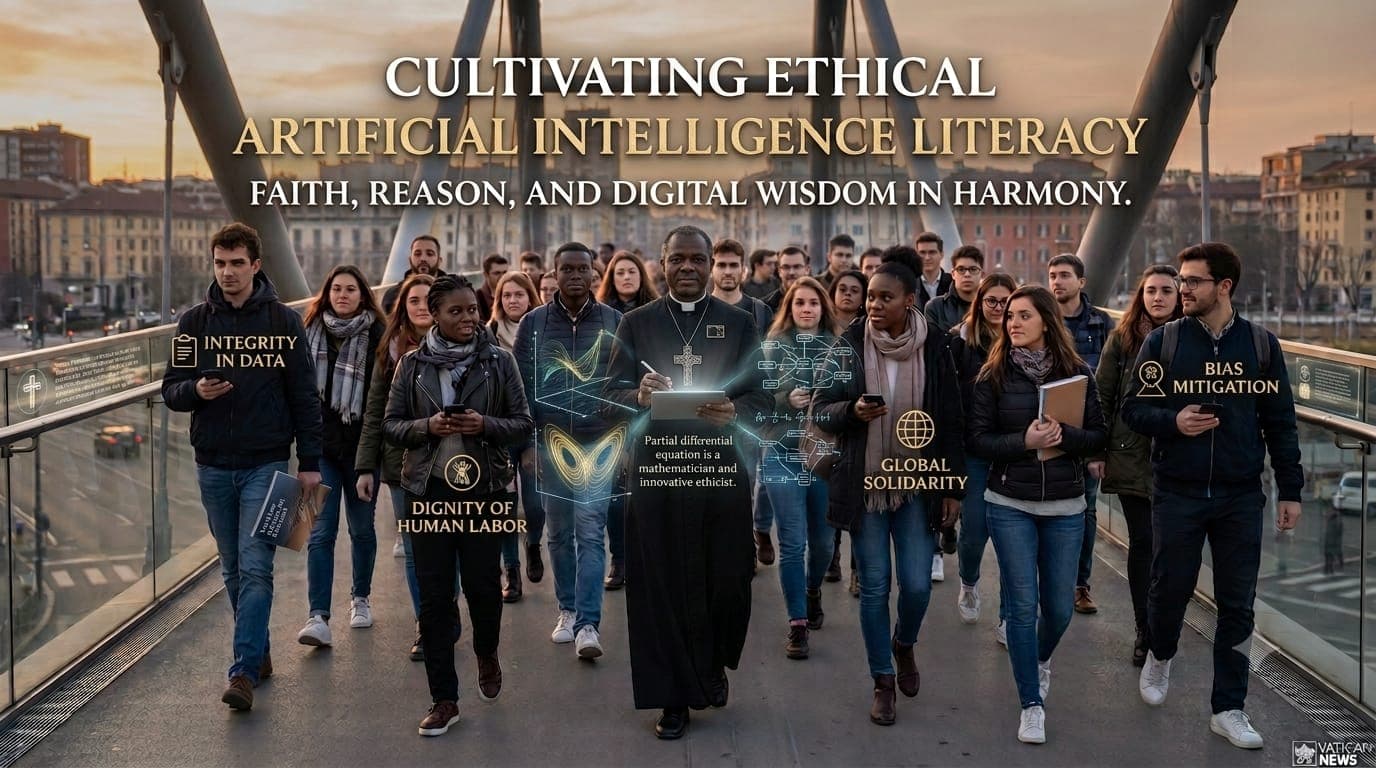
This partnership between human intelligence and artificial intelligence reflects a broader ethical vision articulated by Pope Leo XIV in his first encyclical, Magnifica Humanitas, published on 25 May 2026.
Subtitled On Safeguarding the Human Person in the Time of Artificial Intelligence, the document reminds the world that technology is never morally neutral. Every technological system reflects the values, priorities, and intentions of those who design, finance, and govern it.
The Holy Father contrasts the pride that built the Tower of Babel with the cooperation required to rebuild Jerusalem.
Technology, he argues, should strengthen communion rather than domination, and artificial intelligence must always serve authentic human flourishing instead of weakening human agency.
For developers, researchers, and innovators, this demands more than technical competence.
It requires prudence.
It requires courage.
Above all, it requires virtue.
The Fermat formalization project offers a compelling example of this vision in practice.
Artificial intelligence serves as an instrument of human reasoning, extending human capability without replacing the human mind itself.
Faith and Reason in the Digital Age
The Church has never regarded faith and reason as opposing forces.
Rather, they are complementary paths in humanity's search for truth.
Saint John Paul II expressed this beautifully in Fides et Ratio. Pope Leo XIV now extends that tradition into the age of artificial intelligence.
The Vatican's January 2025 document, Antiqua et Nova, prepared jointly by the Dicastery for Culture and Education and the Dicastery for the Doctrine of the Faith, draws an important distinction.
Human intelligence possesses conscience, moral freedom, spiritual openness, and the capacity to seek truth.
Artificial intelligence, by contrast, processes information and imitates certain cognitive functions without possessing consciousness, moral responsibility, or a soul.
Viewed in this light, the effort to formalize Fermat's Last Theorem does not diminish humanity.
It celebrates humanity.
It demonstrates how responsible innovation can extend the reach of human reason while preserving the unique dignity of the human person.
Scientific excellence and moral wisdom need not compete.
They can flourish together.
A Hopeful Horizon
The forthcoming Formalizing Fermat Workshop, scheduled for 6–10 July 2026 in London, will gather mathematicians, computer scientists, ethicists, philosophers, educators, and researchers to continue advancing this historic project.
Its significance extends well beyond mathematics.
It offers a glimpse of what becomes possible when scientific inquiry, ethical reflection, and responsible technological innovation work together.
Artificial intelligence, rightly ordered, becomes a servant of human flourishing rather than its substitute.
The future will not belong to machines acting alone.
It will belong to human beings who possess the wisdom to direct extraordinary technologies toward truth, justice, and the common good.
In that collaboration between human creativity and technological assistance, we witness something profoundly hopeful.
Not the triumph of machines over humanity.
But the triumph of humanity using its God-given gifts to reach ever more deeply toward truth.
Prepared by Fr. Oliver CCE — Ethical Innovator | Synodal Secretary