
Conversion in the Age of Artificial Intelligence: Cultivating Hearts that Bear Fruit through Magnifica Humanitas, Synodality, Fratelli Tutti, Laudato Si’, and the Economy of Francesco
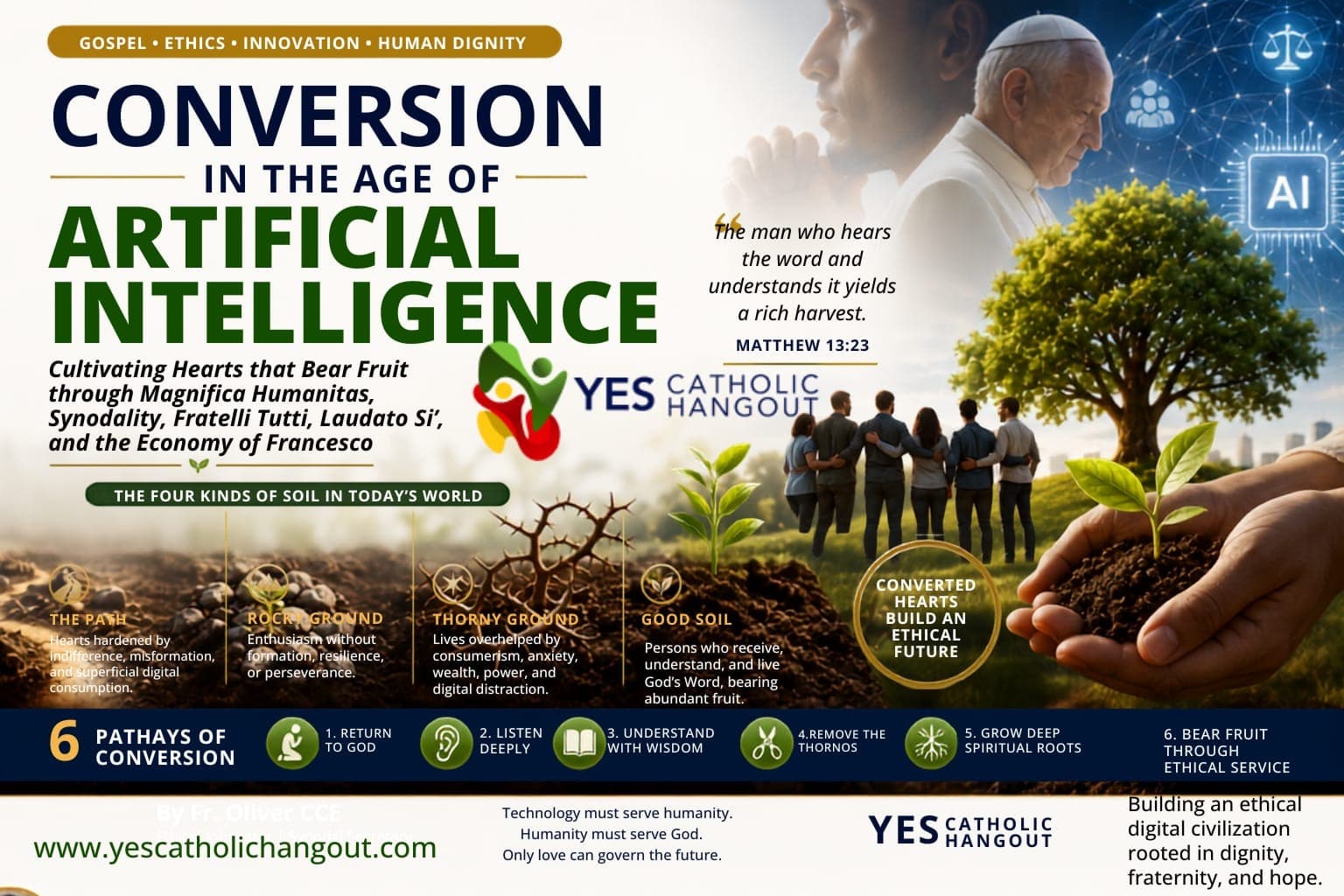
The Human Heart Remains the First Algorithm
Artificial Intelligence is reshaping how humanity communicates, learns, governs, heals, creates, and even imagines the future. Yet beneath every technological breakthrough lies a deeper question that no algorithm can answer: who is the human person that technology is meant to serve?
The Gospel of the Parable of the Sower (Matthew 13:18-23) reminds us that history is ultimately determined not by the sophistication of our tools but by the condition of our hearts. Jesus does not begin with technology, institutions, or economics. He begins with the soil.
In every age, including the digital age, the human heart remains the first environment where every idea, innovation, law, culture, economy, and political system takes root. Artificial Intelligence will inevitably reflect the moral quality of the people who design, govern, regulate, and use it. Consequently, the Church’s most urgent contribution to the digital era is not merely technological expertise but the continual conversion of the human heart.
This is the enduring vision of Magnifica Humanitas: authentic innovation begins with authentic humanity.
Conversion: The Foundation of Ethical AI
The temptation of our technological age is to believe that better machines will automatically produce a better world. Sacred Scripture proposes the opposite. God’s first concern is not external systems but interior transformation.
Through the prophet Jeremiah, the Lord calls His people:
“Come back, disloyal children… I will give you shepherds after my own heart.”
The promise is striking. God does not first promise stronger institutions, greater prosperity, or more efficient governance. He promises leaders whose hearts resemble His own. Every civilization ultimately becomes a reflection of the character of its leaders and citizens.
Artificial Intelligence therefore presents not only an engineering challenge but an anthropological and spiritual one.
Without conversion, technology easily becomes an amplifier of greed, manipulation, exclusion, misinformation, surveillance, violence, and inequality. With conversion, the same technologies can become instruments of healing, education, peacebuilding, inclusion, ecological stewardship, and integral human development.
The deepest AI governance begins not inside the computer but inside the conscience.
Four Kinds of Soil in the Digital Age
Jesus’ Parable of the Sower offers a remarkably contemporary diagnosis of our technological civilization.
The Path: Hearts Hardened by Digital Noise. The seed never penetrates. Today’s hardened path appears wherever endless information replaces genuine wisdom. Constant scrolling, superficial engagement, misinformation, ideological polarization, and digital distraction prevent God’s Word from taking root. Technology informs, but it cannot transform without openness to truth.
Rocky Ground: Excitement without Formation. Many enthusiastically embrace innovation, yet lack moral depth. New technologies arrive faster than ethical reflection. Without spiritual formation, intellectual humility, perseverance, and discernment, enthusiasm quickly collapses when confronted by complexity, sacrifice, criticism, or suffering. Innovation without virtue cannot sustain civilization.
Thorny Ground: Choked by Consumerism. The third soil mirrors perhaps the greatest temptation of contemporary society. Economic success, technological prestige, personal influence, algorithmic popularity, wealth, and constant productivity become the thorns that slowly suffocate deeper human values. Pope Francis consistently warns that economies exist to serve people, not people to serve economies. Artificial Intelligence must never become another mechanism that rewards efficiency while neglecting fraternity.
Good Soil: Hearts that Bear Fruit. The fertile soil represents persons who receive God’s Word with humility, understand it through discernment, and live it through love. These become ethical innovators. They develop technologies that protect dignity. They educate for wisdom rather than mere information. They govern with justice. They communicate truth. They create economies of participation rather than exclusion. They place the human person, not profit, power, or data, at the centre of every innovation. Such hearts produce a harvest “thirty, sixty and a hundredfold.”
Magnifica Humanitas: An Ethical Vision for AI
The vision of Magnifica Humanitas begins with a simple conviction: technology exists for humanity because humanity exists for God.
Every algorithm should therefore be evaluated according to one fundamental question: does it protect, strengthen, and promote the dignity of the human person?
This vision calls governments, universities, technology companies, healthcare providers, educators, researchers, entrepreneurs, and faith communities to collaborate in developing AI that respects freedom, protects privacy, promotes accountability, advances justice, and strengthens social trust.
Ethics cannot remain an afterthought added after innovation. It must become innovation’s first design principle.
Synodality: Listening Before Programming
The Church’s synodal journey offers a profound lesson for technological governance.
Synodality begins with listening. Artificial Intelligence often seeks faster decisions. The Gospel first seeks deeper understanding.
Listening to one another, especially the poor, the vulnerable, young people, older persons, persons with disabilities, indigenous communities, migrants, and those on the margins, ensures that technology serves everyone rather than a privileged few.
Ethical innovation grows wherever dialogue precedes design.
Fratelli Tutti: From Competition to Fraternity
Artificial Intelligence connects billions of people. Yet connection alone does not create communion.
Fratelli Tutti reminds us that authentic human progress depends upon fraternity. Digital technologies should therefore build bridges rather than deepen divisions. Algorithms should encourage encounter rather than hostility. Innovation should strengthen solidarity rather than isolation.
Our greatest technological achievement will not be autonomous machines but communities that remain profoundly human.
Laudato Si’: Caring for Our Common Home
The digital revolution carries ecological consequences. Data centres consume enormous energy. Electronic waste continues to grow. Rare minerals are extracted from fragile ecosystems.
An ethical digital civilization must therefore embrace the vision of Laudato Si’, recognizing that environmental responsibility and technological development are inseparable. Integral ecology asks innovators to measure success not only by performance but by sustainability, responsibility, and care for creation.
The future cannot be intelligent if it is environmentally irresponsible.
The Economy of Francesco: Restoring the Human Person
Economic systems increasingly rely upon algorithms. Markets predict behaviour. Platforms shape consumption. Automation transforms employment.
The Economy of Francesco reminds us that economic life should always place persons before profit. Artificial Intelligence should generate meaningful work, promote inclusive opportunity, reduce poverty, encourage responsible entrepreneurship, and widen participation rather than concentrate wealth and power.
Economic innovation becomes genuinely successful only when every person can flourish.
Six Pathways Toward Conversion
The Gospel offers a practical roadmap for individuals, families, institutions, and nations.
Return to God. Renew the relationship from which all ethical living begins.
Listen Deeply. Cultivate silence, dialogue, and attentive discernment before acting.
Understand with Wisdom. Seek truth through prayer, study, reason, and moral reflection.
Remove the Thorns. Reject consumerism, fear, manipulation, selfish ambition, and digital addiction.
Grow Deep Spiritual Roots. Remain faithful through prayer, Scripture, the sacraments, community, and perseverance.
Bear Fruit through Ethical Service. Allow every talent, profession, institution, and technology to become an instrument of love and the common good.
These are not merely spiritual disciplines. They are principles for ethical leadership in every sphere of society.
A Prophetic Mission for the Digital Age
The Church’s mission is no longer simply to enter the digital continent. She is called to help shape its moral foundations.
The future of Artificial Intelligence, democratic governance, education, healthcare, economics, communications, and international cooperation will depend less upon computational power than upon moral character.
Converted hearts create ethical institutions. Ethical institutions create trustworthy technologies. Trustworthy technologies help cultivate a civilization rooted in justice, fraternity, peace, and hope.
In an era fascinated by artificial intelligence, the Gospel reminds us that authentic wisdom still begins where it always has: in the conversion of the human heart.
The question before humanity is therefore no longer merely whether our machines are becoming more intelligent. It is whether we ourselves are becoming more faithful, more compassionate, more just, and more capable of reflecting the face of Christ in every decision we make.
Only hearts transformed by God’s grace can cultivate an ethical digital civilization worthy of the human person.
“The question of our age is no longer simply, ‘How intelligent are our technologies?’ but rather, ‘What kind of soil has our heart become?’ For only converted hearts can cultivate a truly human future.”