
Carlo Acutis Was Right
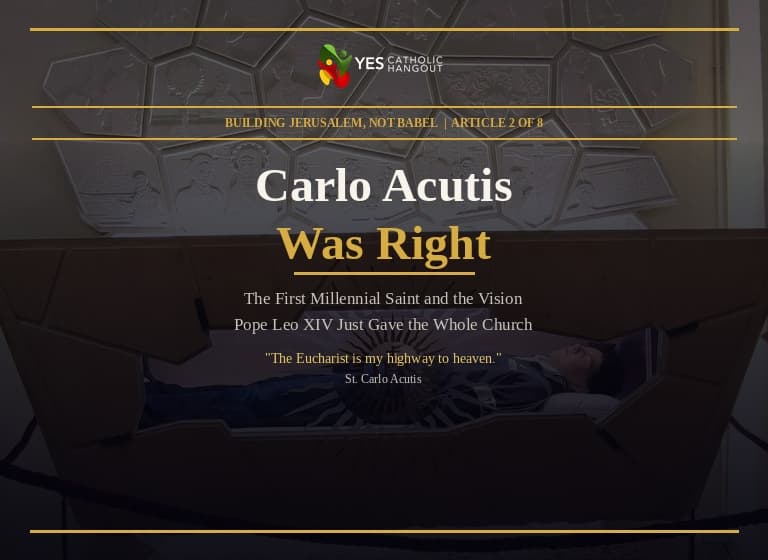
In January 2019, something quiet happened in a small town in Italy.
The Church opened the tomb of a fifteen-year-old boy who had died thirteen years earlier. What his mother Antonia Salzano witnessed that day was not just a moment of grief revisited. It was, by her own account, something that stirred the deepest foundations of her faith. A message, she called it. One that spoke beyond science and into the heart of belief.
That same month, Yes Catholic Hangout was founded.
We have written about this connection before. But now, in the light of Magnifica Humanitas, that January 2019 moment carries even more weight. Because what Pope Leo XIV has written in his first encyclical is, in many ways, the Church’s formal theological confirmation of everything Carlo Acutis lived and died believing.
Carlo was right.
Who Was Carlo Acutis?
For those who are new to his story, Carlo Acutis was born in London in 1991 and grew up in Milan. He was an ordinary teenager in many ways. He loved video games, football, and his cat. He was funny, loyal, and deeply attached to his friends.
But he was also extraordinary in one defining way: he loved the Eucharist with a passion that most adults never reach. He attended daily Mass. He spent hours before the Blessed Sacrament.
And he once said something that has since become one of the most quoted lines of his short life: “The Eucharist is my highway to heaven.”
Carlo also loved computers. He taught himself programming, web design, and graphic work.
And at some point, those two loves converged into a single mission. He began documenting Eucharistic miracles from around the world, verifying them, organizing them, and building a website that made them accessible to anyone with an internet connection.
He was not doing this for fame. He told his mother he wanted people to see what he saw. He wanted the internet, which most people were using for distraction, to become a doorway to the sacred.
Carlo died of leukemia on October 4, 2006. He was fifteen years old. His last recorded words included the hope that he had not wasted a single moment of his life.
He was beatified in 2020 and canonized in 2025, becoming the first millennial saint of the Catholic Church.
What the Encyclical Says
In Magnifica Humanitas, Pope Leo XIV does not mention Carlo Acutis by name. But almost every major argument in the document reads like a theological framework built around the kind of life Carlo actually lived.
Consider what the Pope writes about the digital world. He does not condemn it. He does not treat it as a necessary evil or a threat to be managed. Instead, he calls the internet and digital technology a genuine frontier, one that can either become a new Tower of Babel, built on pride, distraction, and the logic of profit, or a rebuilt Jerusalem, a space where human dignity is honored, truth is pursued, and genuine encounter becomes possible.
Carlo Acutis, at twelve years old, was already living the second option.
The Pope also writes about what he calls the “technocratic paradigm,” the tendency to let efficiency, profit, and control become the supreme measure of all things. In this paradigm, technology stops serving people and starts shaping them, subtly replacing wonder with consumption, relationship with engagement metrics, and truth with whatever gets the most clicks.
Carlo resisted this without anyone ever teaching him the term. He used his skills not to build a platform for himself but to point people toward something infinitely greater than himself. His website on Eucharistic miracles was not monetized. It was not designed to go viral. It was designed to convert.
The Internet as a Tool for Evangelization
One of the most important lines in Magnifica Humanitas comes when Pope Leo XIV insists that the Church does not stand outside the digital world but actively enters it with purpose. Digital spaces, he argues, are not a parallel reality separate from real life. They are part of real life, especially for young people. And therefore they are part of the Church’s mission.
This is not a new idea. But it is one that has often been resisted, misunderstood, or treated with suspicion in Catholic circles. Many well-meaning Catholics have treated the internet as something to be tolerated at best or avoided at worst. A distraction. A danger. Something the saints would not have used.
Carlo Acutis turns that argument on its head. Here was a young man who was, by every account, genuinely holy. He went to daily Mass. He prayed the Rosary. He was close to his parish priest and deeply formed in the faith. And he spent hours on his computer, not despite his holiness but as an expression of it.
He understood something that Pope Leo XIV is now teaching the whole Church: the question was never whether to use the internet. The question was always what to use it for.
Why Yes Catholic Hangout Exists
We will be honest with you. Yes Catholic Hangout was not founded because of a business plan or a content strategy. It was founded because a small group of young Catholics looked at the digital world and believed, the way Carlo believed, that it did not have to be what it currently was.
It did not have to be a space defined by outrage, loneliness, distraction, and superficiality. It could be something else. A place where faith is lived openly. Where questions are taken seriously. Where the Gospel is not just proclaimed but embodied in the way we engage with one another online.
We did not know, when we started, that a Pope would one day write an encyclical making almost exactly the same argument. But here we are.
The fact that Yes Catholic Hangout was founded in the same month that Carlo’s tomb was opened is something we hold with gratitude and a sense of quiet responsibility. We do not claim a direct connection. We simply notice that God’s timing is rarely accidental.
What Carlo’s Life Demands of Us
Carlo Acutis is not just an inspiring story. He is a challenge.
He challenges every Catholic who uses the internet, which in 2026 means virtually every Catholic alive, to ask a serious question: what am I building with my digital presence?
Am I building Babel? Consuming endlessly, performing for an audience, spreading outrage or anxiety, reducing myself and others to data points and follower counts?
Or am I building Jerusalem? Using whatever small platform, skill, or voice I have to point people toward truth, toward beauty, toward the God who became flesh and dwells among us?
Carlo was fifteen. He had no institutional backing, no large audience, and no guarantee that anyone would pay attention. He built his website anyway, because it was the right thing to do with what he had been given.
Pope Leo XIV is asking all of us to do the same.
Coming Up in This Series
In Article 3, we will go deeper into what Magnifica Humanitas actually says about artificial intelligence itself. What is AI, according to the Pope? What can it do, and more importantly, what can it never do? The answers are more clarifying, and more hopeful, than you might expect.
The series continues. Stay with us.
Yes Catholic Hangout. Digital Faith. Real Mission.