
Building Tables, Not Walls
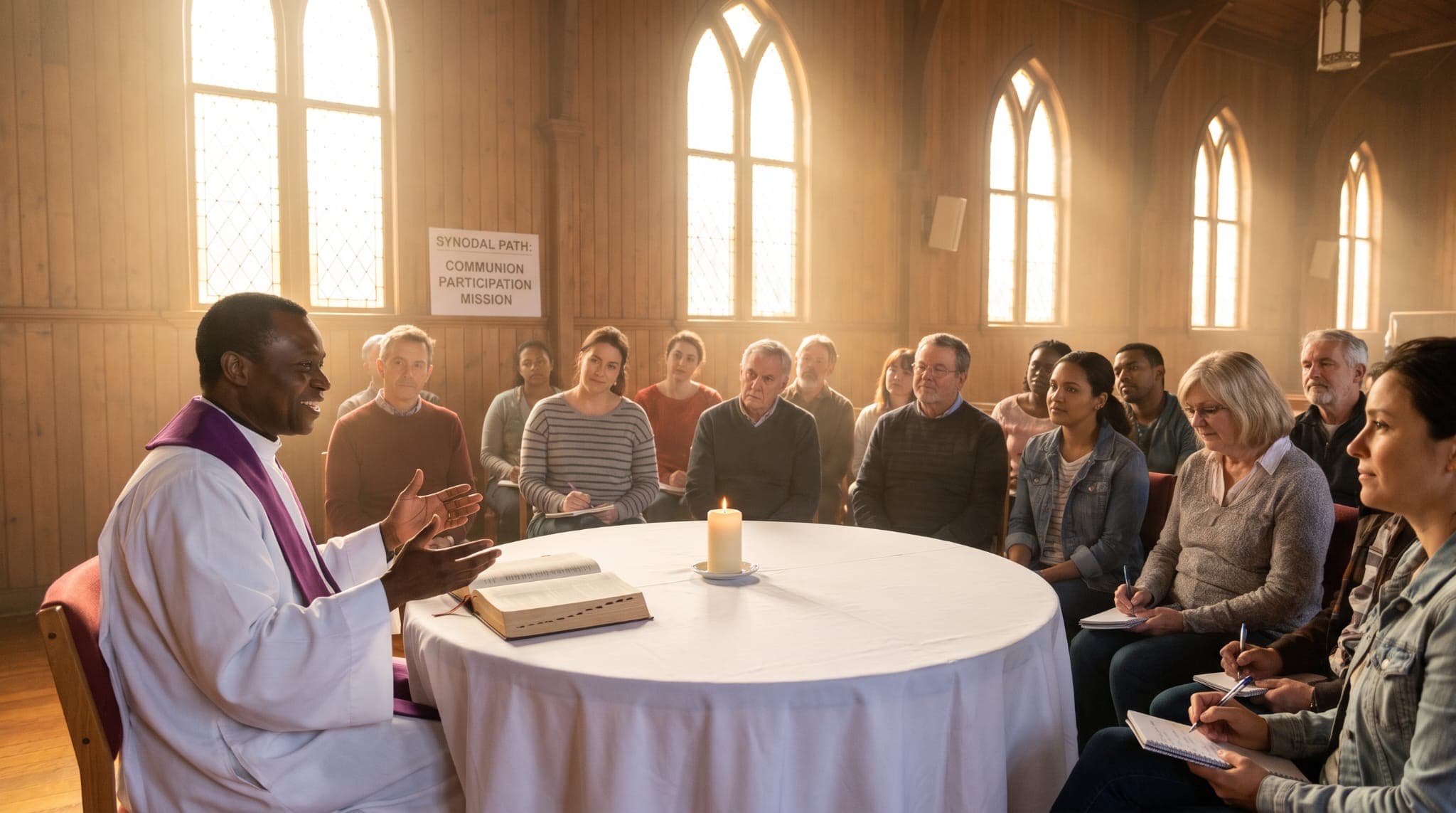
Synodal Hospitality, Human Dignity, and the Future of Peace in the Age of Artificial Intelligence
1. The World’s Dividing Walls
The human family stands at a crossroads. Across nations and neighbourhoods, the ancient instinct to protect has hardened into the modern reflex to exclude. Walls of political polarization, ethnic suspicion, economic inequality, and technological exclusion are rising not only between countries but within hearts. In an age of astonishing connectivity, loneliness is epidemic. In an age of abundance, hunger and displacement remain scandalous. In an age of artificial intelligence, the risk is not merely that machines will replace human work, but that they will deepen the distance between those who design the future and those who are left outside its gates.
From the devastated neighbourhoods of active conflict zones to the anxious corridors of democratic societies, the signs are unmistakable. Migration is debated as a threat rather than a shared vocation. The climate crisis pits the comfortable against the climate-vulnerable, the present against the future. The digital revolution, for all its gifts, has produced echo chambers where contempt travels faster than curiosity. The table is not a retreat from these realities. It is the only architecture spacious enough to hold them.
Against this fragmentation, the Gospel proposes a counter-imagination: the table. Not the barricade. Not the algorithmic filter bubble. Not the fortified border. The table. It is there, where bread is broken, where strangers become neighbours, where the vulnerable are seated with honour, that the Kingdom of God quietly takes shape.
In a world that builds walls, we build tables, serving with our hands and listening with our hearts. That is how we outlast hostility with holiness.
This reflection is not a slogan. It is a spiritual and civic strategy. It is the stance of a Church that believes holiness is not withdrawal from the world but humble, courageous engagement with it. It is the method of synodality. It is the grammar of peace.
To build a table is a daring act. It means clearing space, setting aside agenda, and risking the presence of the other. It means believing that enemies can become guests, that the rich and poor can share bread, and that the wounds of history can be addressed not by another wall but by a common cup. The table is both sacrament and strategy: it feeds the body and repairs the body politic.
2. The Table in the Gospel
From beginning to end, Scripture locates salvation around food, fellowship, and forgiveness. The table is the privileged place where God restores communion, heals divisions, forms disciples, and renews society.
Consider the Lord’s own table manners. Jesus dines with sinners and tax collectors, scandalising the respectable but revealing the heart of the Father. “I have come to call not the righteous but sinners” (Mark 2:17). The multiplication of the loaves shows that divine providence begins not with scarcity but with the generous offering of what little is available, multiplied by grace until every hunger is satisfied. The Last Supper transforms a Passover meal into the perpetual sacrament of Christ’s self-giving, making the Eucharist the table that holds the Church together across time and space.
On the Road to Emmaus, the risen Lord is recognised precisely “in the breaking of the bread” (Luke 24:35). The first Christian communities, as Acts 2:42 tells us, “devoted themselves to the apostles’ teaching and fellowship, to the breaking of bread and the prayers.” Their table was not an escape from society. It was the seed of a new social order.
Even the Parable of the Good Samaritan, though it is a road story and not a meal scene, ends with the wounded man brought to an inn, cared for, and sheltered. The table is implied: hospitality is the concrete form of mercy. The commandment to “love your neighbour as yourself” finds its natural expression in making room for the other.
Each of these scenes teaches the same grammar. With Zacchaeus, the table becomes the place of restitution and conversion. With the five thousand, it becomes the place of abundance born from smallness and trust. In the Upper Room, it becomes the sacramental source of the Church’s unity. On the Emmaus road, it becomes the place of recognition after confusion. In the early Jerusalem community, it becomes the visible sign of a new society. The Samaritan’s inn becomes the table extended to the enemy. And the commandment of love gives every table its permanent mandate: there is no disciple without the neighbour, no communion without hospitality.
In a world where meals marked social rank and ritual purity, Jesus’s table fellowship was a radical politics of grace. He did not first require the sinner to become respectable. He first set the table, and the encounter did the healing. That is still the method of the Gospel.
The wall, by contrast, is the architecture of fear. It separates the clean from the unclean, the worthy from the unworthy, the insider from the outsider. Jesus systematically dismantles such walls. The table is his hermeneutic: everyone is invited, no one is wasted, and the least are given the place of honour.
3. The Table in the Church’s Teaching
The Catholic tradition has never treated the table as a private devotional symbol. It is a public and political sacrament. In Magnifica Humanitas, the Church reminds the world that the human person is not a problem to be managed but a mystery to be served, a dignity to be defended, and a vocation to be honoured. Every person carries within the image of God, and that image is not subject to efficiency audits, market value, or algorithmic scoring.
Fratelli Tutti extends the table into the global commons. Pope Francis insists that authentic fraternity is built through encounter, dialogue, and the patient work of removing barriers that prevent belonging. No one is saved alone; no nation flourishes by locking its gates; no economy is healthy when it discards the poor. The encyclical’s vision of a more human world is, at its core, a world reorganised around the table.
Laudato Si’ adds the ecological dimension. The earth itself is a shared home, a table set for all generations and all species. To neglect creation is to break the common table, to spoil the food, soil, air, and water on which the poor depend most directly. Care for our common home is therefore inseparable from hospitality to the poor.
The Economy of Francesco invites economists, entrepreneurs, and young leaders to imagine an economy that is fraternal, sustainable, and inclusive. Catholic Social Teaching, in its full breadth, provides the ethical architecture: the dignity of the person, the common good, solidarity, subsidiarity, the option for the poor, and the universal destination of goods. These principles do not belong to one political party or one economic school. They belong to the moral grammar of human flourishing.
The Final Document of the Synod on Synodality calls the Church to walk together, listening to the Spirit through the voices of all the baptised, especially those at the margins. And the Rome Call for AI Ethics, Algorethics, warns that artificial intelligence must be transparent, inclusive, responsible, and impartial, serving the person before the market. Each of these teachings is a leg of the table on which a civilisation of encounter can be built.
Taken together, these teachings compose a single vision: the human person is sacred, the earth is shared, communion is possible, and technology must serve both. They are not optional spiritual add-ons to political and economic life. They are its true foundation. Without this foundation, development becomes domination, innovation becomes intrusion, and governance becomes administration. With it, every table becomes a site of hope.
4. Synodality: A Spirituality of the Table
Synodality is not a management technique. It is a way of being Church, a spirituality, a culture of the table. At its heart is the conviction that the Holy Spirit speaks through the many, not only through the few; that authority is exercised as service; and that communion is the fruit of patient, prayerful listening.
The synodal Church is called to practise listening before speaking, accompaniment before judgement, encounter before ideology, and communion before competition. These are not bureaucratic procedures. They are ascetical disciplines. They require the conversion of our anxious desire to control, to win, to be right, to be first. Synodality asks us to set the table before we issue the verdict.
Listening before speaking means trusting that the Spirit may speak through the person we most want to correct. Accompaniment before judgement means walking with another until their dignity becomes more visible than their failure. Encounter before ideology means refusing to treat human beings as illustrations of an argument. Communion before competition means recognising that the success of one part of the body is the health of the whole. These disciplines do not weaken the Church’s witness. They purify it.
To be synodal is to believe that the Church’s unity is not uniformity. It is the patient conviction that what we hold in common, Christ, the sacraments, the poor, the call to holiness, is deeper than the differences that frighten us. It is the decision to stay at the table even when the conversation is hard, because the table is where Christ promised to be present.
In a polarised world, this is a revolutionary posture. The table does not eliminate differences. It holds them in charity. It creates the conditions in which disagreement can become dialogue and conflict can become encounter. It is the space where the enemy, seen up close, becomes a brother or sister whose story wounds and instructs. Synodality is the Church’s attempt to institutionalise the Gospel table, to make every parish, every council, every digital platform a place where the Spirit can be heard.
5. The Walls of Our Age
The walls of our time are rarely built with stone. They are algorithmic, political, cultural, and emotional. They are built when social media platforms reward outrage over understanding, when news feeds amplify the most extreme voices, and when citizens stop talking to neighbours who vote differently. Political polarisation turns fellow citizens into existential threats. Ethnic divisions revive ancient fears and dress them in modern grievances. Economic inequality concentrates power and opportunity while leaving millions at the gate, wondering whether the table has room for them.
These walls reinforce one another. Economic anxiety feeds political resentment. Political resentment feeds ethnic scapegoating. Ethnic scapegoating feeds algorithmic extremism. And all of them conspire to convince the lonely that they are alone by choice, that the stranger is the enemy, that the common good is a fantasy. The wall is not only an external structure. It is a state of soul. It turns the heart inward, hardens it against mercy, and baptises fear as wisdom.
Technological exclusion is a particularly subtle wall. It whispers progress while silently excluding those who lack devices, data, or digital literacy. Algorithmic bias can lock a person out of credit, employment, housing, or justice simply because a dataset encoded historical injustice. Digital misinformation poisons trust, making shared truth, the shared table of rational discourse, almost impossible. Loneliness and social isolation, deepened by the very tools designed to connect us, show that a wall can exist in the heart even when borders remain open.
Ideological extremism, left or right, builds walls of purity: only the ideologically correct are admitted. Ecological neglect builds walls between present consumption and future survival, between wealthy nations and climate-vulnerable peoples, between humanity and the rest of creation. Each of these walls is, at root, a failure of hospitality. They are signs that we have forgotten how to set the table for the other.
The pastoral response is not to deny the real dangers that walls claim to guard against. It is to insist that security without solidarity is an illusion. A nation that is safe but cruel is not at peace. A community that is pure but closed is not holy. A heart that is guarded but loveless is not alive. The wall always promises protection. It always delivers isolation.
6. Artificial Intelligence: Serve or Sever?
Artificial intelligence is neither a saviour nor a demon. It is a tool of extraordinary power, and like every tool, its moral meaning depends on the hands that wield it and the purposes it serves. The question before the human family is not whether AI will shape the future, but whether it will shape a future of wider tables or higher walls.
When AI is used to diagnose illness, protect crops, translate languages, or connect the marginalised with resources, it becomes an extension of the table. When it is used to manipulate voters, deepen surveillance, automate exclusion, or concentrate wealth without accountability, it becomes a wall. The difference lies not in the code but in the conscience behind it.
The speed of AI development makes ethical vigilance urgent. A facial-recognition system deployed without consent, a hiring algorithm trained on biased histories, a content-recommendation engine optimised for addiction rather than truth, these are not neutral technical choices. They are moral choices with real victims. The table-builder asks: who is not in the room when this is designed? Who is missing from the dataset? Who will be blamed when the system fails? The wall-builder asks only: does it scale? Does it profit? Does it protect us from them?
The Church’s engagement with AI, especially through the Rome Call for AI Ethics, insists on six foundational principles: transparency, inclusion, responsibility, impartiality, reliability, and security. These are not technical checkboxes. They are moral imperatives. They demand that AI serve human dignity, the common good, and care for our common home. The Church does not oppose innovation. She opposes innovation that forgets the human face.
There is a particular duty for believers who work in technology. They carry into laboratories and boardrooms a conscience formed by the Gospel. They can ask the questions that quarterly reports do not ask: does this tool make the lonely less alone? Does this platform help the truth be heard? Does this system give the migrant a fair hearing? Such questions are the beginning of an algorithmic ethics worthy of the human person.
Christians must therefore enter the AI conversation not as frightened bystanders but as ethical innovators. We must ask, at every stage of design and deployment, who benefits and who is burdened. We must resist the seduction of efficiency when it masks exploitation. We must demand that algorithms be explainable, that data be justly gathered, and that the fruits of automation be shared with those whose labour made it possible.
7. The Anthropological Theoalgorithm
In the face of these challenges, a human-centred framework is urgently needed. The Anthropological Theoalgorithm, developed by Fr. Oliver CCE, is offered as a compass for every technological decision. It begins with a single, non-negotiable question:
“Who is the human person technology is meant to serve?”
This question is not a prelude to engineering. It is the foundation of ethics. Before any code is written, before any model is trained, before any product is launched, the human person must be named, honoured, and placed at the centre. The human person is not a user, a consumer, or a data point. He or she is a creature of infinite dignity, created by God and destined for communion.
The Anthropological Theoalgorithm therefore proposes a threefold test. First, does the technology protect and promote the dignity of the most vulnerable person it will touch? Second, does it strengthen communion rather than replace encounter? Third, does it leave the earth and future generations richer rather than poorer? Only when these questions receive affirmative answers may efficiency, productivity, and profit be pursued as secondary goods. Efficiency without dignity is a wall. Profit without participation is a wall. Innovation without the poor is a wall.
This framework also insists on participation. Those who will live with a technology must have a meaningful voice in shaping it. The poor, the elderly, the disabled, the migrant, the child, these are not afterthoughts for ethical review but primary dialogue partners. An algorithm shaped only by those who profit from it will inevitably become a wall to those who do not.
Every ethical algorithm must therefore first recognise the God-given dignity of the human person before pursuing efficiency, productivity, automation, or profit. The theoalgorithm reminds technologists, policymakers, and educators that the moral measure of any system is found in the lives of the most vulnerable people it touches. If an innovation makes the poor poorer, the lonely lonelier, the migrant more invisible, or the child more commodified, it is not progress. It is a wall disguised as a bridge.
This framework also calls for transparency, accountability, and participation. Those affected by technology must have a seat at the table where it is shaped. Ethical innovation is not the work of isolated experts. It is the work of communities discerning together what serves the human family and the common home.
8. Building Tables: Twelve Practices for Christian Communities
If walls are built by fear and self-protection, tables are built by concrete acts of hospitality. Christian communities can become schools of the table through a constellation of practices that turn synodal listening into daily discipleship.
Synodal listening means creating spaces where every voice, especially the least powerful, is genuinely heard. Pastoral accompaniment means walking with people in their complexity without rushing to judgement. Intergenerational dialogue brings elders and youth into shared discernment, honouring memory and imagination together. Ecological responsibility treats the earth as a common table that must be set with care for those who will eat after us.
Digital evangelisation uses technology to proclaim the Gospel, form faith, and accompany the searching. Ethical AI governance insists that parish, diocesan, and institutional decisions about technology are moral decisions. Inclusive leadership opens decision-making tables to women, youth, minorities, migrants, and the poor. Education equips every person to participate critically and creatively in the digital age.
These practices are mutually reinforcing. A parish that listens synodally will be more likely to welcome the stranger. A school that teaches digital ethics will form young people who question biased algorithms. A business that includes diverse leadership will build products that serve diverse communities. A family that practises hospitality will raise children unafraid of the other.
Reconciliation tears down the walls built by sin, hurt, and division, replacing them with shared Eucharistic memory. Hospitality welcomes the stranger not as a problem but as a gift. And service to migrants, the poor, and the marginalised keeps the table from becoming a club for the comfortable. Each practice is a hammer against the walls of our time.
Together, these practices form a spirituality of table-building. They are not the work of specialists alone. They are the vocation of every baptised person. A parent who teaches a child to welcome the excluded is building a table. A programmer who refuses to deploy a biased model is building a table. A politician who listens to critics is building a table. A student who befriends the lonely foreigner is building a table. The table is not a single project. It is the shape of Christian life.
9. Yes Catholic Hangout: A Table in the Digital Valley
Amid this landscape, www.yescatholichangout.com emerges as a digital table where the Gospel meets the questions of the age. Founded by Fr. Oliver CCE, Yes Catholic Hangout is an emerging Catholic platform dedicated to ethical innovation, digital evangelisation, faith formation, synodal collaboration, and global dialogue.
The platform exists to connect generations through responsible technology rooted in the Gospel. It is a space where young people encounter the beauty of the faith, where leaders learn the ethics of AI, where migrants and minorities find a voice, and where the Church’s social doctrine is translated into action. It does not replace parishes. It extends their tables into the digital commons.
Through forums, courses, and collaborative projects, Yes Catholic Hangout tries to embody the four synodal disciplines: listening before speaking, accompaniment before judgement, encounter before ideology, and communion before competition. It is a laboratory where the Anthropological Theoalgorithm becomes concrete. It is an invitation to the global Church to treat the digital world not as a battlefield to be won but as a valley where tables can be set.
In a digital culture often marked by performative conflict and shallow engagement, Yes Catholic Hangout seeks to model a different rhythm: listen deeply, speak kindly, serve generously, and build together. It is a small but intentional sign that the future of the Church, and of peace, depends on our capacity to set tables even in the most unlikely places.
10. Call to Action: Builders of Tables
The moment invites a broad and generous alliance. Church leaders are called to govern as servants of communion, making every synodal process a genuine table of encounter. Governments are called to enact policies that protect the vulnerable, regulate technology in the service of the common good, and welcome migrants with dignity. Educators are called to form citizens and technologists who understand that knowledge without conscience is hollow.
Technologists are called to design with the Anthropological Theoalgorithm as a north star, placing human dignity at the centre of every innovation. Young people are called to be prophets of fraternity, refusing the false choices of cynicism and withdrawal. Families are called to be the first schools of the table, where forgiveness is practised and strangers are embraced. Entrepreneurs are called to build businesses that include rather than exclude, that create wealth without creating wastelands.
This is not a utopian demand for instant perfection. It is a call to conversion, to the slow, patient, grace-filled work of replacing walls with tables. It means that every budget line, every line of code, every policy draft, every classroom lesson, and every family meal can become an act of peace. The civilisation of encounter is not built by heroes but by hosts. It is built by ordinary people who decide, again and again, that the other is a gift.
Every person of goodwill is invited to become a builder of tables. Every technological, economic, political, and ecclesial decision can reflect the dignity of the human person and contribute to a civilisation of encounter, peace, justice, and hope. The task is immense, but it begins with small, faithful steps: a conversation across difference, a meal shared with a stranger, an algorithm audited for justice, a parish council that truly listens.
The table is not a weak alternative to the wall. It is the stronger choice, because it corresponds to the truth of the human person. We are made for communion. We are made to give and receive. We are made for a shared future. A wall can be breached, climbed, or outlasted; a table, once set, changes the hearts of those who sit at it.
11. A Future of Trust
The world does not need more walls. It needs tables, long tables, open tables, tables set with justice and mercy, tables where the broken are healed and the forgotten are named. The Christian mission, in this hour, is to keep building those tables, in the parish hall and the boardroom, in the laboratory and the refugee camp, in the digital square and the quiet home.
The future will be shaped by whichever imagination prevails: the imagination of the wall, which sees the other as threat, or the imagination of the table, which sees the other as neighbour. Synodality, ethical innovation, and integral human development are not separate programmes. They are three expressions of the same table-building mission. When the Church listens, when technology serves, when the earth is cherished, the wall loses its logic.
Walls preserve fear. Tables cultivate trust. The future belongs to those who serve with their hands, listen with their hearts, and build communities where every person has a place.
This is the future the Gospel promises. This is the future synodality seeks. This is the future that ethical innovation, at its best, can help us build. Let us begin, one table at a time.