
Artificial Intelligence for a Synodal Church: Practical Pathways to Magnifica Humanitas and the New Evangelization
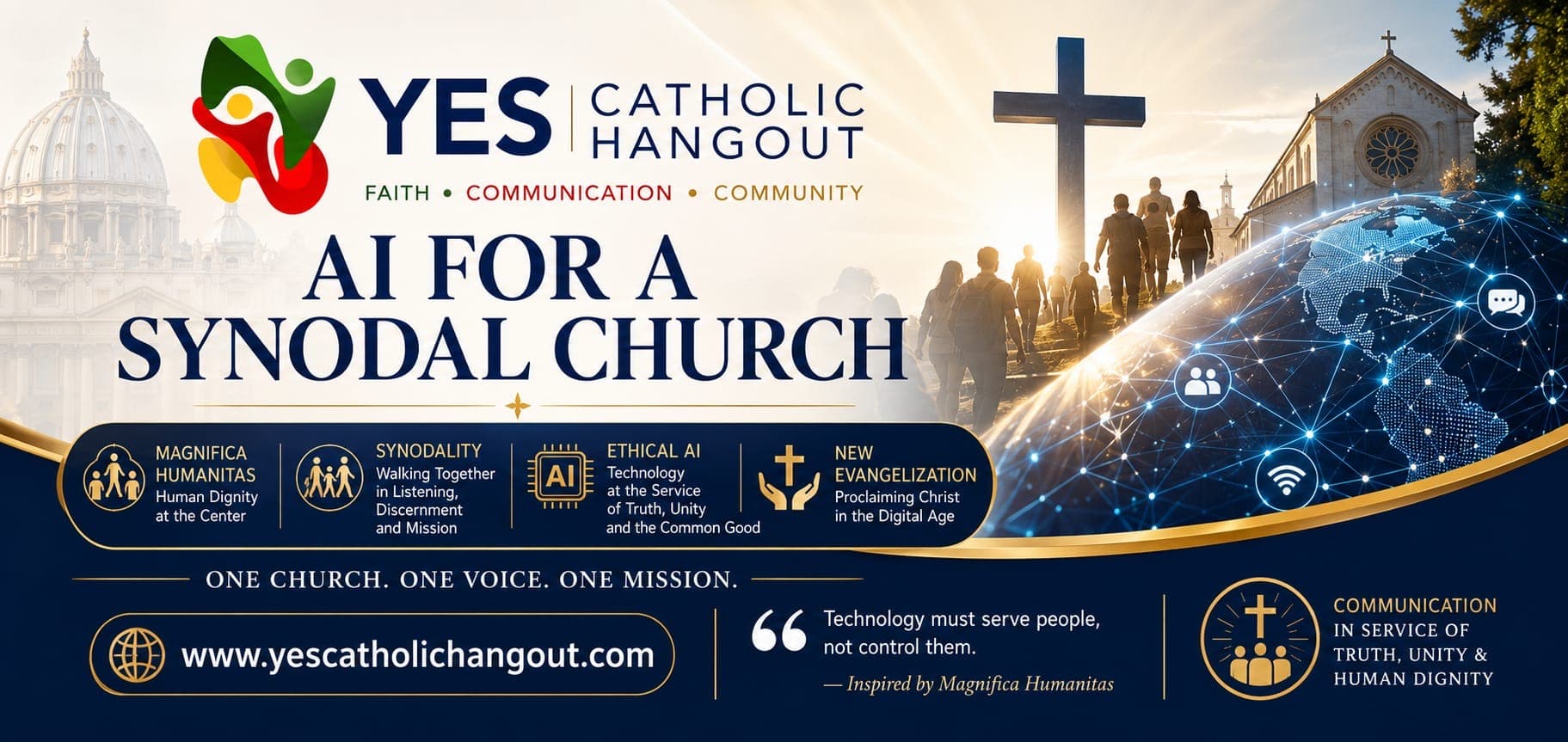
An editorial exploring how AI can become an instrument of communion rather than division, helping the Church renew her mission of evangelization over the next sixty years.
“The Church has entered a new missionary frontier, not another continent, but the digital ecosystem where billions now search for meaning, identity, truth, and hope.”
Artificial Intelligence is transforming communication faster than any previous technological revolution. It presents both unprecedented opportunities and profound ethical responsibilities. The Church must engage, not retreat, ensuring that AI serves as a responsible servant of the Gospel, strengthening human dignity, fostering synodality, supporting ecclesial communication, and enabling every baptized person to participate more fully in the mission of Christ.
The central theme of this editorial is that Magnifica Humanitas, the primacy of human dignity in the digital age, and Synodality, walking together in listening, discernment, and shared mission, can become the foundations of a sustainable Catholic communication strategy for the New Evangelization. Communication is no longer simply about broadcasting information. It is about building authentic relationships, cultivating trust, protecting truth, and forming missionary disciples in an increasingly AI-shaped world.
1. Collaborate: One Church, One Voice
AI can help Catholic communicators collaborate across dioceses, episcopal conferences, religious congregations, universities, movements, and media apostolates. Shared AI translation, for example, makes multilingual evangelization more achievable than ever, allowing a homily, catechetical resource, or pastoral letter to reach the faithful in many languages while preserving theological precision. Collaborative Catholic media networks can pool content, talent, and distribution channels so that smaller dioceses and poorer regions are not left without a voice.
Common digital content repositories can gather liturgical catechesis, formation materials, and social-communications best practices in one accessible place. Ethical fact-checking tools powered by AI can assist Catholic journalists and pastoral teams in countering misinformation without replacing human judgment. During humanitarian crises, AI-supported coordination can help Church agencies mobilize relief more quickly across borders. Synodal listening platforms can gather the voices of the faithful, especially those on the margins, and channel them into prayerful discernment.
All of this reflects the ecclesiology of communion: one Church proclaiming one faith through many cultures, languages, and charisms. Technology, when ordered to communion, becomes an instrument of unity rather than fragmentation.
2. Produce: Content That Forms Hearts
AI can strengthen, never replace, human creativity in proclaiming the Gospel. Catechetical videos, youth podcasts, homily-preparation support, accessible theological resources, children’s evangelization, faith formation for families, and inclusive communication for persons with disabilities are all areas where responsible AI assistance can multiply the reach of pastoral ministers.
The goal is not digital popularity but formation: content that forms hearts in truth, beauty, and charity. An algorithm may suggest a headline, but only a disciple can discern whether that headline serves the Gospel. AI may draft a script, but only a pastor can judge whether it speaks to the concrete suffering and hope of a community. Quality must always be measured by fidelity to Christ and love for the audience, not by clicks or shares. In this way, the Church can produce communication that evangelizes rather than merely entertains.
3. Mobilize: Participation Builds Communion
AI can encourage responsible civic engagement inspired by Catholic Social Teaching. Parish volunteer coordination becomes more effective when intelligent tools help match gifts with needs. Digital missionary outreach can connect seekers with local communities, Bible studies, and sacramental preparation. Disaster-response communication can be accelerated so that aid reaches the suffering more quickly. Voter education rooted in conscience, offered without partisan endorsement, can help the faithful form their political judgments in light of the Church’s social doctrine.
Youth leadership formation and community listening initiatives can also be supported by AI, but only when the technology is placed at the service of encounter. Evangelization naturally leads to active participation in building the common good. The Church does not form passive consumers of content. She forms missionary disciples who go out to heal, serve, and reconcile the world.
4. Educate: Digital Wisdom Before Digital Skills
AI literacy has become a pastoral necessity. Formation is needed for children, parents, teachers, seminarians, priests, religious, Catholic journalists, and parish communication teams. The aim is not merely technical competence but digital wisdom: the ability to recognize deepfakes, resist online manipulation, guard against digital addiction, protect privacy, think critically, and use AI responsibly while preserving human discernment.
Authentic education integrates faith, ethics, and technology. A child who learns to question a manipulated video is also learning to seek truth. A seminarian who studies AI ethics is also learning to care for the flock entrusted to him. A journalist who understands algorithmic bias is better able to report with justice and charity. Digital wisdom is, at its heart, a spiritual discipline: learning to place every tool at the service of the human person and the kingdom of God.
5. Rebuild: Renewing Culture Through Hope
Ethical communication can contribute to rebuilding society. The Church’s mission is not only to save souls but to transform cultures from within by restoring trust, healing polarization, promoting peace, supporting reconciliation, protecting families, defending human dignity, and encouraging truthful public dialogue. AI can assist this work when it helps communicators listen across divisions, translate peace-building resources, and amplify the voices of the excluded.
Yet the rebuilding begins not with a platform but with a heart converted by grace. The Church’s communication must therefore embody the hope she proclaims: patient, merciful, truthful, and unafraid to address the wounds of the world. Every article, video, podcast, and parish bulletin can become a small sign that another way of living together is possible.
A Communication Strategy for the Next Sixty Years
A sustainable framework for Catholic institutions should include several practical commitments.
First, AI-assisted multilingual evangelization, so that language is no longer a barrier to the Gospel. Second, ethical communication policies that govern the use of AI in parishes, dioceses, and media outlets. Third, continuous AI literacy programmes for clergy, religious, and lay leaders. Fourth, responsible data governance that respects the privacy and dignity of every person.
Fifth, human oversight of AI systems, ensuring that algorithms remain tools and never become arbiters of truth. Sixth, digital missionary formation that prepares the baptized to evangelize in online spaces. Seventh, collaborative global Catholic communication networks that share resources and learn from one another. Eighth, intergenerational dialogue among Gen Z, Millennials, Gen X, and older generations, so that wisdom and innovation meet. Ninth, partnerships with universities, technology companies, and civil society to advance ethical innovation for the common good.
Magnifica Humanitas
Magnifica Humanitas is a vision that insists: technology exists for people, human dignity is never programmable, every person remains infinitely more valuable than any algorithm, and innovation must always serve the common good.
This vision does not reject technology. It orders it. It recalls that every digital system is made by human hands for human flourishing, and that no efficiency can justify the diminishment of the human person.
This vision complements the Church’s longstanding commitment to human dignity and integral human development. From the earliest teaching on the dignity of work to the most recent reflections on the digital environment, the Church has consistently taught that progress must be measured by its impact on the least, the excluded, and the vulnerable. Magnifica Humanitas is simply the same commitment expressed in the language of the digital age.
Synodality in Practice
Synodality means listening before speaking, accompanying before judging, collaborating before competing, and serving before leading. It is a style of Church life that reflects the Trinity itself: a communion of persons who receive, discern, and give together. AI can support this culture through responsible digital participation, transparent communication, multilingual dialogue, and wider inclusion of voices that have often been unheard.
At the same time, synodality always preserves genuine human encounter. A listening platform is valuable only if the voices collected are truly heard and responded to. A translated message is meaningful only if it is carried by a living witness. The digital dimension of synodality must remain a path to communion, not a substitute for it.
Practical Recommendations
The following ten commitments are offered to Catholic communicators everywhere:
Place human dignity before technological efficiency.
Build collaborative Catholic media ecosystems.
Form every communicator in AI ethics.
Use AI to amplify, not replace, pastoral ministry.
Prioritize truth over engagement metrics.
Strengthen digital literacy for all generations.
Ensure transparency in AI-assisted communication.
Protect privacy and vulnerable communities.
Foster global solidarity through ethical innovation.
Make every digital initiative serve the mission of proclaiming Christ.
Closing Reflection
“The future of evangelization will not be determined by the sophistication of algorithms, but by the holiness, wisdom, and missionary courage of those who use them. Guided by Magnifica Humanitas and sustained by the spirit of Synodality, the Church can enter the next sixty years with confidence, ensuring that every technological advance remains at the service of truth, unity, the common good, and the inviolable dignity of every human person.”
May the Church walk this new frontier with courage, charity, and hope, proclaiming the Gospel through every legitimate means that human ingenuity makes available.