
A decade after the publication of Amoris Laetitia, the Church continues to reflect deeply on the vocation and mission of the family in a rapidly changing world
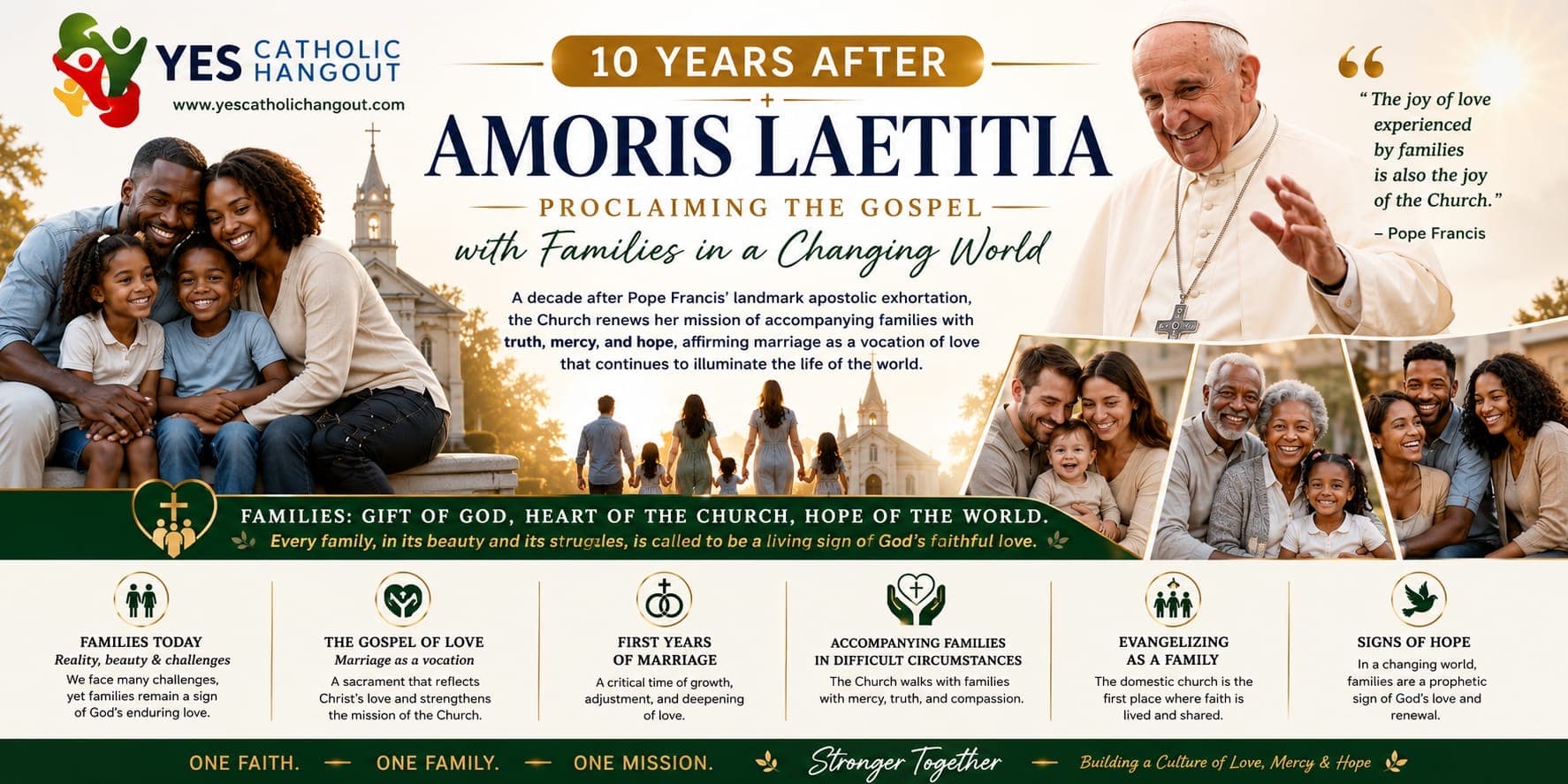
The forthcoming international meeting, “Ten Years After Amoris Laetitia: Proclaiming the Gospel with Families Today,” offers an opportunity not only for evaluation but for renewed missionary commitment. It situates the family at the heart of ecclesial life, recognizing it as both a recipient and a protagonist of evangelization.
Ten Years After Amoris Laetitia: Proclaiming the Gospel with Families in a Changing World
A decade after Pope Francis’ landmark apostolic exhortation, the Church renews her mission of accompanying families with truth, mercy, and hope, affirming marriage as a vocation of love that continues to illuminate the life of the world.
Families Today: Reality, Beauty and Challenges
The Christian family, founded on the sacrament of Matrimony, remains one of the most profound expressions of God’s covenantal love. Rooted in Christ’s union with the Church (cf. Eph 5:25–32), marriage is not merely a social arrangement but a vocation—a path of holiness through which spouses are called to mutual self-gift, fidelity, and openness to life. The Second Vatican Council described the family as a “domestic church” (Lumen Gentium, 11), a place where faith is lived, transmitted, and embodied.
Ten years after Amoris Laetitia, this vision stands in contrast with a complex and often fragmented global reality. Demographic shifts, including declining birth rates in many regions, reveal both economic pressures and cultural transformations. Migration, often driven by conflict or poverty, separates families or reshapes their structure. War—described in recent magisterial teaching as a grave failure of human fraternity—continues to wound families, depriving them of stability, security, and hope.
At the same time, secularization has weakened shared moral frameworks in many societies, leading to a diminished understanding of marriage as a lifelong covenant. Consumerist cultures risk reducing relationships to utility or personal satisfaction, while digital environments—though offering new forms of connection—can foster isolation, superficiality, and emotional distance.
Artificial intelligence and emerging technologies introduce further complexity. While these tools can support family life through education, communication, and healthcare, they also raise ethical questions about human dignity, relational authenticity, and the formation of young people. The Church’s social teaching, particularly in Laudato Si’ and Fratelli Tutti, calls for discernment to ensure that technological progress serves integral human development rather than undermining it.
Yet amid these challenges, the beauty of family life endures. Countless families continue to live heroic fidelity in ordinary circumstances: caring for children and the elderly, welcoming new life, sustaining relationships across distances, and witnessing to love in times of hardship. Amoris Laetitia invites the Church to contemplate this beauty with gratitude, recognizing that grace is at work even in fragile situations.
Young People and the Discovery of Marriage
The question of how young people encounter and embrace the vocation to marriage is central to the Church’s pastoral mission. In a cultural context often marked by individualism and uncertainty, the discernment of marriage requires renewed attention.
Magisterial teaching affirms that marriage is a freely chosen covenant between a man and a woman, ordered toward the good of the spouses and the procreation and education of children (cf. Catechism of the Catholic Church, 1601). Canon law further specifies the essential elements for validity: free consent, capacity, and openness to the essential properties of unity and indissolubility (cf. can. 1055–1057). These juridical norms serve a pastoral purpose: safeguarding the truth of the sacrament and the dignity of those who enter into it.
Preparation for marriage, therefore, cannot be reduced to administrative procedures or short-term instruction. It is a process of formation in human and spiritual maturity. AmorisLaetitia emphasizes the need for comprehensive catechesis that integrates affective development, moral responsibility, and a deep understanding of love as self-gift.
Young people today navigate relationships in a digital landscape that shapes expectations and behaviors. Online communication, while offering accessibility, can obscure the demands of authentic intimacy, which requires presence, patience, and vulnerability. The Church’s pastoral response must include accompaniment—walking with young people as they discern their vocation, helping them distinguish between transient attraction and enduring commitment.
Chastity, often misunderstood, is presented not as repression but as the integration of sexuality within the person. It enables authentic freedom, preparing individuals for a love that is faithful, fruitful, and total. In this light, marriage emerges not as a limitation but as a joyful vocation, a participation in God’s creative and redemptive love.
Witness remains essential. When young people encounter married couples who live their vocation with joy, resilience, and faith, the attractiveness of marriage becomes evident. The Church is thus called to foster communities where such witness is visible and accessible.
The First Years of Marriage
The early years of marriage constitute a decisive period in which the foundations of shared life are tested and strengthened. Recognizing this, Amoris Laetitia calls for sustained pastoral accompaniment beyond the wedding day.
These years often involve significant transitions: establishing a home, navigating financial responsibilities, and, for many, welcoming children. Economic pressures, particularly in uncertain labor markets, can strain relationships. The balance between professional commitments and family life requires discernment and mutual support.
Pastoral practice increasingly recognizes the value of mentoring by experienced couples, who can offer guidance grounded in lived experience. Parish communities play a vital role in creating spaces where newly married couples feel supported rather than isolated. Initiatives such as small faith-sharing groups, retreats, and family-oriented liturgies foster a sense of belonging and spiritual growth.
Communication and forgiveness are essential skills that must be cultivated. The sacrament of Matrimony confers grace, but this grace calls for cooperation. Spouses learn to navigate differences, reconcile conflicts, and grow in mutual understanding. Family spirituality—rooted in prayer, participation in the Eucharist, and reflection on Scripture—nourishes this process.
The Church’s pastoral approach in this area reflects a broader ecclesiological vision: accompaniment is not a temporary intervention but an ongoing journey. As Pope Francis has emphasized, the Church is called to be close to families, sharing in their joys and struggles.
Accompanying Families in Difficult Circumstances
One of the most significant contributions of Amoris Laetitia is its call for pastoral discernment in complex situations. The Church, faithful to the indissolubility of marriage as taught by Christ (cf. Mt 19:6), also recognizes the need to accompany those who experience brokenness or hardship.
Separation and divorce, often accompanied by deep suffering, require compassionate pastoral care. Canon law provides procedures to examine the validity of a marriage through tribunals, distinguishing between a valid sacramental bond and situations where consent may have been defective from the beginning. This distinction is not merely legal but serves the truth and justice of persons.
For those who are divorced and civilly remarried, AmorisLaetitia calls for careful discernment, guided by pastors, attentive to individual circumstances. This discernment does not alter doctrine but seeks to apply it with pastoral wisdom, recognizing degrees of responsibility and the complexity of human situations.
Other forms of suffering—widowhood, infertility, disability, addiction, mental health challenges, and poverty—likewise call for the Church’s presence. Interfaith marriages and migrant families face unique challenges that require cultural sensitivity and support.
The Church’s response is grounded in mercy, understood not as the suspension of truth but as its fullest expression. As Deus Caritas Est reminds us, love is at the heart of the Church’s mission. Pastoral care, therefore, seeks to integrate individuals and families into the life of the Church, fostering healing and hope.
Christian Families as Subjects of Evangelization
Beyond receiving pastoral care, families are called to be active agents of evangelization. This insight, present in FamiliarisConsortio and reaffirmed in Amoris Laetitia, highlights the missionary dimension of the domestic church.
Within the home, parents are the first educators of their children in faith. Through prayer, example, and instruction, they transmit the Gospel in a manner that is both personal and transformative. The family becomes a school of love, where virtues such as patience, generosity, and forgiveness are learned.
Families also contribute to the life of the parish and the broader community. Their participation in liturgy, charitable initiatives, and pastoral activities enriches the Church’s mission. In a synodal perspective, families offer insights and experiences that help shape pastoral priorities.
In the contemporary digital environment, families are increasingly called to witness to the Gospel in new ways. Digital platforms, while presenting risks, also offer opportunities for evangelization, dialogue, and community-building. Ethical engagement with technology—ensuring that it serves human dignity and authentic relationships—becomes part of the family’s mission.
This dimension resonates with broader reflections on integral human development. As highlighted in Laudato Si’, care for creation is inseparable from care for the human family. Families, through their daily choices, contribute to a culture of sustainability, solidarity, and respect for life.
Theological and Ecclesial Foundations
The enduring relevance of Amoris Laetitia lies in its rootedness in the Church’s tradition. Marriage, as a sacrament, participates in the mystery of Christ’s love for the Church. This theological foundation gives meaning to its essential properties: unity, indissolubility, and openness to life.
The Holy Family of Nazareth remains a model of trust, obedience, and fidelity. Though marked by trials—including displacement and uncertainty—it reveals how God’s presence sanctifies ordinary life. This example continues to inspire families facing contemporary challenges.
Ecclesiologically, the emphasis on the family reflects a broader understanding of the Church as communion. The domestic church is not isolated but integrated into the wider Body of Christ. This communion is expressed sacramentally, particularly in the Eucharist, which strengthens families in their vocation.
Canon law, often perceived as technical, serves this communion by providing structures that uphold the integrity of the sacraments and the rights of the faithful. Its norms are ordered toward salvation, reflecting the Church’s pastoral mission.
Contemporary Challenges and Signs of Hope
The past decade has witnessed rapid transformations that affect family life. Artificial intelligence, economic instability, and cultural polarization present new questions that require discernment. Yet these challenges also reveal opportunities for renewal.
Initiatives that promote ethical technology, responsible communication, and community engagement demonstrate how the Church can respond creatively. Efforts to foster dialogue, support migrants, and address poverty reflect a commitment to integral human development.
Young families, often navigating uncertainty, bring fresh energy and perspectives. Movements and communities dedicated to family life continue to grow, offering support and formation. The synodal journey of the Church further underscores the importance of listening to families and involving them in discernment.
Conclusion: A Gospel of Hope
Ten years after Amoris Laetitia, the Church’s proclamation of the Gospel of the family remains both a challenge and a source of profound hope. In a world marked by fragmentation and uncertainty, the witness of faithful, loving families stands as a sign of God’s enduring presence.
Christian marriage, sustained by sacramental grace, reveals that love is not fleeting but faithful, not self-centered but life-giving. Families, despite their imperfections, are places where the Gospel is lived in concrete and transformative ways.
As the Church gathers to reflect on this mission, she does so with confidence that Christ continues to walk with every family. In their joys and struggles, in moments of unity and reconciliation, He is present, inviting each household into deeper communion.
In this light, every family—accompanied with patience, formed in truth, and sustained by grace—can become a living sign of God’s faithful love, a domestic church radiant with hope, and a beacon that illuminates the path of humanity toward a future shaped not by division, but by communion, mercy, and joy.